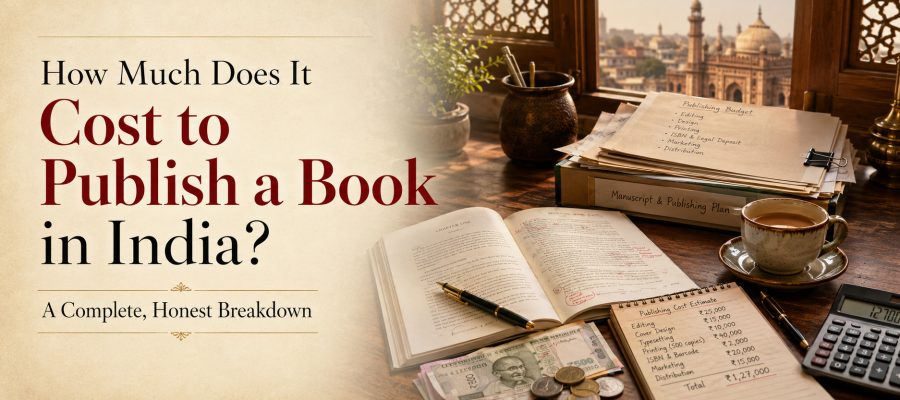
Every aspiring author eventually asks the same question: how much does it cost to publish a book in India?
It is one of the most important questions you can ask before starting the publishing journey, and also one of the most misunderstood. Search online and you will find answers ranging from “it is completely free” to “it costs several lakhs of rupees.” Both can be true, depending on which publishing route you choose and which services you use. The wide range is not dishonest, it reflects the genuine variety of options available to Indian authors today.
This guide gives you a complete, transparent breakdown of every cost involved in publishing a book in India, from professional editing and cover design to ISBN registration, printing, distribution, and marketing. It covers traditional publishing (where the cost to the author is zero), self-publishing (where you control the investment), and everything between.
For a broader look at the factors behind these figures, read our guide to how much it costs to publish a book.
Book Publishing Cost in India: Quick View by Publishing Route
The book publishing cost in India depends first on the route you choose. With a genuine traditional publisher, the author should not pay a publication fee because the publisher funds editorial work, design, printing and distribution. With self-publishing, the platform may be free to use, but professional editing, cover design, formatting, printing and marketing are usually paid by the author. Hybrid or assisted publishing can bundle those services into a package, so compare the scope, rights and distribution terms before comparing price alone.
The Most Important Distinction: Traditional vs. Self-Publishing Costs
Before we look at any numbers, the single most important thing to understand about book publishing costs in India is this:
Traditional publishing costs the author zero upfront.
When a traditional publishing house selects your manuscript, they invest in the entire production, editing, cover design, interior layout, ISBN registration, printing, and distribution. The publisher funds all of this because they believe your book will earn back that investment through sales. You receive royalties on every copy sold. There is no upfront payment from the author to the publisher.
If any publisher asks you to pay upfront to be published, that is not traditional publishing. It is paid self-publishing or, in its most exploitative form, a vanity press. The distinction matters enormously, read our guide on common publishing scams to avoid to understand the red flags.
Anecdote Publishing House operates as a traditional publisher. We invest fully in every manuscript we select, editing, design, distribution to over 100 bookshops across India, and PR support, at no cost to the author. You can submit your manuscript for a free consultation here.
Self-publishing means you fund the process yourself. The total investment varies based on which services you use, the length of your book, and the quality level you target. The realistic range for a professionally produced self-published book in India is Rs. 20,000 to Rs. 1,40,000, depending on the services included.
If you are still choosing a route, our guide to traditional publishing vs self-publishing in India compares the costs, control, royalties, and distribution involved in each.
The table below shows the complete cost picture at a glance:
| Cost Component | Traditional Publishing | Self-Publishing (Your Cost) |
|---|---|---|
| Professional editing | Covered by publisher | Rs. 5,000 – Rs. 50,000 |
| Book cover design | Covered by publisher | Rs. 3,000 – Rs. 25,000 |
| Interior formatting | Covered by publisher | Rs. 2,000 – Rs. 15,000 |
| ISBN registration | Covered by publisher | Free (government) |
| Copyright registration | Your choice | Rs. 500 onwards |
| Printing (per copy) | Covered by publisher | Rs. 50 – Rs. 200+ |
| Distribution | Covered by publisher | Platform fees apply |
| Marketing | Publisher provides PR | Rs. 5,000 – Rs. 50,000+ |
| Total author investment | Zero | Rs. 20,000 – Rs. 1,40,000+ |
Now let us break down each component in detail.
Cost 1: Professional Editing
Editing is the most important investment in any published book, and the one most frequently skipped or underfunded by first-time self-publishing authors. A poorly edited book generates negative reviews, damages your author reputation, and is very difficult to recover from commercially.
There are three types of editing, each addressing a different level of the manuscript:
Developmental (Structural) Editing, Reviews the entire manuscript for structural integrity: plot, pacing, character arcs for fiction; argument organisation and clarity for non-fiction. This is the deepest and most expensive type of editing, and it must happen before any other editing.
Copy Editing, Addresses grammar, syntax, sentence structure, word choice, consistency, and clarity at the line level. This follows developmental editing once the structure is confirmed.
Proofreading, The final quality check before print, catching any errors that survived previous editing rounds plus any formatting inconsistencies introduced during typesetting.
Realistic Editing Costs in India
| Type of Editing | Cost Range (India) | Notes |
|---|---|---|
| Developmental editing | Rs. 15,000 – Rs. 50,000+ | Depends on manuscript length and complexity |
| Copy editing | Rs. 8,000 – Rs. 30,000 | Typically priced per word or per page |
| Proofreading | Rs. 3,000 – Rs. 15,000 | Final pass before print |
| Combined editing package | Rs. 20,000 – Rs. 70,000 | All three stages from a single editor |
Per-word rates for copy editing in India typically range from Rs. 0.50 to Rs. 3.00 per word. A 60,000-word novel would cost approximately Rs. 30,000 to Rs. 1,80,000 at these rates, which is why it is important to clarify what type of editing is included in any quote you receive.
The cost of skipping editing: Saving Rs. 15,000 to Rs. 30,000 by skipping professional editing risks the commercial life of your entire book. Negative reviews citing poor editing follow a book permanently on Amazon India and Goodreads. The upfront investment in editing is almost always the best money spent in the self-publishing process.
For authors published by Anecdote Publishing House, all editing stages are included at no cost to the author, managed entirely by our editorial team.
Cost 2: Book Cover Design
Your book cover is the primary marketing tool for your book in online marketplaces. On Amazon India and Flipkart, readers scroll through thumbnail images and make purchasing decisions in seconds. A professionally designed cover that clearly communicates your genre stops the scroll. An amateur cover is scrolled past without a second look.
Cover Design Costs in India
| Design Tier | Cost Range | What You Get |
|---|---|---|
| Basic / template-based | Rs. 3,000 – Rs. 8,000 | Template customisation, stock imagery |
| Mid-range professional | Rs. 8,000 – Rs. 18,000 | Custom design, genre-appropriate typography |
| Premium custom design | Rs. 18,000 – Rs. 35,000+ | Original concept, custom illustration or photography |
The right investment depends on your genre and commercial goals. A premium romance novel or thriller with commercial aspirations warrants a premium cover. A personal memoir for a limited audience may need only a clean, professional mid-range design.
What the cover price should include:
- The front cover image formatted for eBook (2,560 x 1,600 pixels minimum)
- A full cover wrap (front, spine, back) if you are also printing a paperback
- The correct file formats for both digital (JPEG/PNG) and print (PDF)
- At least one revision round
Important: The cover included in most basic self-publishing packages is a template-based design. If your book is competing commercially in a popular genre, a custom design that looks indistinguishable from traditionally published books in that genre is worth the additional investment.
Cost 3: Interior Formatting
Interior formatting ensures your book looks professional in both print and digital formats. Poor formatting, inconsistent heading styles, incorrect margins, missing page numbers, text that disappears into the binding, creates a bad reading experience regardless of how strong the writing is.
Formatting Costs in India
| Format Type | Cost Range | Notes |
|---|---|---|
| eBook only (ePub/Kindle) | Rs. 2,000 – Rs. 8,000 | Reflowable format for all devices |
| Print book only (PDF) | Rs. 3,000 – Rs. 12,000 | Fixed layout for specific trim size |
| Both eBook and print | Rs. 5,000 – Rs. 18,000 | Separate files required for each |
| Complex formatting (tables, images, academic) | Rs. 8,000 – Rs. 25,000 | Higher cost for image-heavy or technical books |
eBook vs. print formatting are completely different. An eBook is reflowable, text adjusts to fit the reader’s screen and font settings. A print book is fixed to a specific page size with precise margins, headers, and typography. Both require separate files and different technical preparation.
Planning an eBook? Our guide to Kindle book publishing in India covers manuscript preparation, uploading, pricing, and royalties.
When you can format yourself: If you are comfortable with technology, free tools like Amazon’s Kindle Create handle basic eBook formatting well. For print books, Atticus (paid, approximately Rs. 10,000–12,000 one-time) or free tools like Draft2Digital’s print formatter handle standard fiction formatting reasonably well. Complex books with many images, tables, or academic elements benefit strongly from professional formatting.
Cost 4: ISBN Registration in India
An ISBN (International Standard Book Number) is the unique 13-digit identifier that every book needs to be listed, sold, and distributed on any commercial platform, Amazon India, Flipkart, any bookstore, or any library catalogue. Without an ISBN, your book cannot enter commercial distribution.
For the application process and format-specific requirements, read our guide to ISBN for books in India.
Good news for Indian authors: ISBNs are completely free in India.
ISBNs in India are issued by the Raja Rammohun Roy National Agency for ISBN, which operates under the Ministry of Education. Applications are submitted online at isbn.gov.in and are processed at no charge. Each edition and format of your book, paperback, hardcover, and eBook, requires a separate ISBN.
Some sources report nominal charges (Rs. 500 to Rs. 1,000) for single ISBNs through certain agencies. This is not accurate for applications made directly through the official government portal, which are genuinely free.
Critical note: Always ensure your ISBN is registered in your name as the author, not in a publishing service company’s name. If the ISBN is in the publisher’s name, you may lose the right to distribute your book under that ISBN if you end your relationship with that publisher. At Anecdote Publishing House, ISBNs for every book we publish are registered in the author’s name.
Amazon KDP also assigns a free ISBN if you choose to use their identifier for your book. This works for distribution on Amazon but lists Amazon as the publisher of record, which may be fine for purely digital distribution but limits your ability to distribute through other channels under the same ISBN.
Cost 5: Copyright Registration
Copyright in India is automatic, it exists from the moment you create your work. You do not need to register copyright to legally own your book.
However, registering your copyright with the Copyright Office of India at copyright.gov.in provides a formal, legally recognised record of ownership. This is valuable in any dispute about authorship or rights. Registration for literary works involves a government fee starting at Rs. 500 and processing that can take a few months.
Most authors choose to register copyright, particularly for books they have invested significant time in or that contain commercially sensitive intellectual property. For a detailed explanation of both ISBN and copyright requirements, see our guide on how to publish a book in India.
Cost 6: Book Printing Costs in India
Printing cost and publishing cost are not the same thing, and confusing them leads to significant budget errors. Printing is what you pay to physically produce copies of your book, paper, ink, binding, and cover. Publishing cost covers everything else: editing, design, ISBN, distribution, and marketing.
Key Factors That Affect Printing Cost
Page count: More pages means higher printing cost. This is the single biggest driver of per-copy cost. A tightly edited 180-page book will cost significantly less to print than an unedited 380-page manuscript.
Trim size: Standard sizes (5.5″ x 8.5″ for fiction, 6″ x 9″ for non-fiction) are the most economical. Custom sizes add cost.
Colour vs. black and white: Black and white interior printing is the standard for most novels and non-fiction. Full colour interior printing, required for children’s books, photography books, or illustrated titles, adds Rs. 8 to Rs. 20 per page on top of standard printing costs.
Paperback vs. hardcover: Hardcover printing typically costs 2.5 to 4 times more per copy than paperback for the same page count and quantity.
Print quantity: Higher quantities dramatically reduce the per-copy cost. This is the core economics of offset printing.
Print-on-Demand vs. Offset Printing
| Method | Per-Copy Cost | Upfront Investment | Best For |
|---|---|---|---|
| Print-on-demand (POD) | Higher per copy (Rs. 80–200+) | Zero, printed per order | First-time authors, online sales, eBooks |
| Offset printing (100 copies) | Rs. 100–200 per copy | Rs. 10,000 – Rs. 20,000 | Authors with confirmed sales, events |
| Offset printing (500 copies) | Rs. 60–120 per copy | Rs. 30,000 – Rs. 60,000 | Authors with distribution deals |
| Offset printing (1,000 copies) | Rs. 40–80 per copy | Rs. 40,000 – Rs. 80,000 | Established authors, large print runs |
Note: Above are printing-only costs. They do not include editing, design, ISBN, or distribution.
Print-on-demand is typically the most practical choice for first-time self-publishing authors. There is no upfront printing cost, no inventory risk, and no storage overhead. Amazon KDP and Pothi.com both offer POD services. The per-copy cost is higher than offset printing, but this is offset by zero inventory risk.
Offset printing makes economic sense when you have confirmed sales channels, a strong event presence where you sell books directly, or a distribution deal with bookstores. For a standard 200-page black and white paperback at 500 copies, a realistic total printing-only budget is Rs. 30,000 to Rs. 60,000.
Many Indian self-publishing authors use a hybrid approach: POD for online sales (no upfront cost, global reach) combined with a modest offset print run of 100 to 200 copies for book launch events, gifting, and personal sales.
Cost 7: Distribution and Platform Fees
Getting your book onto Amazon India, Flipkart, and other platforms is either free (with print-on-demand services) or involves a percentage of each sale rather than an upfront cost.
How Distribution Costs Work
Online platforms (Amazon KDP, Flipkart): No upfront listing fee. Platforms take a percentage of each sale, typically 30% to 65% depending on the platform and pricing, with the remainder going to the author as royalties. You pay nothing until a book sells.
Physical bookstore distribution: Getting your self-published book into physical bookstores across India is significantly harder than online distribution. Most bookstores work with established distributors and are unlikely to stock a self-published title without a direct relationship. Traditional publishers like Anecdote Publishing House have established distribution networks that place books in over 100 bookshops nationwide, a significant advantage over self-publishing for authors who want physical retail presence.
IngramSpark: For global distribution beyond India, IngramSpark charges a setup fee (currently around Rs. 2,000 to Rs. 4,000 per title) plus a small annual fee per title to maintain listing. It connects your book to bookstores and libraries worldwide.
Cost 8: Marketing and Promotion
Marketing is both the most underestimated cost in self-publishing and the one with the highest direct impact on sales. A book with no marketing investment will reach almost no readers regardless of how well it is written.
Marketing costs for Indian self-publishing authors vary enormously based on goals and strategy. Here is a realistic breakdown:
| Marketing Activity | Cost Range | Notes |
|---|---|---|
| Social media presence (organic) | Free | Time investment required |
| Book launch event (venue, copies, refreshments) | Rs. 5,000 – Rs. 20,000 | Bookstore or literary cafe launches |
| Amazon ads (initial campaign) | Rs. 5,000 – Rs. 15,000 | Per click; budget depends on targeting |
| Bookstagram / influencer outreach | Free – Rs. 15,000 | Many book bloggers review for free copies |
| Professional PR services | Rs. 25,000 – Rs. 1,00,000+ | Media coverage, event coordination |
| Author website (annual) | Rs. 3,000 – Rs. 15,000 | Domain, hosting, basic site |
| Book trailer video | Rs. 5,000 – Rs. 25,000 | Optional but effective for certain genres |
A realistic first-book marketing budget for a self-published Indian author aiming for genuine market visibility is Rs. 15,000 to Rs. 40,000, covering a launch event, initial Amazon ads, an author website, and advance copies for reviewers.
At Anecdote Publishing House, our PR team manages media outreach, literary event participation, and promotional activities for every author we publish, as part of the publishing investment, at no additional cost to the author.
Total Cost Summary: What to Expect at Every Budget Level
Here is a realistic budget summary for self-publishing a standard 200-page book in India at three investment levels:
Budget Tier 1: Minimal (Rs. 15,000 – Rs. 30,000)
Suitable for personal projects, poetry collections, or niche books with a limited intended audience.
- Basic or no professional editing (self-edited)
- Template-based cover design
- DIY interior formatting using free tools
- ISBN via government portal (free)
- Print-on-demand only (no upfront printing cost)
- Organic social media marketing (no paid promotion)
Risk at this tier: Quality will be noticeably lower than professionally published books. Suitable for personal distribution but not for competitive commercial publishing.
Budget Tier 2: Professional (Rs. 40,000 – Rs. 80,000)
Suitable for first-time authors who want a credible, market-competitive book.
- Copy editing and proofreading: Rs. 12,000 – Rs. 25,000
- Professional cover design: Rs. 8,000 – Rs. 15,000
- Interior formatting (print + eBook): Rs. 5,000 – Rs. 12,000
- ISBN registration: Free
- Print run of 100–200 copies for events: Rs. 15,000 – Rs. 30,000
- Launch event and basic marketing: Rs. 10,000 – Rs. 20,000
This is the recommended minimum for authors publishing commercially.
Budget Tier 3: Premium (Rs. 80,000 – Rs. 1,50,000+)
Suitable for authors targeting significant commercial success or building a long-term author brand.
- Full developmental + copy editing + proofreading: Rs. 30,000 – Rs. 70,000
- Premium custom cover design: Rs. 18,000 – Rs. 35,000
- Professional interior formatting: Rs. 10,000 – Rs. 20,000
- Print run of 300–500 copies: Rs. 27,000 – Rs. 60,000
- Comprehensive marketing: Rs. 20,000 – Rs. 50,000
For a broader comparison across publishing routes, see our detailed breakdown of how much it costs to publish a book.
Self-Publishing Packages vs. Individual Services
Most self-publishing companies in India offer bundled packages that combine multiple services at a lower combined price than sourcing each individually. These packages typically include editing, cover design, formatting, ISBN registration, and distribution setup.
Understanding Package Pricing
Self-publishing packages in India typically fall into these ranges:
| Package Type | Price Range | What’s Usually Included |
|---|---|---|
| Entry-level / basic | Rs. 5,000 – Rs. 20,000 | Formatting, ISBN, eBook listing only; limited editing |
| Standard | Rs. 20,000 – Rs. 50,000 | Editing, cover design, formatting, POD + Amazon listing |
| Comprehensive | Rs. 50,000 – Rs. 1,00,000 | All above + proofreading, marketing support, author copies |
| Premium | Rs. 1,00,000 – Rs. 1,50,000+ | All above + premium cover, PR, bookstore distribution |
Questions to Ask Before Buying Any Package
Before committing to any self-publishing package in India, ask:
- Is editing included, and what type? (Proofreading only, copy editing, or developmental editing?)
- Who owns the ISBN, you or the company?
- Are there royalty-sharing arrangements, or do you keep 100% of net sales?
- Is there a separate distribution fee, or is distribution included?
- What are the revision limits, how many rounds of changes are included?
- Are there any recurring annual fees to keep your book listed?
- Can you see samples of previously published books to assess quality?
When comparing publishing models in India, look beyond the quoted price and check what editorial, design, distribution, and author support a company provides.
Sourcing services individually allows more control over quality but requires you to coordinate multiple vendors. A bundled package from a reputable company is typically more convenient and often more cost-effective.
Hidden Costs Authors Often Miss
First-time authors frequently overlook several cost components that do not appear in standard package descriptions:
Author copies: The copies you personally receive to sell at events, give to reviewers, and keep for yourself. These are usually not included in package prices and must be purchased separately at a discounted rate. For 50 author copies of a standard paperback, budget Rs. 4,000 to Rs. 10,000.
Cover revisions: Many cover design packages include only one or two revision rounds. Additional revisions are charged separately, typically Rs. 500 to Rs. 2,000 per round.
Hardcover edition: If you want a hardcover in addition to a paperback, this is usually a separate cost, hardcover printing is 2.5 to 4 times more expensive per copy than paperback.
Shipping author copies: If you order physical author copies for events, factor in shipping costs from the printer or publisher to your location.
eBook conversion (separate from print formatting): Some packages include only one format. If you want both a print book and an eBook, confirm both are included in your package or budget for the conversion separately (Rs. 2,000 to Rs. 8,000).
Content updates: If you identify errors in your book after publishing and want to correct the interior file, some platforms allow updates for free but some companies charge a content revision fee (Rs. 500 to Rs. 3,000 per revision).
Tax on royalties: Royalty income is subject to income tax in India. If you earn royalties from book sales, consult a tax advisor about your applicable obligations and any available deductions for authors.
How Royalties Work, and How They Affect Your Real Cost
Understanding royalties is essential to calculating the true net cost of self-publishing, because royalties are how you recover your upfront investment over time.
Traditional Publishing Royalties in India
Traditional publishers typically pay:
- 7% to 10% of MRP for paperback editions
- 10% to 15% of MRP for hardcover editions
- Approximately 25% for eBook editions
On a paperback priced at Rs. 300 with a 10% royalty, you earn Rs. 30 per copy sold. To earn Rs. 1,00,000 in royalties, you need to sell approximately 3,333 copies.
Self-Publishing Royalties in India
Self-publishing typically yields significantly higher royalties per copy:
- Amazon KDP eBooks priced Rs. 199 to Rs. 650: 70% royalty (minus delivery cost)
- Amazon KDP print books: approximately 40% to 60% after printing cost deduction
- Flipkart and other Indian platforms: typically 40% to 55% of list price
On an eBook priced at Rs. 299, the 70% royalty is approximately Rs. 209 per copy. To recover a total investment of Rs. 60,000 through eBook sales alone, you would need to sell approximately 287 copies.
The higher royalty rate in self-publishing means your breakeven point is potentially much lower, if your marketing generates sufficient sales. The challenge, as many self-published Indian authors have noted, is that building those sales without the distribution infrastructure and marketing support of a traditional publisher is the harder part of the equation.
You can read a detailed discussion of royalties and realistic earnings in our guide on how can I publish my book.
Why Two Publishing Quotes Can Be Very Different
A low quote may cover only file setup and online listing, while a higher quote may include editing, cover development, interior design, print copies, distribution support and launch work. Compare line items, rights and deliverables before deciding that one package is cheaper. The useful question is not only how much it costs to publish, but what the author receives for that amount.
Frequently Asked Questions
1. How much does it cost to publish a book in India with a traditional publisher?
Zero. A legitimate traditional publisher funds the entire production, editing, cover design, printing, distribution, and marketing, in exchange for a share of royalties from book sales. The author pays nothing upfront. If a publisher asks you for money to publish your book, that is not traditional publishing. Anecdote Publishing House is a traditional publisher that publishes at no cost to the author. Submit your manuscript here.
2. What is the minimum cost to self-publish a book in India?
The minimum realistic cost for a self-published book that is professionally produced and commercially viable is approximately Rs. 20,000 to Rs. 40,000. Entry-level packages starting at Rs. 5,000 to Rs. 10,000 exist but typically provide only basic formatting and eBook listing, with limited or no editing and basic cover design. Whether that investment level is sufficient depends on your commercial goals.
3. Is ISBN registration free in India?
Yes. ISBNs are issued completely free of charge by the Raja Rammohun Roy National Agency for ISBN, under India’s Ministry of Education. Apply online at isbn.gov.in. Each format of your book (paperback, hardcover, eBook) requires a separate ISBN. Some private agencies charge a fee for ISBN services, you are not required to use them; the government agency is free.
4. What is the cost of printing a book in India?
For a standard 200-page black and white paperback: approximately Rs. 150 to Rs. 200 per copy for print-on-demand, Rs. 100 to Rs. 150 per copy for a 100-copy offset print run, and Rs. 60 to Rs. 90 per copy for a 500-copy offset run. Full colour interior printing adds Rs. 8 to Rs. 20 per page. Hardcover printing is 2.5 to 4 times more expensive than equivalent paperback.
5. How much does book editing cost in India?
Copy editing in India typically costs Rs. 8,000 to Rs. 30,000 for a full-length manuscript, depending on word count and the editor’s rate. Proofreading costs Rs. 3,000 to Rs. 15,000. Developmental editing ranges from Rs. 15,000 to Rs. 50,000. Per-word rates typically range from Rs. 0.50 to Rs. 3.00 depending on the type of editing and the editor.
6. How much does a book cover design cost in India?
A professional book cover designed for commercial publishing in India typically costs Rs. 8,000 to Rs. 18,000 for a mid-range professional design. Template-based covers start at Rs. 3,000 to Rs. 8,000. Premium custom designs with original illustration or photography range from Rs. 18,000 to Rs. 35,000 or more. A full cover wrap (front, spine, back) for a paperback is essential for print books and is usually priced separately from the eBook cover-only design.
7. Can I publish a book for free in India?
Yes, in a limited sense. Amazon KDP allows you to publish an eBook and a print-on-demand paperback at zero upfront cost. However, “free” publishing means you take on all editing, formatting, and design yourself. A book published without professional editing, design, and formatting will typically underperform commercially compared to a professionally produced title. The only genuinely free and professionally produced route to publication is traditional publishing, where the publisher funds everything.
8. What are the hidden costs of self-publishing in India that authors miss?
The most commonly missed costs are: author copies (books you purchase for events and gifts), additional revision rounds beyond what a package includes, hardcover edition printing if you want a hardcover alongside a paperback, eBook conversion if it is not included in the package, shipping charges for physical author copies, and content update fees if you need to correct the interior file after publication.
9. How much should I budget for marketing my book in India?
A realistic minimum marketing budget for a self-published book targeting genuine commercial visibility in India is Rs. 15,000 to Rs. 40,000. This covers a book launch event (Rs. 5,000 to Rs. 15,000), initial Amazon advertising (Rs. 5,000 to Rs. 15,000), an author website (Rs. 3,000 to Rs. 8,000 annually), and advance reading copies for reviewers. More ambitious marketing, professional PR, influencer campaigns, multiple events, can run Rs. 50,000 to Rs. 1,00,000 or more.
10. What is the difference between printing cost and publishing cost?
Printing cost is what you pay to physically produce copies of your book, paper, ink, binding, and cover printing. Publishing cost includes all the other services required to take a manuscript to a market-ready book: editing, cover design, interior formatting, ISBN registration, distribution setup, and marketing. Many authors confuse the two. A book printing quote tells you what it costs to produce physical copies, it does not include any of the pre-press production services.
11. How do I calculate whether self-publishing is financially worth it?
Calculate your total investment (editing + design + formatting + printing + marketing). Then calculate your net royalty per copy at your planned selling price. Divide total investment by net royalty per copy to get your breakeven sales volume. Example: Rs. 60,000 total investment ÷ Rs. 199 net royalty per eBook copy sold = 302 copies to break even. Assess whether 302 sales is realistic for your book given your genre, marketing budget, and audience size. If not, consider whether traditional publishing, where the investment is zero, is a more appropriate route.
12. Can I publish in both traditional and self-publishing simultaneously?
Not for the same book at the same time. If a traditional publisher accepts your manuscript, they will require exclusivity over publication rights for the contracted edition and territory. However, you can self-publish other titles while being traditionally published for a specific book. Some authors self-publish one series while pursuing traditional publishing for another, or self-publish in one format (eBook) while a traditional publisher handles print distribution. Always review your specific contract terms carefully.
13. How much does it cost to publish a book in India with a traditional publisher?
Under a genuine traditional publishing model, the publisher invests in the selected manuscript and the author does not pay a publication fee. The author may still choose to spend independently on activities outside the contract, such as personal travel or additional promotion, but those are different from paying the publisher to accept and publish the book.
Make the Right Publishing Decision for Your Book
Publishing cost is not a single number, it is a range that depends entirely on which publishing route you choose and which services you invest in.
The most cost-effective route to professional, nationally distributed publication is traditional publishing, where the publisher funds the entire process and you keep your royalties without any upfront investment. The most flexible route, if you want full creative control and faster timelines, is self-publishing, where your investment and quality control are entirely in your hands.
If you have a manuscript ready and want to explore traditional publishing with Anecdote Publishing House, submit your details for a free consultation. We publish books at no cost to the author and distribute to over 100 bookshops across India.