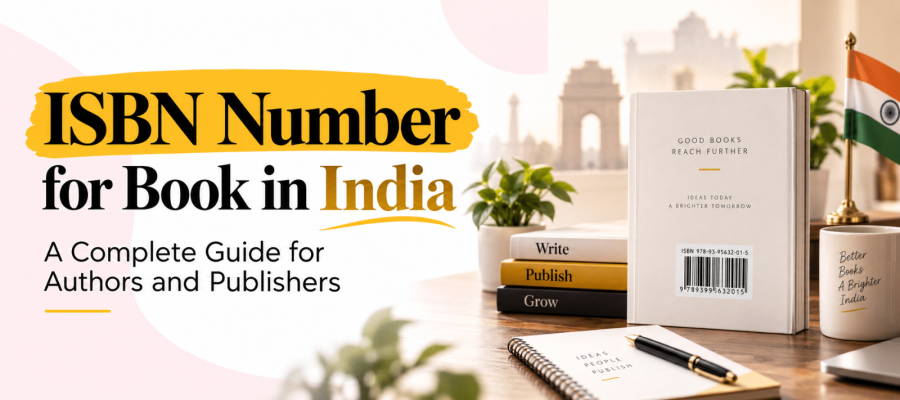
If you are preparing to publish a book in India, whether through a traditional publisher or independently, you will need an International Standard Book Number, commonly known as an ISBN. It is the 13-digit code printed on the back of every published book that gives it a unique, internationally recognised identity across libraries, bookshops, and online retail platforms worldwide.
The good news: in India, ISBNs are issued completely free of cost by the government. The process is straightforward, entirely online, and open to any Indian author or publisher. What most first-time authors do not know is exactly how the system works, who can apply, what documents are required, and how long the process takes, which is what this guide covers in full.
What Is an ISBN and Why Does Your Book Need One?
An ISBN, International Standard Book Number, is a unique 13-digit numerical identifier assigned to each edition and format of a published book. Think of it as your book’s digital fingerprint: a globally unique code that distinguishes your book from every other publication in the world across bookshops, libraries, distributors, and online retail platforms.
The ISBN system is regulated internationally by the International ISBN Agency, headquartered in London. In India, it is administered by the Raja Rammohun Roy National Agency for ISBN, operating under the Department of Higher Education, Ministry of Education, Government of India.
What an ISBN does for your book:
Retail discoverability. Bookshops and online retailers, Amazon India, Flipkart, and physical bookshops, use ISBNs to list, track, and order books. Without an ISBN, most major retail platforms will not list your book, and bookshops cannot order it.
Library cataloguing. School, college, and public libraries across India use ISBNs to catalogue and locate books. An ISBN is essential for institutional distribution and bulk orders from educational establishments.
Sales tracking. Publishers, distributors, and authors use ISBNs to track sales across different platforms and formats. If you intend to monitor your book’s performance or collect royalties, an ISBN ensures sales are recorded accurately under your title.
International recognition. ISBNs are internationally standardised, a book with an Indian ISBN is recognisable and orderable by bookshops, libraries, and distributors in any country that uses the ISBN system, which includes virtually all major book markets worldwide.
Credibility. A book without an ISBN signals to retailers, libraries, and professional readers that it has not been registered through established publishing channels. An ISBN registers your book in your name in the national and international publishing record.
Who Issues ISBNs in India?
In India, ISBNs are issued free of cost by the Raja Rammohun Roy National Agency for ISBN, which operates under the Ministry of Education, Government of India. The official website where authors and publishers apply for an ISBN is www.isbnindiaonline.gov.in, this is the only legitimate, government-authorised platform for ISBN registration in India.
The land address of the Raja Rammohun Roy National Agency is: Room No. 13, 4th Floor, Jeevandeep Building, Parliament Street, New Delhi 110001. The phone number is 011-23369668.
A critical warning: Several private companies in India charge fees to obtain ISBNs on behalf of authors, typically Rs. 1,000 to Rs. 5,000 per ISBN. This is entirely unnecessary. ISBNs are completely free when obtained directly through the official government portal. Any company charging you for an ISBN is charging for a service, filling out a form, that you can do yourself at zero cost. Always apply directly through isbnindiaonline.gov.in.
Does Your Book Need an ISBN?
An ISBN is not legally required to publish a book in India. However, it is practically essential for almost any publishing goal beyond purely private distribution.
You need an ISBN if:
- You want your book listed on Amazon India, Flipkart, or any major online retail platform
- You want bookshops to be able to order and stock your book
- You want your book catalogued by libraries and academic institutions
- You want your book to be distributed through national or international distribution networks
- You want a professional publishing record under your name or publishing house
You may not need an ISBN if:
- You are producing a limited number of copies purely for personal or family use
- You are creating a digital document (such as a PDF) for direct distribution to a closed group with no retail ambition
- You are producing conference proceedings or internal institutional publications not intended for retail sale
For virtually any author intending to reach readers beyond their immediate personal circle, through any traditional or self-publishing route, an ISBN is essential. Since it is free in India, there is no practical reason not to obtain one.
How Much Does an ISBN Cost in India?
ISBN registration in India is completely free for publishers and authors who apply through the official government portal. You do not need to pay any fee to get an ISBN for your book.
An ISBN may be free, but editing, printing and marketing can still add to your book publishing cost in India.
This applies to both individual authors and registered publishing houses. Whether you are a debut author self-publishing your first book or a publishing company registering multiple titles, the Raja Rammohun Roy National Agency issues ISBNs at zero cost.
What you might pay for, and should not need to:
Some self-publishing platforms include an ISBN as part of their publishing package and charge for it as a bundled service. If you use such a platform, check whether they are providing their own ISBN (assigned to the platform as publisher, not to you) or a genuine government-issued ISBN assigned to you personally. This distinction matters significantly, see the rules section below.
Some third-party services charge for “ISBN procurement.” As noted above, this service is unnecessary since the process is free and entirely self-serviceable through the government portal.
Who Can Apply for an ISBN in India?
Any Indian resident who intends to publish a book can apply for an ISBN through the Raja Rammohun Roy National Agency’s portal. This includes:
Individual authors, including debut authors and self-publishing authors. When applying as an individual author, you register as the publisher of your own work.
Publishing houses and companies, registered publishers can apply for blocks of ISBNs for multiple titles.
Educational institutions, universities, colleges, and schools publishing academic works, journals, or conference proceedings.
Government bodies and non-profit organisations, publishing reports, research, or institutional materials.
Foreign authors or publishers cannot apply through the Indian ISBN agency. Only Indians who are registered residents, publishers, or institutions are entitled to apply. Foreign authors publishing in India should work with their Indian publisher, who will obtain the ISBN on the book’s behalf.
How to Get an ISBN in India, Step-by-Step Process
Step 1: Visit the Official Portal
Go to www.isbnindiaonline.gov.in, this is the only official, government-authorised ISBN registration portal in India. Do not use any third-party website claiming to offer ISBN registration.
Step 2: Create Your Publisher Account
Click on “New User Registration” or “Publisher Registration.” You will need to create an account with your name, email address, and contact details.
Since you are self-publishing, you are the publisher. Fill in your personal details as the publisher. If you are a registered publishing house, enter your company details.
Step 3: Submit Your Documents
You will need to upload a self-attested copy of a valid photo ID, Aadhaar card or PAN card are the most commonly accepted. Ensure your document scans are clear and legible; blurry or incomplete scans cause delays.
If registering as a publishing company rather than an individual, you will also need your company registration documents.
Step 4: Wait for Registration Approval
The Raja Rammohun Roy National Agency will review and approve your registration. You will receive an email notification once your profile is activated. This process typically takes around 2 to 4 weeks, depending on application volume and the accuracy of submitted information.
Some applicants report approval within 7 to 15 working days when their documentation is complete and accurate. Apply well in advance of your planned publication date.
Step 5: Apply for Your ISBN
Once your publisher account is approved, log back in to your dashboard and apply for an ISBN for your specific book.
You will need to fill in the following details for each book: title, subtitle (if any), author name(s), language of publication, format (print or ebook), subject category, and planned publication date.
Each format of your book, print, ebook, and audiobook, requires a separate ISBN. If you are publishing your book in all three formats, you will need to apply for three separate ISBNs.
Step 6: Receive and Use Your ISBN
Once approved, your ISBN will be issued and listed in your dashboard. Your printer or cover designer can then add it as a barcode to the back cover of your book. Include the ISBN in your book’s copyright page and in all publisher registration details.
Documents Required for ISBN Registration in India
For individual authors / self-publishing authors:
- Self-attested copy of a valid government photo ID (Aadhaar card, PAN card, or passport)
- Your email address and contact number
- Details of the book you are registering (title, author, format, language, subject)
For publishing houses and companies:
- Company registration documents
- PAN card of the company
- Authorised signatory’s photo ID
- Contact details of the publisher
Ensure all documents are clear, legible, and accurate before submitting. Incomplete or unclear documentation is the primary cause of delays in the registration process.
How Long Does ISBN Registration Take in India?
The registration process has two stages, each with its own timeline:
Publisher registration (creating your account): 7 to 15 working days after submitting complete documentation. The processing time can vary, but it is best to apply well in advance.
ISBN application for a specific book: Once your publisher account is active, applying for an individual ISBN is typically processed within 5 to 10 working days.
Total time from first application to ISBN issued: Allow 3 to 6 weeks in total for a smooth process. If your publication date is fixed, begin the ISBN application at least 6 to 8 weeks before the date you need it.
Important: An ISBN must be assigned to a book before it is published as it is a pre-publication identifier. You cannot apply for an ISBN after the book has already been released.
Important ISBN Rules Every Indian Author Must Know
Each format requires its own ISBN. A print book and its ebook version are different publications and each requires a separate, unique ISBN. If you publish in print, Kindle, and audiobook formats, you need three ISBNs, one for each. Yes, each different format of a book requires its own unique ISBN to ensure proper cataloguing.
Each edition requires its own ISBN. A revised second edition of a previously published book is a new publication and requires a new ISBN. The original ISBN cannot be reused.
ISBNs cannot be transferred between books. An ISBN assigned to one title cannot be reassigned to a different title, even if the original book was never published.
The publisher of record matters. If you obtain your ISBN through a self-publishing platform like Amazon KDP or Notion Press, the platform may be listed as the publisher of record rather than you. This means the book is officially registered under the platform’s name, not yours. If you want the book registered under your own name, obtain your own ISBN through the government portal and use it when uploading to the platform.
ISBNs are free, never pay for one. Any company charging you to obtain an ISBN is charging for a facilitation service, not the ISBN itself. Apply directly through isbnindiaonline.gov.in at zero cost.
ISBN for Traditional Publishing vs. Self-Publishing in India
Traditional publishing: When your book is published by a traditional publisher, including Anecdote Publishing House, the publisher obtains and registers the ISBN on your behalf as part of the standard publishing process. You do not need to apply for your own ISBN. The publisher is registered as the publisher of record, and the ISBN is issued in the publisher’s name for your title. This is standard practice across all traditional publishing.
Self-publishing: If you are self-publishing your book, whether through Amazon KDP, Notion Press, or direct printing, you are responsible for obtaining your own ISBN. Apply through isbnindiaonline.gov.in before your publication date. Using your own ISBN (rather than the platform’s assigned ISBN) ensures the book is officially registered under your name or your own imprint.
Vanity and subsidy publishing: Companies that charge authors for publishing services sometimes include an ISBN in their package. Confirm whether the ISBN they provide is issued in your name or in theirs. If it is issued in the company’s name, your book will not be registered as yours in the official publishing record.
For a complete guide to the differences between traditional publishing, self-publishing, and vanity publishing, and why it matters, see our article on traditional publishing vs. self-publishing in India.
Frequently Asked Questions
1. Is an ISBN free in India?
Yes. The Raja Rammohun Roy National Agency issues ISBNs free to publishers and authors. You must register on the official portal, submit book details, and get the ISBN before distribution. The official portal is www.isbnindiaonline.gov.in. Never pay a third party for ISBN registration.
2. Can I publish a book in India without an ISBN?
Legally, yes, there is no law requiring an ISBN to publish a book. Practically, no, without an ISBN, your book cannot be listed on Amazon India, Flipkart, or most major retail platforms, cannot be ordered by bookshops, and cannot be catalogued by libraries. For any book intended to reach readers beyond your personal circle, an ISBN is essential.
3. Do I need a separate ISBN for the print and ebook versions of my book?
Yes. Every distinct format, print, ebook (Kindle, EPUB), and audiobook, requires its own unique ISBN. Apply for as many ISBNs as you have formats planned for your book.
4. How long is an ISBN valid?
An ISBN does not expire. Once assigned to a specific edition and format of a book, it remains permanently associated with that publication in the international ISBN database.
5. What if I make changes to my book after the ISBN is assigned?
Minor corrections and reprints do not require a new ISBN. A new edition, with significant content changes, a new chapter, or a substantially revised text, does require a new ISBN, as it is considered a new publication.
6. Do I need an ISBN if I am only publishing as an ebook?
It is not legally required but strongly recommended. Most major ebook platforms, including Amazon Kindle Direct Publishing, allow you to publish without your own ISBN and will assign their own identifier. However, using your own ISBN ensures the book is registered under your name in the international database rather than under the platform’s name. It is not a requirement of digital publishing such as Kindle eBooks, but it is very much recommended for inclusion in online and offline stores and libraries.
For the steps involved in preparing and releasing an eBook through KDP, read our guide to Kindle book publishing in India.
7. If I publish with Anecdote Publishing House, do I need to get my own ISBN?
No. Anecdote Publishing House handles all ISBN registration as part of the standard traditional publishing process. When we publish your book, we obtain and register the ISBN on your behalf, at zero cost to you, as part of the full editorial, design, printing, and distribution support we provide. You do not need to apply separately. Submit your manuscript for a free consultation.
Your Book, Officially Published
An ISBN is one of the final steps in preparing your book for the world, a small but essential formality that transforms a manuscript into an officially published work with a permanent identity in the global publishing record.
If you are pursuing traditional publishing rather than self-publishing, Anecdote Publishing House handles all aspects of the publishing process, including ISBN registration, editorial development, cover design, printing, and distribution to over 100 bookshops across India, at zero cost to the author. No upfront fees, no hidden charges.