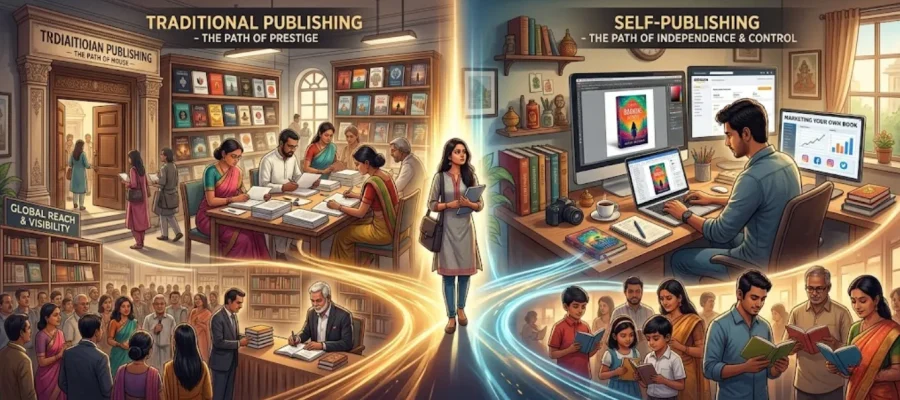
Every author who has finished a manuscript eventually reaches this crossroads: do I approach a traditional publisher, or do I publish this myself?
It is one of the most important decisions in an author’s career, and most guides on this topic are written by self-publishing companies with a clear commercial interest in steering you toward paying for their services.
This article is written by a traditional publisher. That means we have a bias too, toward traditional publishing. So we will be explicit about that upfront and commit to one standard: presenting both routes honestly, including the real advantages of self-publishing and the real limitations of traditional publishing.
Because the truth is that neither route is universally better. The right choice depends on your specific book, your goals, and what you are willing to invest, of both money and time.
Understanding the Two Models
Traditional Publishing
A traditional publisher, also called a trade publisher, evaluates your manuscript and decides whether to invest in it. If selected, the publisher funds the entire production: editing, cover design, interior formatting, printing, and distribution. You pay nothing. The publisher recovers its investment through book sales, paying you royalties on every copy sold.
Traditional publishing involves a genuine selection process, publishers accept manuscripts they believe have commercial or literary merit and reject those they do not. In India, most traditional publishers accept direct manuscript submissions without requiring a literary agent, unlike the US and UK markets.
Self-Publishing
Self-publishing means you take on the publisher’s role. You fund or perform every stage of production, editing, cover design, formatting, printing, and distribution, and you retain complete control over all decisions. Platforms like Amazon KDP, Pothi.com, Notion Press, and many others provide the distribution infrastructure; the production services are either done by you or purchased from freelancers and service companies.
There is no selection process in self-publishing. Anyone can publish. The consequence is that the quality of a self-published book reflects entirely the investment, of money and effort, that the author made in production.
Comparison 1: Cost to the Author
Traditional Publishing
Cost to the author: Zero.
A traditional publisher pays for everything. Editing, cover design, formatting, printing, distribution, and marketing are all funded by the publisher. Authors receive royalty cheques, money flows toward the author, not away from them. Any publisher that asks you to pay upfront is not a traditional publisher, regardless of what they call themselves.
Self-Publishing
Cost to the author: Rs. 0 to Rs. 1,50,000+, depending on services used.
Platform listing is free on Amazon KDP, Google Play Books, Draft2Digital, and Pothi.com. However, professional editing, cover design, and interior formatting are the author’s responsibility and cost. A professionally produced self-published book in India typically requires:
- Copy editing and proofreading: Rs. 8,000 – Rs. 30,000
- Professional cover design: Rs. 8,000 – Rs. 25,000
- Interior formatting (print + eBook): Rs. 5,000 – Rs. 18,000
- Marketing: Rs. 10,000 – Rs. 50,000+
Total realistic investment for a professionally produced self-published book: Rs. 30,000 to Rs. 1,25,000+. Authors who skip professional services can publish for less, but the quality gap is visible to readers and shows in reviews.
For a closer look at each expense, read our breakdown of book publishing cost in India.
Advantage: Traditional publishing, for authors prioritising zero upfront investment.
Comparison 2: Royalties and Earnings Per Copy
Traditional Publishing
Traditional publishers in India typically pay:
- 7% to 15% of MRP for print books
- Approximately 25% for eBook editions
On a paperback priced at Rs. 300 with a 10% royalty, you earn Rs. 30 per copy. To earn Rs. 1,00,000, you need approximately 3,333 copies sold. Some publishers pay advances, an upfront sum against future royalties, though advances for debut Indian authors are not guaranteed.
Self-Publishing
Self-publishing offers significantly higher royalties per copy:
- Amazon KDP eBook at Rs. 299 with 70% royalty: approximately Rs. 199 per copy after delivery fee
- Amazon KDP print book: 60% of list price minus printing cost
- Pothi.com, Flipkart: approximately 40–55% of list price after fees
To earn Rs. 1,00,000 from a Rs. 299 eBook at a Rs. 199 net royalty, you need approximately 500 copies sold, substantially fewer than the 3,333 copies required at 10% traditional royalties for the same earning target.
If Amazon KDP is the route you are considering, our guide to Kindle book publishing in India covers the setup, formatting, pricing and distribution steps.
The critical nuance: Self-publishing’s higher royalty rate only translates to higher earnings if you sell enough copies. Self-publishing requires an upfront investment of Rs. 30,000 to Rs. 1,25,000 that traditional publishing does not. An author who invests Rs. 60,000 in self-publishing and sells 200 copies at Rs. 199 net royalty earns Rs. 39,800, a loss. The same author published traditionally invests nothing, earns Rs. 30 per copy, and on 200 copies earns Rs. 6,000, a smaller absolute return, but a positive one.
Self-publishing’s financial advantage is real, but only above a sufficient sales volume. Below that threshold, traditional publishing’s zero-cost model is financially more rational.
Advantage: Self-publishing, for authors who achieve sufficient sales volume. Traditional publishing, for authors whose expected sales volume is modest or uncertain.
Comparison 3: Creative Control
Traditional Publishing
Traditional publishers share creative decision-making with the author. Cover design, title, subtitle, chapter structure, and occasionally content edits are discussed collaboratively, but the publisher has meaningful influence, particularly on commercial books where they have strong market instincts.
For most authors, this shared control is not a significant loss: a publisher’s editorial and design team brings genuine expertise and market knowledge. Their input typically improves the book’s commercial performance. But for authors with a strong personal vision for their book, particularly non-fiction authors who have developed proprietary methodologies or entrepreneurs who want their brand embedded in the book’s look and feel, the loss of final say over design decisions can be frustrating.
Self-Publishing
Self-publishing gives you complete, unrestricted creative control over every element: content, title, cover design, interior layout, pricing, and release timing. No one approves or overrides your decisions.
This control is most valuable for authors who genuinely have strong creative vision and the taste and knowledge to make effective decisions, or who hire professionals they trust to guide those decisions. It is least valuable for authors who lack design or editorial expertise and end up making decisions that harm their book’s quality and commercial performance.
Advantage: Self-publishing, for authors who value complete creative authority. Traditional publishing, for authors who value experienced editorial and design guidance.
Comparison 4: Editorial and Production Quality
Traditional Publishing
Traditional publishers invest in full editorial support, typically developmental editing, copy editing, and proofreading by experienced editors, followed by professional cover design and interior typesetting. All of this is funded by the publisher and quality-controlled by the publisher’s editorial team.
The result, for books selected by good publishers, is a consistently professional-quality final product. This is one of traditional publishing’s most underappreciated advantages, not just that the editing exists, but that it is funded, managed, and quality-controlled by people with professional stakes in the outcome.
Self-Publishing
The quality of a self-published book is entirely the author’s responsibility. Authors who invest properly in professional editing, cover design, and formatting can produce books indistinguishable in quality from traditionally published titles. Authors who cut corners on editing produce books that read as though they cut corners, and reviews reflect that.
The challenge is that the author must source, evaluate, and manage every professional involved in production, editor, cover designer, interior formatter, without the institutional experience and industry relationships that publishers bring to these decisions.
Advantage: Traditional publishing, for consistent quality assurance at no cost to the author. Self-publishing, for authors who invest seriously in professional production and manage it well.
Comparison 5: Timeline
Traditional Publishing
The traditional publishing timeline in India from manuscript submission to published book: 6 months to 3 years.
This breaks down as:
- Finding the right publisher and receiving an acceptance decision: weeks to 18+ months
- Editorial development after acceptance: 2 to 6 months
- Cover design and production: 1 to 3 months
- Printing and distribution setup: 1 to 2 months
- Release timing based on publisher’s seasonal calendar
The extended timeline is the most cited reason authors choose self-publishing instead. For time-sensitive books, business titles, topical non-fiction, or books tied to personal circumstances, the traditional publishing timeline can be a genuine limitation.
Self-Publishing
Self-publishing timelines are significantly faster. From a completed, edited manuscript:
- Editing: 2 to 6 weeks
- Cover design: 1 to 3 weeks
- Formatting: 1 to 2 weeks
- Platform upload and review: 24 to 72 hours (eBook), 3 to 5 business days (print)
- Total: 4 to 12 weeks from edited manuscript to published book
For authors who need to publish quickly, to coincide with a speaking opportunity, a professional milestone, or a timely topic, self-publishing’s speed advantage is real and meaningful.
Advantage: Self-publishing, significantly faster from completed manuscript to published book.
Comparison 6: Physical Distribution and Bookstore Presence
Traditional Publishing
Physical bookstore distribution is one of the strongest genuine advantages of traditional publishing in India. Established publishers have relationships with distributors who supply Crossword, Oxford Bookstore, Kitab Khana, regional chains, and independent bookstores across India. A book from a well-distributed traditional publisher can appear in hundreds of bookshops nationwide.
Physical distribution also enables:
- Display at literary events and book fairs (New Delhi World Book Fair, Kolkata Book Fair, Jaipur Literature Festival)
- Library acquisition by public and institutional libraries
- Academic adoption in some cases
- Review consideration by newspapers and magazines (many reviewers only cover traditionally published books)
Self-Publishing
Self-published books are available online, Amazon India, Flipkart (via Pothi.com or aggregators), Google Play Books, Apple Books, but are not typically stocked in physical bookstores in India without deliberate, additional effort.
Getting a self-published book into physical bookstores requires either: a distribution deal with IngramSpark (approximately USD 49 per title, with a 40% wholesale discount and returnability enabled) and direct outreach to bookstore buyers, or negotiating consignment arrangements with individual stores. This is achievable but requires significant effort and relationships that most debut authors do not have.
For Indian readers, where print-to-digital reading ratios are approximately 70:30, physical bookstore presence remains a meaningful commercial advantage.
Advantage: Traditional publishing, significantly stronger for physical bookstore distribution across India.
Comparison 7: Marketing and Promotion
Traditional Publishing
Traditional publishers provide PR infrastructure: media outreach, literary event participation, advance review copy distribution, and in some cases social media promotion. The extent of this support varies significantly by publisher, major houses invest more in established authors; mid-tier publishers provide more targeted support.
At Anecdote Publishing House, our in-house PR team manages media outreach for every author we publish, and we participate in prestigious literary events across India. You can read more about the support we provide on our About Us page.
However, even traditionally published authors are expected to build their own author platform, participate in marketing efforts, and help drive reader discovery through social media and events. Publisher support supplements author marketing; it does not replace it.
Self-Publishing
All marketing is the author’s responsibility in self-publishing. Amazon’s algorithm surfaces books that already have sales and review momentum, a new self-published book with no reviews and no marketing effort will not be discovered organically, regardless of quality.
Effective self-publishing marketing requires the author to:
- Build an author platform (Instagram, LinkedIn, newsletter) before launch
- Generate early reviews through advance reading copies
- Run Amazon advertising campaigns
- Participate in literary events
- Pitch to book bloggers and media
This is entirely achievable, but it requires time, skill, and in many cases financial investment in paid promotion.
Advantage: Traditional publishing, for publisher-backed PR at no additional cost. Self-publishing, for authors who have strong personal platforms or who are willing to build one.
Comparison 8: Credibility and Literary Recognition
Traditional Publishing
Being selected by a traditional publisher carries a credibility signal. The selection process implies that a professional editorial team evaluated your work and invested in it. This matters for:
- Literary journalism coverage, many book reviewers still primarily cover traditionally published books
- Award eligibility, some major literary prizes in India require traditional publication
- Academic and institutional adoption, libraries and institutions strongly prefer traditionally published titles
- Professional credibility, for non-fiction authors, being published by an established house carries authority signals that self-publishing typically does not
Self-Publishing
Self-publishing carries less inherent credibility, though this gap is narrowing as more high-quality self-published books demonstrate that professional production can match traditionally published standards.
For genre fiction (romance, thriller, fantasy), self-published authors have largely erased any credibility gap through consistent quality and direct reader connection. For literary fiction, memoir, and non-fiction, where review coverage, prize consideration, and institutional adoption matter, the credibility gap remains more significant.
Advantage: Traditional publishing, for literary fiction, memoir, academic, and professional non-fiction. Advantage: More comparable, for genre fiction and popular non-fiction where reader engagement matters more than institutional credibility.
Comparison 9: Rights Ownership
Traditional Publishing
Traditional publishing contracts grant the publisher exclusive rights to publish your book in the contracted territory and edition for a specified period. Most contracts include reversion clauses, rights return to the author if the book goes out of print or after a specified period.
You retain copyright. The publisher licenses specific rights, print rights, eBook rights, possibly audio rights and translation rights, which they may exploit or sub-license. Understanding what rights you are granting and what rights you are retaining is one of the most important reasons to read any publishing contract carefully before signing.
Self-Publishing
In self-publishing, you retain all rights to your work. No publisher holds any license on your book. You decide where and how it is distributed, and you can change those decisions at any time (outside any active platform exclusivity period, such as KDP Select).
This complete rights retention is particularly valuable for non-fiction authors whose book is the foundation of a consulting practice, speaking career, or course business, where controlling the methodology and the brand associated with it is commercially important.
Advantage: Self-publishing, for complete, permanent rights ownership. Traditional publishing, rights are contracted but copyright is retained; review any contract carefully.
The Master Comparison Table
| Factor | Traditional Publishing | Self-Publishing |
| Upfront cost to author | Zero | Rs. 30,000 – Rs. 1,50,000+ |
| Royalty rate (print) | 7–15% of MRP | 40–60% after printing cost |
| Royalty rate (eBook) | ~25% | 35–70% |
| Creative control | Shared with publisher | Complete |
| Editorial support | Full, funded by publisher | Author’s responsibility and cost |
| Timeline | 6 months – 3 years | 4–12 weeks |
| Physical bookstore distribution | Yes, across India | Limited, requires effort |
| Marketing and PR support | Publisher provides | Author’s full responsibility |
| Literary credibility | High, selection process | Varies by genre and quality |
| Rights ownership | Contracted; copyright retained | Full |
| Who selects the manuscript | Publisher (competitive) | No one, open to all |
| Financial risk | Zero for author | Author bears upfront cost |
Who Should Choose Traditional Publishing
Traditional publishing is the right choice when one or more of the following applies:
Your manuscript is strong enough to be selected. The quality hurdle is real. Traditional publishers receive many submissions and select a small fraction. If your manuscript genuinely competes with published titles in your genre, in terms of writing quality, story craft or argument coherence, and commercial appeal, traditional publishing gives you the most professionally supported route at zero cost.
You want physical bookstore distribution across India. If readers finding your book in a bookstore is important to your goals, traditional publishing is the most accessible route to achieve that. Self-publishing can reach physical bookstores but requires significant additional effort and expense.
You want professional editorial development without managing it yourself. Working with an experienced editorial team, developmental editors, copy editors, and cover designers with genre expertise, improves most books. Traditional publishing provides this at no cost.
You are writing literary fiction, memoir, or literary non-fiction. These genres depend heavily on review coverage, literary credibility, and institutional adoption. The infrastructure supporting these outcomes is largely built around traditionally published books.
You prefer zero financial risk. If you cannot afford to invest Rs. 30,000 to Rs. 1,25,000 in production, or if the financial risk of that investment feels inappropriate given your expected sales volume, traditional publishing is the rational choice.
To explore traditional publishing with Anecdote Publishing House, you can submit your manuscript for a free consultation here. We accept direct submissions across fiction, non-fiction, self-help, romance, mystery thriller, young adult, spirituality, and society and culture.
Who Should Choose Self-Publishing
Self-publishing is the right choice when one or more of the following applies:
You need to publish within weeks, not months or years. If your book is time-sensitive, a business book tied to a current opportunity, a memoir linked to a recent milestone, or a topical non-fiction title, self-publishing’s 4 to 12 week timeline from edited manuscript to live book is a genuine advantage.
You have or can build an author platform. Self-publishing works best for authors who already have an audience, a newsletter, a social media following, a corporate client list, a professional speaking circuit, or who are committed to building one. Without any platform, the marketing burden of self-publishing is very heavy for a debut author.
You write genre fiction with an active Kindle Unlimited readership. Romance, thriller, fantasy, and science fiction have large, dedicated eBook reader communities in India who actively use Kindle Unlimited. Self-publishing with KDP Select can directly monetise this audience through per-page-read royalties that traditional publishing does not access.
Complete creative control is essential to your goals. Non-fiction authors who have developed proprietary methodologies, brand-specific aesthetics, or content that must stay precisely as written benefit from self-publishing’s unrestricted creative authority.
You are willing to invest in quality production. Self-publishing rewards authors who treat it as a professional business investment, hiring a real editor, a real cover designer, and marketing their book seriously. Authors who use self-publishing as a shortcut to avoid editorial scrutiny typically produce books that reflect that choice.
For a step-by-step guide to publishing your own book, see our complete article on how to publish your own book.
Can You Do Both?
Yes, and many successful Indian authors do.
Start with traditional publishing for credibility, then self-publish supplementary content. An author who secures a traditional publishing deal for their flagship book gains bookstore distribution, editorial credibility, and PR support. They can simultaneously self-publish supplementary titles, a companion guide, a workbook, shorter pieces, through KDP at higher royalties, building both their brand and their income.
Self-publish a first book to demonstrate commercial viability, then approach traditional publishers. Some authors self-publish their first book to build a readership, generate reviews, and demonstrate that their book sells. A self-published book with strong sales data is a meaningful asset when approaching traditional publishers for a second book deal.
Important note: If you self-publish a book and then want traditional publishing for the same title, this is difficult. Publishers know the initial sales audience has been reached and may not want to invest in relaunching a title that has already been in market. The better hybrid strategy is to self-publish one set of titles and pursue traditional publishing for a different book.
The routes are not mutually exclusive, they are complementary strategies that many authors combine intelligently across their careers. For a complete map of all publishing options, see our guide on where to publish a book.
Frequently Asked Questions
1. Which is better, traditional publishing or self-publishing in India?
Neither is universally better. Traditional publishing is better if you want zero financial risk, professional editorial support, physical bookstore distribution, and literary credibility at no cost, provided your manuscript is strong enough to be selected. Self-publishing is better if you want speed, complete creative control, higher royalties per copy, and are willing to invest in and manage professional production yourself. The right answer depends on your specific book, your goals, and your willingness to invest time and money.
2. Do Indian traditional publishers accept submissions from debut authors?
Yes. Unlike the US and UK publishing markets, where most traditional publishers require literary agent representation, most Indian traditional publishers accept direct manuscript submissions from debut authors without requiring an agent. This makes the traditional publishing route in India significantly more accessible for first-time authors than comparable markets elsewhere.
3. How much do self-published authors earn per book in India?
For an eBook priced at Rs. 299 on Amazon India with KDP Select (70% royalty tier), the author earns approximately Rs. 199 per copy after the delivery fee deduction. For a print book priced at Rs. 350, the author earns approximately Rs. 60 to Rs. 100 per copy after printing cost deduction. These per-copy earnings are significantly higher than traditional publishing royalties (Rs. 21 to Rs. 45 per copy at 7–15% on a Rs. 300 book), but self-publishing requires an upfront investment that traditional publishing does not.
4. Can I get a book advance from an Indian traditional publisher?
Some Indian traditional publishers offer advances, an upfront sum paid against future royalties, particularly for books from established authors or for manuscripts they believe will sell strongly. For debut Indian authors, advances are less common and typically modest when offered. The absence of an advance does not mean a publisher is not legitimate; many genuine publishers offer royalties without upfront advances.
5. Is self-publishing considered less credible than traditional publishing in India?
In some contexts, yes, particularly for literary fiction, memoir, and professional non-fiction where review coverage, prize eligibility, and institutional adoption matter. In other contexts, especially genre fiction like romance, thriller, and fantasy, self-published authors have built highly credible author brands through consistent quality and direct reader relationships. The credibility gap is real in some literary and academic contexts; it is largely irrelevant for genre fiction with strong reader engagement.
6. Does a traditional publisher take all my rights?
No. You retain copyright on your work. A traditional publisher licenses specific rights, typically print rights, eBook rights, and sometimes audio and translation rights, for a specified territory and period. Most contracts include reversion clauses that return rights to the author if the book goes out of print or if sales fall below a minimum threshold. Reading and understanding any publishing contract before signing is essential, what specific rights you are granting, for how long, and under what conditions they revert.
7. Can I self-publish my book and then approach a traditional publisher later?
You can approach a traditional publisher for a different book. Using a self-published book to demonstrate commercial viability and build a readership is a credible strategy for approaching publishers for a subsequent title. However, approaching a traditional publisher for the same already-self-published title is more difficult, publishers know the initial sales audience has been accessed and may not want to relaunch a title that has already been available.
8. What types of books are best suited for self-publishing in India?
Genre fiction (romance, thriller, fantasy, science fiction), particularly eBook-first content for Kindle Unlimited readers. Niche non-fiction targeting a specific professional audience (business, entrepreneurship, coaching). Personal development and self-help books where the author has an existing platform. Regional language content where the author wants to reach a specific linguistic community. Books where speed of publication is a competitive advantage.
9. What types of books are best suited for traditional publishing in India?
Literary fiction and upmarket commercial fiction. Narrative non-fiction and memoir where literary credibility and review coverage are important. Books targeting libraries, educational institutions, or professional adoption. Children’s books, which heavily depend on bookstore discovery. Books in established bestselling genres, romance, thriller, self-help, where a publisher’s marketing infrastructure and bookstore placement create strong commercial leverage.
10. Does traditional publishing take longer in India than self-publishing?
Yes, significantly. The traditional publishing timeline from submission to publication is typically 6 months to 3 years. Self-publishing from an edited manuscript to a live book typically takes 4 to 12 weeks. For time-sensitive content, self-publishing’s speed advantage is real and meaningful.
11. What happens if a traditional publisher rejects my manuscript?
Rejection is a normal part of the traditional publishing submission process. A rejection does not mean your book is unpublishable, it may mean the genre does not fit the publisher’s current list, the timing is not right, or the manuscript needs further development. Many highly successful Indian authors faced multiple rejections before publication. Submit to several publishers simultaneously (unless a publisher explicitly requires exclusive submission), incorporate any feedback received, and continue submitting. Self-publishing also remains available as a parallel or alternative route.
12. Is there a hybrid option between traditional and self-publishing?
Yes. Hybrid publishing involves a shared investment between author and publisher, the author pays for some production services while the publisher contributes professional support and distribution. The quality and terms of hybrid arrangements vary widely. Research any hybrid publisher carefully: who owns the ISBN, what royalty is paid, what distribution reach they actually provide, and what other authors have experienced working with them. The cost to the author in hybrid publishing typically ranges from Rs. 50,000 to several lakhs. For a complete overview of all publishing models, see our guide on where to publish a book.
The Decision That Serves Your Book
The traditional vs. self-publishing debate does not have a correct answer that applies to every author. What matters is matching the publishing route to your specific book, your goals, and your situation.
If your manuscript is strong and your genre aligns with what traditional publishers publish, traditional publishing offers the most professionally supported route at zero financial risk. If your goals require speed, complete creative control, or higher per-copy royalties above a volume you are confident of reaching, self-publishing is the stronger choice.
And in India specifically, where traditional publishers accept direct submissions from debut authors without requiring literary agents, pursuing traditional publishing is more accessible than in most other markets. It is worth trying before committing to self-publishing’s upfront investment.
If you want to explore whether traditional publishing is right for your book, Anecdote Publishing House accepts direct manuscript submissions across fiction, non-fiction, self-help, romance, mystery thriller, young adult, spirituality, and society and culture. We publish at zero cost to the author, distribute to over 100 bookshops across India, and provide full editorial, design, and PR support.