Your query letter is the first thing a publisher reads about your book. Before they see a single page of your manuscript, before they encounter your voice or your story, they read your query, and on the basis of that one page, they decide whether your manuscript is worth their time.
That is a significant amount of weight for one page to carry. It is also why authors who have spent years writing a book sometimes spend weeks getting their query right, and why the most common reason for manuscript rejection is not that the writing is poor, but that the query failed to represent it well.
This guide covers everything you need to know about writing a query letter for Indian publishers: what the letter must contain, how each element should be written, what the India-specific differences are from international querying, and the most common mistakes that get queries rejected before the manuscript is ever read.
What Is a Query Letter and Why Does It Matter?
A query letter is a one-page document that introduces your manuscript to a publisher and asks them to consider it for publication. It is not a synopsis (which describes your entire plot), not a book proposal (a longer document required mainly for non-fiction), and not a cover letter (which accompanies the manuscript after acceptance). It is the document that determines whether a publisher requests your full manuscript in the first place.
Publishers and editors receive many submissions. The query letter is their first filter, the document that allows them to quickly assess whether a manuscript might be a fit for their list. A strong query letter will lead to a request for sample chapters or the full manuscript. A weak one will lead to a rejection without the manuscript ever being read.
The query letter does three things simultaneously: it introduces your book’s premise in a compelling way, it positions your book correctly in the market, and it establishes you as a professional author who understands the publishing industry. All three of these functions matter.
The India Difference, What Changes When Querying Indian Publishers
Most query letter advice online is written for authors approaching US or UK literary agents. The Indian publishing market has important differences that affect how queries work:
Most Indian publishers accept direct submissions. In the US and UK, most major publishers only accept manuscripts submitted through a literary agent. In India, publishers including HarperCollins India, Rupa Publications, Speaking Tiger, Pan Macmillan India, Srishti Publishers, Leadstart Publishing, and Anecdote Publishing House accept direct manuscript submissions from authors. You submit to the publisher, not to an agent representing you to a publisher.
This changes the query’s tone slightly. When writing to a publisher directly rather than to an agent, you are pitching your book for publication, not for representation. The structure is the same, but you address the submission to the publisher’s editorial team rather than to a specific agent.
Indian publishers typically request a standard package. Most Indian publishers ask for a query letter, a synopsis, and sample chapters (usually the first three). Some ask for the query letter alone; check each publisher’s submission guidelines before sending.
Genre knowledge matters as much in India as elsewhere. Indian publishers have specific genre strengths. A query for a romance novel should go to publishers with active romance lists (Anecdote Publishing House, Rupa, Srishti). A query for self-help should go to publishers like Jaico, Anecdote Publishing House, or HarperCollins India. Matching your query to the right publisher is as important as writing the query well.
Simultaneous submissions are standard practice in India. You can and should submit to multiple publishers at the same time. If you receive an offer while your manuscript is under consideration elsewhere, inform the other publishers promptly.
The Four Essential Elements of a Query Letter
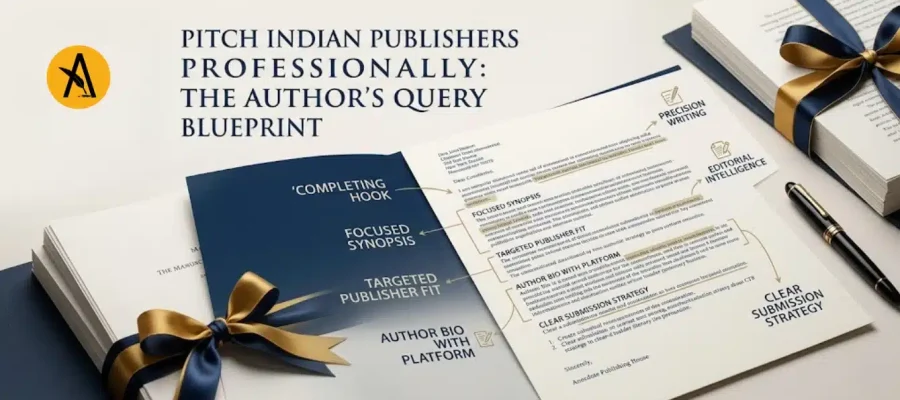
Every effective query letter contains four components, in roughly this order:
- The opening hook, your book’s premise in one or two compelling sentences
- The book description, a 150 to 250 word summary of the story or argument
- Comparable titles (comps), two published books that share something with yours
- The author biography, who you are and why you wrote this book
The entire letter should fit on one page, single-spaced, approximately 250 to 400 words. Shorter is generally better than longer.
Element 1: The Opening Hook
The opening of your query letter must accomplish one thing: make the reader want to continue reading.
The most effective openings do this by naming the protagonist, their situation, and the central conflict or tension in one or two sentences, enough to create narrative momentum without explaining everything.
For fiction, a strong hook typically contains:
- Who the main character is (with one specific detail that makes them feel real)
- What situation they are in when the story begins
- What is at stake
Example opening for a contemporary fiction query: “When Priya Subramaniam’s father dies leaving behind a letter she was never meant to find, she has three weeks before the family arrives from Chennai, and not nearly enough time to decide whether the truth will save her family or destroy it.”
This opening names the character, creates immediate stakes, establishes a ticking clock, and leaves a question the reader wants answered. It does not explain everything, it creates the desire to read more.
For non-fiction, a strong hook typically contains:
- The specific problem or question the book addresses
- Who it serves
- What the book promises to do that existing books do not
Example opening for a self-help query: “Most Indian professionals know exactly what they want from their career. The problem is that none of the career advice available to them was written for the specific obstacles they face, and Roadmap for the Rest of Us is the book they have been waiting for.”
Element 2: The Book Description
The book description is the most important part of your query letter. It is where you demonstrate that your manuscript has a compelling premise, that the story works, and that you can write a sentence worth reading.
For most fiction queries, this section should be 150 to 250 words. For non-fiction, similar length. It should not be a chapter-by-chapter summary, it should be a compelling description of what your book is and why it matters.
For Fiction
Your book description should convey:
The protagonist and their world. Who is the main character, and what is the specific world they inhabit? Not “a young woman in Delhi”, but “Meena Kapoor, a 28-year-old corporate lawyer in Gurugram who has spent six years building a career her family still does not consider a real job.”
The central conflict. What happens that disrupts your protagonist’s world and sets the story in motion? This is the engine of your plot.
The stakes. What does your protagonist stand to lose if they fail to resolve the conflict? Emotional stakes (what they want, what they fear) matter as much as plot stakes (what will happen if they fail).
The tone and feel. Does your novel read like a fast-moving thriller? A warm family comedy? Literary fiction? The description’s own tone should reflect this.
What you do not need: The ending. A query letter is not a synopsis, you do not reveal how the story resolves. The mystery of the ending is part of what makes the publisher want to read the manuscript.
For Non-Fiction
Your book description should convey:
The specific problem or subject the book addresses. Not “leadership in modern India” but “why the management approach that has made Indian IT companies globally competitive fails almost universally when those same companies expand into creative or service industries.”
The book’s core argument or promise. What does the reader learn or gain that they cannot learn elsewhere?
The intended audience. Who specifically will buy and read this book?
Why you are the right person to write it. (This can be in the bio section instead, but for non-fiction it is often woven into the description.)
Element 3: Comparable Titles (Comps)
Comparable titles, called “comps”, are two published books that share something meaningful with your manuscript. They serve two purposes: they show the publisher that you understand the market, and they help the publisher quickly visualise where your book sits.
How to choose comps:
Choose books that were published within the last five years. Comps should be books that have found a readership, not necessarily bestsellers, but books with enough commercial track record that the publisher can use them to gauge your book’s potential audience.
Choose books that share your manuscript’s tone, readership, or structural approach, not just its subject matter. A mystery set in Mumbai should not be compared to every mystery set in India; it should be compared to specific mysteries that have the same pacing, the same kind of protagonist, or the same emotional register.
What to avoid in comps:
Do not compare your book to its own genre’s bestselling classics (“my book is like The God of Small Things meets Amish Tripathi’s Shiva Trilogy”). Comparing to iconic titles comes across as either arrogant or naive, it implies either that you overestimate your manuscript or that you have not read widely enough to find a more precise comparison.
Do not compare to books so obscure that the publisher has likely never heard of them. The comp should be something they can immediately picture.
How to frame comps in the letter:
“The Naming of the Bones will appeal to readers of Savi Sharma’s Everyone Has a Story and Preeti Shenoy’s The One You Cannot Have, readers who want romance that does not shy away from emotional difficulty.”
Or: “Midlife Velocity is for the same reader who made Sudha Murty’s Wise and Otherwise a bestseller, and who has been waiting for a book that addresses the second chapter of an Indian professional woman’s career with the same honesty.”
Element 4: The Author Biography
The author biography tells the publisher who you are and why you are the right person to write this book.
For fiction authors:
Keep the bio short, 50 to 75 words. Include any published writing credits (short stories in literary magazines, other novels, published pieces). If you have no writing credits, do not draw attention to this by apologising for it, simply omit it and introduce yourself with one or two specific personal details that are relevant to the manuscript or that make you memorable.
What you must never do: begin with “Although I haven’t been published before…” Apology signals a lack of professional confidence and is always counterproductive.
Example fiction bio with publishing credits: “I am an engineer based in Bengaluru. My short fiction has appeared in Out of Print magazine and the anthology New Indian Short Stories (Harper Perennial). This is my debut novel.”
Example fiction bio for a debut author without prior publications: “I am a schoolteacher in Jaipur who has been writing fiction for ten years. The Glass Courtyard is my first novel.”
Simple, confident, specific. The publisher does not need your life history, they need to be able to picture you as a person.
For non-fiction authors:
The bio is far more important. For non-fiction, publishers are buying your expertise and your platform as much as your manuscript. Address:
- Your professional credentials and experience related to the book’s subject
- Any relevant academic qualifications
- Your author platform: newsletter size, social media following, professional speaking, relevant media appearances, anything that demonstrates you have an audience and can reach them
Example non-fiction bio: “I am a certified financial planner with fifteen years of experience working with NRI investors and high-net-worth families in Mumbai. My weekly newsletter on personal finance reaches 12,000 subscribers. I have been quoted in The Economic Times and Mint, and I speak at corporate financial wellness events across India.”
Query Letter Format and Length
Length: 250 to 400 words. One page, single-spaced when printed. Shorter is better than longer. Publishers read many queries; they prefer writers who can be concise.
Format for email submission (most common in India):
- Subject line: Query, [Your Book Title], [Genre]
- Salutation: Dear [Editor’s Name], (Research the editor’s name; “Dear Editorial Team” is acceptable if specific names are not available)
- Body: Hook, description, comps, bio, in that order
- Closing: “The complete manuscript is available upon request. This is a simultaneous submission. Thank you for your time.”
- Signature: Your name, phone number, email
Do not attach your manuscript to the query email unless the publisher’s submission guidelines specifically request this. Many publishers will not open unsolicited attachments.
Research each publisher’s submission guidelines before sending. Some publishers request the query letter plus sample chapters in the same email. Some want only the query. Some have an online submission form. Always follow the specific instructions for each publisher.
Query Letter Template, Fiction
Below is a template structure. The content in brackets is instructional, replace it entirely with your specific information.
Subject: Query, [TITLE IN CAPS], [Genre]
Dear [Editor’s Name],
[Personalisation, if you have a genuine reason, you attended their author’s book launch, you have read a specific book on their list and can name it, etc. If you have no genuine personalisation, skip this and go directly to the hook. Do not fabricate connection.]
[HOOK, 1–2 sentences. Protagonist, situation, central conflict, stakes. Make the editor want to continue.]
[BOOK DESCRIPTION, 150–200 words. Who the protagonist is, with specific detail. What happens to set the story in motion. What is at stake emotionally and narratively. The central dramatic question the book explores. Do not reveal the ending. Write this in the same tone as your novel.]
[TITLE IN CAPS] is a [genre] novel of approximately [word count] words.
[COMP TITLES, 2 sentences. Name two published books your manuscript resembles in tone, audience, or approach. Explain the connection briefly.]
[AUTHOR BIO, 50–75 words. Writing credits if you have them. One or two specific personal details. “This is my debut novel” if applicable. No apologies.]
The complete manuscript is available upon request. This is a simultaneous submission. Thank you for your time and consideration.
[Sincerely / With regards], [Your Name] [Email Address] [Phone Number]
Query Letter Template, Non-Fiction
Subject: Query, [TITLE IN CAPS], [Category, e.g. Self-Help / Business / Memoir]
Dear [Editor’s Name],
[HOOK, 1–2 sentences. The specific problem the book addresses, the audience it serves, and what it promises that existing books do not.]
[BOOK DESCRIPTION, 150–200 words. The central argument or promise. How the book is structured to deliver on that promise. Who the specific intended reader is. What the reader gains by the end of the book. Key themes, chapters, or a distinctive approach that makes this book different from existing titles on the subject.]
[TITLE IN CAPS] is a [category] book of approximately [word count] words, written for [specific audience description].
[COMP TITLES, 2 sentences. Name two published books that have served a similar audience or argument. Explain the connection.]
[AUTHOR BIO, 75–100 words. Your credentials, professional experience, and how they make you the right person to write this book. Your platform: newsletter, social media following, speaking engagements, media appearances. Publications or recognition if applicable.]
The complete manuscript is available upon request. This is a simultaneous submission. Thank you for your time.
[Sincerely / With regards], [Your Name] [Email Address] [Phone Number]
The Most Common Query Letter Mistakes
1. Beginning with “Dear Sir/Madam” or “To Whom It May Concern.” Research the editor’s name. Most Indian publishers have submission guidelines that name a contact. If no name is available, “Dear Editorial Team” is acceptable. A generic salutation signals that you have not done basic research.
2. Writing too long. Queries over 500 words are almost always rejected. If you cannot describe your book compellingly in 200 words, you likely do not yet have sufficient clarity about what your book is about. Brevity is a skill, not a shortcut.
3. Starting with a rhetorical question. “Have you ever wondered what would happen if…?” Every editor has seen thousands of queries that begin with a rhetorical question. It is a cliché that signals an amateur. Begin with the story.
4. Comparing your book to major classics. “My novel is the Indian Harry Potter” or “the next The God of Small Things”, comparisons to iconic titles come across as arrogant or naive. Choose specific, recent, commercially real comparisons.
5. Summarising the plot chapter by chapter. A query is not a synopsis. It does not need to cover everything that happens. It needs to make the editor want to read the manuscript. Focus on premise, character, and stakes, not events.
6. Apologising for being a debut author. Do not write “Although I have not been published before…” or “I know you probably receive many better queries…” Apology signals a lack of professional confidence. Simply state who you are without self-deprecation.
7. Attaching the manuscript without being asked. Unless the submission guidelines specifically request the full manuscript, do not attach it. Attach only what is requested, typically the first three chapters or first 50 pages.
8. Describing the book in vague, superlative terms. “A gripping, fast-paced, emotionally resonant story” tells an editor nothing. Describe your actual story specifically. The specificity is what makes a query interesting, not the adjectives.
9. Submitting to the wrong publisher. Read each publisher’s submission guidelines and recent catalogue before submitting. Sending a mystery thriller to a publisher whose list is entirely self-help wastes both your time and theirs. For guidance on which Indian publishers publish which genres, see our guide on book publishers in India.
10. Not following the specific submission guidelines. Every Indian publisher has different requirements. Some want only the query. Some want the query plus sample chapters. Some have online submission forms. Failing to follow these instructions is an immediate negative signal.
After You Send the Query, What to Expect
Response times: Most Indian publishers take 4 to 16 weeks to respond to a query. Some state their response window on their submission guidelines page; wait the full stated window before following up. If no window is stated, 12 weeks is a reasonable baseline.
Following up: After the stated response window, a single, polite follow-up email is appropriate. Keep it brief: “I am following up on my query for [TITLE], submitted on [date]. I would be grateful for any update on your timeline.” Do not follow up before the window has passed. Do not follow up more than once.
Rejection: Most queries are rejected. Most published authors have a significant rejection history. A rejection from one publisher does not mean your manuscript is not publishable, it frequently means the genre was not the right fit, the list was full, or the timing was wrong. Incorporate any specific feedback you receive, revise if needed, and continue submitting.
A manuscript request: If a publisher responds asking for your full manuscript or additional chapters, congratulations, this is the outcome you were working toward. Send what they ask for promptly, in the format requested, with a brief, professional covering note.
For guidance on what happens after a publisher receives your manuscript, see our article on what publishers look for in a manuscript.
Frequently Asked Questions
1. How long should a query letter be?
One page, single-spaced, approximately 250 to 400 words. Most publishing professionals recommend brevity. If your query is running over 450 words, identify what you can cut. Shorter queries that are tightly written make a stronger impression than longer ones that explain too much.
2. Do I need a literary agent to submit to Indian publishers?
For most Indian publishers, no. Unlike the US and UK markets, where most major publishers only accept agented submissions, the majority of Indian traditional publishers accept direct manuscript submissions from authors. HarperCollins India, Rupa Publications, Srishti Publishers, Pan Macmillan India, Anecdote Publishing House, Jaico Publishing House, Leadstart Publishing, and many others accept direct queries. Hachette India is the most notable exception for adult titles.
3. Should I send the query letter before the manuscript is complete?
No. Your manuscript should be complete, revised, and as polished as you can make it before you send a single query. If a publisher responds to your query with a manuscript request, which can happen within days, you need to be ready to send it immediately. Starting to query before the manuscript is finished often leads to rushed revisions and a weaker submission.
4. What are comp titles and how do I find them?
Comp titles (comparable titles) are published books your manuscript resembles in tone, audience, or approach. To find good comps, browse the catalogues of publishers you are targeting, read recent releases in your genre on Amazon India and Goodreads, and identify books that feel like neighbours to your manuscript. Choose books published within the last five years by identifiable publishers. Avoid classic titles or books so successful that comparisons seem presumptuous.
5. What if I have no writing credits for my author bio?
Do not apologise for the absence of credits, simply omit them. Introduce yourself with one or two specific personal details that are relevant to your manuscript or that make you memorable as a person. For fiction, prior publication credits are helpful but not required. For non-fiction, professional credentials and platform are more important than writing credits.
6. Can I submit to multiple publishers simultaneously?
Yes. Simultaneous submissions are standard practice in India. Most publishers expect that you will query multiple houses at the same time. If a publisher’s guidelines explicitly require exclusive submission, follow that instruction. Otherwise, submit broadly, keep a record of each submission and its date, and inform any publishers still evaluating your manuscript promptly if you accept an offer from another house.
7. Should I personalise each query letter?
If you have a genuine reason to personalise, you attended the publisher’s author event, you can name a specific book on their list that your manuscript resembles, you heard an editor discuss what they are looking for at a literary festival, include it briefly at the opening. If you have no genuine connection, a professional, non-personalised query is perfectly acceptable. Do not fabricate personalisations.
8. How many publishers should I query at once?
There is no fixed number, but querying 6 to 10 publishers at a time is a sensible approach. It gives you enough submissions in motion to get responses without creating an unmanageable tracking process. If all of your initial queries are rejected, incorporate any feedback you received, revise your query or manuscript accordingly, and submit to the next group.
9. What should I do if I receive a rejection with feedback?
Take it seriously. Feedback from publishers is rare, most rejections come without explanation. When an editor takes time to identify a specific weakness, that is useful information that can improve your manuscript or your query. Revise with the feedback in mind before submitting to the next group of publishers.
10. Does Anecdote Publishing House accept query letters by email?
Yes. Anecdote Publishing House accepts direct manuscript submissions from authors across fiction, non-fiction, self-help, romance, mystery thriller, young adult, spirituality, family and relationship, contemporary fiction, and society and culture. Submit through our Get Published page, complete the form and our team will contact you for a free consultation about your manuscript.
Submit Your Manuscript
A strong query letter is the result of understanding your own book clearly enough to describe it precisely and compellingly. Take the time to get it right. Revise it as many times as your manuscript required revision. Test it on people who do not know your book, if they cannot tell what the novel is about or who it is for after reading your query, it needs more work.
When your query is ready and your manuscript is complete, Anecdote Publishing House welcomes direct submissions from debut and established authors. We are a traditional publisher on Ansari Road, Daryaganj, Delhi, we publish at zero cost to the author, distribute to over 100 bookshops across India, and provide full editorial, design, and PR support.