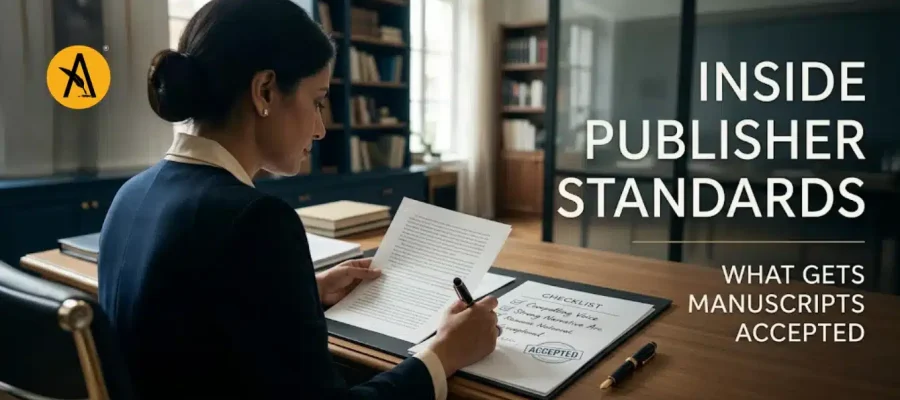
Every author who completes a manuscript eventually asks the same question: what does a publisher actually look for?
It is a reasonable question, and most answers to it are vague, “a compelling story,” “strong writing,” “commercial potential”, without much explanation of what those phrases mean in practice, and especially without addressing what they mean in the specific context of Indian publishing.
This guide is written from the perspective of a traditional publisher. At Anecdote Publishing House, we review manuscript submissions across fiction, non-fiction, self-help, romance, mystery thriller, young adult, spirituality, and society and culture. We will explain what our editorial team actually evaluates, and what the assessment means for how you should prepare your manuscript before submitting anywhere.
The Two Layers of Every Manuscript Evaluation
When a publisher’s editorial team reviews a manuscript, they are simultaneously evaluating two distinct questions:
Question 1: Is this a well-crafted piece of writing? Does the author demonstrate command of their craft, structure, voice, pacing, character or argument, sentence-level quality? Is this a book worth reading?
Question 2: Is this a commercially viable book? Is there a defined audience for this book? Does it fit a genre or category that has a demonstrated readership? Does this manuscript fit what this particular publisher publishes?
A manuscript that scores highly on one dimension but poorly on the other is difficult to publish. A beautifully written book with no identifiable market is a literary problem. A highly commercial premise with weak execution is a craft problem. The ideal manuscript answers both questions convincingly.
As Pan Macmillan India states in their own submissions FAQ: “We evaluate a manuscript on several parameters like style, content, readability, market trends and sales potential. Whether the manuscript fits our publishing programme is also a crucial factor. We look at each manuscript in the context of other manuscripts and previously published books.”
This dual evaluation is worth understanding before you submit anywhere, because it tells you that preparing a manuscript for submission is not just about perfecting the writing. It is also about understanding the publishing landscape well enough to know where your book fits and why.
What Publishers Look For: Fiction Manuscripts
1. A Distinctive Voice
Voice is the element that separates memorable fiction from forgettable fiction. It is not the plot, the premise, or even the quality of the prose at a technical level, it is the specific quality of consciousness that the writing conveys. A distinctive voice is one that makes the reader feel they are in the presence of a specific, irreplaceable perspective.
For Indian fiction publishers, voice is often the first quality that captures attention in a submission. Indian readers encounter many novels, what makes one linger while another is forgotten is almost always the author’s voice. This is what editors mean when they say they are looking for “originality” in a manuscript: not an entirely new story, but a fresh, specific way of seeing and telling.
You cannot manufacture a distinctive voice. You can, however, develop one through extensive reading in your genre and through revising your work until every sentence sounds unmistakably like you rather than like a composite of every book you have read.
2. A Compelling Opening
No matter how strong the middle and ending of a novel are, publishers make their initial judgement from the opening pages. Editors at publishing houses review many submissions, a manuscript that does not engage them in the first ten to twenty pages will rarely receive further consideration, regardless of what follows.
A strong fiction opening does several things simultaneously: it establishes the voice, it places the reader in a specific world or moment, it introduces or implies a character whose situation is sufficiently compelling to make reading on feel necessary. It does not begin with weather, extended backstory, or a prologue that could be removed without loss.
The single most common structural problem in fiction submissions is a slow opening. If your novel only becomes genuinely engaging at chapter three, your chapter three may need to become your chapter one.
3. Well-Constructed Characters
Memorable characters are the backbone of published fiction. Publishers look for characters who feel genuinely three-dimensional, who have specific internal motivations, genuine contradictions, and whose behaviour is consistent with the depth of their inner life.
A common weakness in submissions is characters who exist primarily to serve the plot. The protagonist makes decisions because the story needs them to, not because those decisions emerge organically from who they are. Publishers notice this because readers notice it. A character whose choices always conveniently serve the narrative will feel hollow regardless of how much action surrounds them.
For Indian fiction, characters who feel authentically Indian, whose inner lives are shaped by specific cultural contexts, family dynamics, and social realities, are not simply a cultural preference. They are part of what makes Indian fiction feel necessary rather than generic.
4. Pace and Structure
Publishers assess whether the story moves at the appropriate pace for its genre and sustains momentum through its structure. Literary fiction can be slower and more interior than genre fiction. Romance requires the building and resolution of emotional tension at specific points. Thrillers require sustained momentum and revelation. Each genre has structural conventions that readers bring expectations about, and manuscripts that violate those conventions without deliberate intent confuse both publishers and readers.
The middle of a novel is the most common structural weakness. Many manuscripts begin well, lose direction in the second half, and recover at the ending. Publishers recognise this pattern, and it is a strong reason to reject an otherwise promising submission.
5. Clarity and Coherence
At the sentence and paragraph level, publishers assess whether the writing is clear, coherent, and free of the kinds of errors that signal an unpolished draft. This is not about stylistic conformity, every strong author has distinctive stylistic choices. It is about whether the writing is the result of deliberate craft or of insufficient revision.
A manuscript that has not been through multiple rounds of substantive revision is usually identifiable from the first few pages. Inconsistent tense, point-of-view errors, dialogue that does not sound like distinct characters, and prose that describes rather than evokes are all signals of a manuscript that is not submission-ready.
What Publishers Look For: Non-Fiction Manuscripts
1. A Clear, Specific Promise
Every non-fiction book makes an implicit or explicit promise to the reader: read this book and you will understand X, be able to do Y, or know Z. Publishers assess whether the promise is clear enough to attract a specific readership and compelling enough to make purchase feel necessary.
The weakest non-fiction submissions are those with vague, all-encompassing promises, “a guide to living better,” “everything you need to know about success.” The strongest have a specific, concrete promise that is immediately understandable and credible: “how to navigate career transitions without losing your financial security,” “the history of India’s Partition told through the stories of ordinary families.”
2. Genuine Expertise or Authentic Experience
Non-fiction books make claims about the world. Publishers assess whether those claims are credible, whether the author has genuine expertise (professional, academic, or vocational) or authentic experience (lived, witnessed, researched) that makes them the right person to write this book.
For professional non-fiction, business, self-help, personal development, publishers look for authors whose credentials match their claims. A book about leadership written by someone with documented leadership experience carries more authority than the same book written by someone without it. For narrative non-fiction and memoir, authenticity of experience matters more than formal credentials.
This does not mean that only experts can write non-fiction. But it does mean that the author must have a convincing answer to the question: why are you the right person to write this book?
3. A Defined Audience
Publishers evaluate non-fiction with one question closely in mind: who will buy this book? A manuscript targeting “anyone interested in self-improvement” is harder to publish than one targeting “Indian professionals in their thirties navigating career transitions.” The more specifically you can define your intended reader, the more clearly a publisher can assess whether your book serves a real and reachable audience.
4. Argument Coherence and Chapter Logic
Non-fiction books are arguments, even those that appear to be collections of stories or advice. Publishers assess whether the argument unfolds logically from one chapter to the next, whether each chapter serves the book’s central thesis, and whether the overall structure would satisfy a reader who followed the argument to its conclusion.
A common weakness in non-fiction submissions is repetition, the same point made across multiple chapters in slightly different language, combined with an absence of progression. The strongest non-fiction manuscripts have a clear arc: a reader at the end knows something or can do something they could not at the beginning, and the journey from start to end was necessary to get there.
5. Factual Accuracy and Source Reliability
For non-fiction making factual claims, publishers assess whether the facts are accurate and whether the sources are reliable. Unsupported assertions, outdated statistics, and claims that contradict established knowledge are problems at the editorial stage. A manuscript that would require significant factual verification work represents additional investment that may make acquisition less attractive.
The Opening Pages: Why They Matter More Than Anything Else
The opening pages of a manuscript are disproportionately important in any submission evaluation.
Publishers receive many submissions. Editorial teams cannot read every submission in full before making initial decisions, they use the opening pages to assess whether the manuscript is worth deeper investment of time. A manuscript that fails to engage in the first ten to fifteen pages will rarely be read to completion.
The writer who understands this prepares their submission differently. The opening pages are not where you lay the groundwork for what comes later. They are where you make your case for why this book deserves to be read. The reader, whether that reader is a publisher’s editor or a bookshop customer, should be fully engaged before they reach the end of the first chapter.
Common Opening Problems
Extended backstory or prologue: Beginning with a character’s childhood, a family history, or a scene that establishes “world-building” before the central story begins. Readers, and publishers, need a reason to care about a character before they will engage with their history.
Weather or scene description as the first paragraph: Opening with “It was a dark and stormy night” and its modern equivalents. Description of setting, however well-written, delays the story’s real beginning.
Multiple characters introduced simultaneously: Beginning with a cast of characters before the reader has committed to any of them. Give readers one character to connect with before introducing others.
Starting too late: Some manuscripts have excellent first chapters but choose to begin at chapter three because “that’s where the story starts.” If chapter three is where the story starts, chapter three should be chapter one.
Commercial Potential and Market Fit
Publishers are businesses. They invest in manuscripts they believe will find readers, which means they assess every submission’s commercial potential alongside its literary quality.
Commercial potential is not the same as writing for the mass market. A literary novel with a specific, dedicated audience can have strong commercial potential for a publisher whose list serves that audience. A genre thriller aimed at millions may have weaker commercial potential for a small publisher without genre fiction infrastructure.
What commercial potential actually means in an evaluation:
Identifiable audience: Can you describe the reader who will buy this book, and is that reader reachable? “People who liked Gone Girl” is useful comparator information. “People who enjoy good books” is not.
Market positioning: How does this manuscript fit into the existing landscape of published books in its genre or category? Is it filling a gap, or competing in an already crowded space where it does not differentiate itself clearly?
Sales narrative: Could a sales team describe this book to a bookshop buyer in a compelling sentence? Books that cannot be described concisely are difficult to sell regardless of their quality.
Comparable titles (comps): Publishers assess a manuscript partly by comparison with published titles. If you can identify two or three published books your manuscript resembles in tone, audience, and commercial positioning, and those books have sold well, you have provided useful evidence of your book’s commercial viability.
Genre Fit: Submitting to the Right Publisher
One of the most common and most avoidable reasons for manuscript rejection in India is submitting to a publisher who does not publish your genre.
Publishers develop specific expertise, relationships, and market positioning around the genres they publish. A publisher whose list consists of literary fiction will reject a romance novel, not because the romance is poorly written, but because they are not equipped to edit, position, or market it. Sending your manuscript to a mismatched publisher wastes both your time and the publisher’s.
Before submitting to any publisher:
Review their published catalogue. What have they published in the last two to three years? Is your manuscript clearly similar in genre, tone, and target readership to books they have already published?
Read their submission guidelines carefully. Many publishers explicitly state which genres they do and do not accept. Pan Macmillan India, for example, lists specific fiction and non-fiction genres they accept and notes: “We do not focus on campus-oriented, college romance.” Submitting a campus romance to Pan Macmillan wastes everyone’s time.
Identify the right genre for your manuscript before submitting. If you are uncertain which genre your book belongs to, visit a bookshop and find the shelf where your book would sit. The books around it are your genre comparisons.
Once you know your manuscript’s genre, our guide to publishers in India for new writers can help you assess where to submit it.
Anecdote Publishing House publishes across fiction, non-fiction, self-help, motivational, romance, mystery thriller, young adult, religion and philosophy, spirituality, family and relationship, contemporary fiction, and society and culture. You can browse our genre catalogue and our published authors to assess whether your manuscript is a fit for our list.
Author Platform and Credibility
An author platform, your visibility and credibility as a writer, is increasingly relevant to publishers’ acquisition decisions, particularly for non-fiction.
Publishers are not just acquiring a book. They are entering a commercial relationship with an author over the arc of the book’s life. An author who already has an audience, readers who follow their writing on a blog, LinkedIn, Instagram, or Substack, provides the book with a built-in launch community. For non-fiction especially, an author’s credentials and professional visibility are part of the book’s credibility to readers and reviewers.
What “Platform” Means in Practice
For fiction authors, platform is less critical than for non-fiction, but it is not irrelevant. An active, authentic social media presence that demonstrates engagement with the literary community, sharing reading recommendations, participating in book conversations, building genuine connections with readers in your genre, creates goodwill and a launch-ready audience.
For non-fiction authors, platform can meaningfully influence acquisition decisions. An expert whose writing reaches a demonstrated audience through a newsletter, LinkedIn articles, a professional blog, or a speaking career provides evidence that readers are interested in what they have to say. This does not need to be a large audience, a highly engaged, specifically relevant audience of a few thousand is more commercially meaningful than a large, diffuse following.
Platform Is Not a Requirement for Debut Authors
Many traditionally published debut authors in India have no platform at the time of submission. A compelling manuscript from a debut author without platform will be considered on the quality and commercial potential of the manuscript alone. Platform is a supplementary positive, not a prerequisite.
What Publishers Do Not Look For
Understanding what publishers evaluate is most useful when paired with understanding what they do not evaluate.
They do not look for your personal story about why you wrote the book. Your emotional journey in writing the manuscript is not part of the editorial evaluation. The quality and commercial potential of the result is.
They do not look for perfection. A manuscript acquired by a publisher goes through substantial editorial development before publication. Publishers know that every manuscript they acquire will be edited. They are evaluating potential, not a finished product. What they cannot work with is a manuscript so fundamentally underdeveloped that the level of editorial investment required would make acquisition unviable.
They do not look for a book exactly like what already exists. Publishers want books that fit within a genre’s conventions, enough for readers to recognise and trust them, while offering something fresh. A romance novel that is indistinguishable from ten other romance novels from the same period is difficult to position. One that feels familiar but brings a specific, fresh perspective has a much stronger case.
They do not look for an already-completed marketing plan. As an author, you are not expected to arrive with a fully formed marketing strategy. Publishers have their own PR and marketing infrastructure. What is useful is for you to be able to describe your intended audience, name comparable titles, and demonstrate that you understand where your book sits in the market.
They do not prefer authors who have never been rejected. Rejection is universal in publishing. Many of India’s most successful authors received multiple rejections before their breakthrough publication. Publishers understand this and do not penalise authors for submitting previously rejected manuscripts, as long as those manuscripts have been meaningfully developed based on feedback received.
How the Evaluation Process Works in India
Understanding how a submission moves through a traditional publisher’s evaluation process helps authors calibrate their expectations.
Stage 1: Initial screening. The first reader, typically an editorial assistant or junior editor, reads the opening pages and the submission package (query letter and synopsis). Manuscripts that clearly do not fit the publisher’s genre list, are obviously unpolished, or whose submission package is unprofessional are returned at this stage.
Stage 2: Full manuscript read. Manuscripts that pass the initial screen are read in full by an editor. The editor assesses the full range of criteria discussed in this guide and makes a preliminary recommendation.
Stage 3: Editorial team discussion. Manuscripts under serious consideration are discussed by the broader editorial team, sometimes including marketing and sales colleagues who assess commercial potential.
Stage 4: Acceptance or rejection, with or without feedback. Most publishers, including most Indian traditional publishers, do not provide detailed feedback on rejections. The volume of submissions makes individual feedback impractical. Occasionally, a rejection letter will note specific strengths or concerns, this is valuable feedback worth incorporating.
Response times in India range from a few weeks to several months depending on the publisher and the volume of submissions. If a publisher states a response window of 12 weeks, wait until that window has passed before following up, and do so once, politely.
Preparing Your Manuscript for Submission
Before submitting to any publisher, your manuscript should meet these minimum standards:
Completed from beginning to end. For fiction, the full manuscript should exist. For non-fiction, some publishers accept a proposal with sample chapters, but the book’s structure must be clear and the sample chapters must be compelling.
Revised multiple times. The first draft is never submission-ready. Read the complete manuscript from beginning to end, make structural changes, then revise at the prose level. Minimum two full revision passes after the first draft.
Read by beta readers from your target audience. At least three to five readers whose opinion you trust should have read the complete manuscript and given you honest feedback. Their responses reveal what is working and what is not from a reader’s perspective.
Professionally edited, at minimum, copy edited and proofread. A manuscript full of grammar errors, spelling mistakes, and typographical problems signals to a publisher that the author does not take their work seriously. At minimum, copy editing and proofreading should be complete before submission.
Formatted to industry standards. Font: Times New Roman or Arial, 12 point. Line spacing: 1.5 or double-spaced. Margins: 1 inch on all sides. Page numbers in the header or footer. Each chapter beginning on a new page.
For detailed guidance on manuscript preparation and the full writing-to-publishing journey, see our guide on how can I write a book and get it published.
The Submission Package: Query Letter, Synopsis, Sample Chapters
A submission package is the set of materials you send to a publisher alongside (or in place of) your full manuscript. The specific requirements vary by publisher, always check each publisher’s submission guidelines before sending anything.
A standard submission package typically includes:
The Query Letter
A one-page pitch letter covering:
- Your book’s genre and word count in the opening sentence
- A compelling three-to-five sentence description of the manuscript that conveys its premise, central conflict or argument, and target readership
- Comparable published titles (comps), two or three published books your manuscript resembles in tone or audience
- A brief author biography noting any relevant credentials, publications, or platform
The query letter is your first impression. It must be specific, compelling, and professional. Avoid excessive flattery (“this is the greatest novel ever written”), excessive modesty (“I know this probably isn’t what you’re looking for, but…”), and the inclusion of your entire life history. One page, focused, confident, and specific.
The Synopsis
A one-to-two-page complete summary of the book, including the ending. A synopsis is not a teaser; it is a business document that allows the publisher to assess whether the book holds together structurally. For fiction, include the protagonist’s arc, the central conflict, the key plot developments, and the resolution. For non-fiction, include the central argument, the chapter structure, and the book’s conclusion.
Sample Chapters
Most publishers request the first three chapters or the first 40 to 50 pages. These must represent your best work. If your opening chapters are not as strong as your later chapters, revise them before submitting.
For detailed guidance on preparing your submission package, see our guide on how to publish a book in India.
Frequently Asked Questions
1. How do I know if my manuscript is ready to submit to publishers?
Your manuscript is ready when: it is complete from beginning to end, it has been through at least two full revision passes, beta readers from your target audience have given feedback that you have incorporated, it has been professionally copy edited and proofread, and you can describe it clearly in a single compelling paragraph. If you feel genuine anxiety about specific unresolved problems in the manuscript, not normal nerves, but the specific awareness that something significant is not working, it is not yet ready.
2. What word count do publishers in India expect?
General expectations by genre: literary and commercial fiction 70,000–100,000 words; young adult fiction 55,000–80,000 words; romance 50,000–90,000 words; self-help and motivational non-fiction 40,000–70,000 words; business and professional non-fiction 50,000–80,000 words; memoir 60,000–90,000 words; spirituality and philosophy 50,000–75,000 words. Significantly shorter or longer manuscripts raise questions about completeness or tightness that should be addressed in your query letter.
3. Does my book need to be about India to interest Indian publishers?
Not necessarily. Many Indian publishers publish books by Indian authors on universal themes with no specific India connection. However, books set in India, featuring Indian characters and contexts, or addressing themes specifically relevant to Indian readers have a natural fit with Indian publishers and a built-in argument for their relevance to the Indian market.
4. Should I submit my manuscript to multiple publishers simultaneously?
Yes, in most cases. Simultaneous submissions are standard practice. Most Indian publishers do not require exclusive submission, if they do, it will be stated clearly in their submission guidelines. Keep a simple record of every submission: publisher name, date submitted, and response.
5. What makes a query letter effective?
A good query letter is specific (your exact genre and word count in the first sentence), compelling (a description that makes the publisher want to read the manuscript), and brief (one page, no more). The strongest query letters make the book’s premise and audience immediately clear and include two or three comparable published titles that demonstrate the author understands where their book sits in the market.
6. How long does it take to hear back from Indian publishers?
Response times vary widely, from a few weeks to several months. Many Indian publishers state their expected response window in their submission guidelines. Wait the full stated window before following up, and follow up once, politely. Some publishers may not respond to every submission, particularly those that do not match their list.
7. What does it mean if a publisher asks for revisions?
It means they see genuine potential in the manuscript. A revision request is positive, it means the publisher believes the book is worth further investment. Take the feedback seriously, make the requested changes thoughtfully, and resubmit with a brief note indicating which specific changes you made. Authors who engage seriously with editorial feedback and resubmit strong revised manuscripts frequently convert revision requests into acceptances.
8. Does a publisher care about the genre of my book if it blends multiple genres?
Publishers care about being able to position your book clearly to booksellers and readers. Genre-blending is commercially viable, many of the most successful books blend genres, but the book must have a primary genre home. “A romance with thriller elements” is position-able. “A romance-thriller-literary fiction-memoir hybrid” is very difficult to position and sell. Identify the primary genre that dominates your manuscript’s tone, structure, and target readership, and lead with that in your submission.
9. Will publishers in India consider debut authors?
Yes. Most Indian traditional publishers consider debut authors, and many of the most celebrated Indian books of recent decades were debut novels. The manuscript’s quality and commercial potential are assessed on their merits regardless of the author’s publication history. Having no prior publications is not a disqualifying factor.
10. What does Anecdote Publishing House look for in a submission?
We look for manuscripts that are complete and polished, that demonstrate genuine craft at the sentence and structural level, that have a clear sense of their intended reader, and that fit within the genres we publish: fiction, non-fiction, self-help, romance, mystery thriller, young adult, spirituality, family and relationship, contemporary fiction, and society and culture. We value distinctive voice above almost any other single quality. We are open to debut authors and to manuscripts on any subject within our genre range. You can submit your manuscript here for a free consultation.
11. Should I mention that my manuscript has been rejected before in my query letter?
No. Rejection history is irrelevant in a submission package and including it signals self-doubt or a lack of understanding about how submissions work. Submit your strongest current version of the manuscript without reference to previous submission history.
12. What is the most common reason manuscripts are rejected in India?
From an editorial perspective, the most common reasons are: the manuscript does not match the publisher’s genre list (the single most avoidable rejection), the opening pages fail to engage sufficiently for the submission to receive a full read, the manuscript is clearly in an early draft stage (poor formatting, abundant typos, inconsistencies that signal it has not been properly revised), or the writing quality is not yet competitive with published titles in the genre.
Submit When You Are Ready, Not Before
The most valuable thing you can take from this guide is an honest assessment of where your manuscript stands against these criteria before you submit.
Publishers are not looking for perfection. They are looking for evidence that the manuscript has the potential to become an excellent published book through their editorial process. The author who submits a well-crafted, revised, genre-appropriate manuscript with a professionally prepared submission package gives themselves the strongest possible foundation.
If you believe your manuscript is ready and your genre fits our list, Anecdote Publishing House accepts direct submissions. We review every manuscript we receive and provide a free consultation for manuscripts that show genuine promise.