
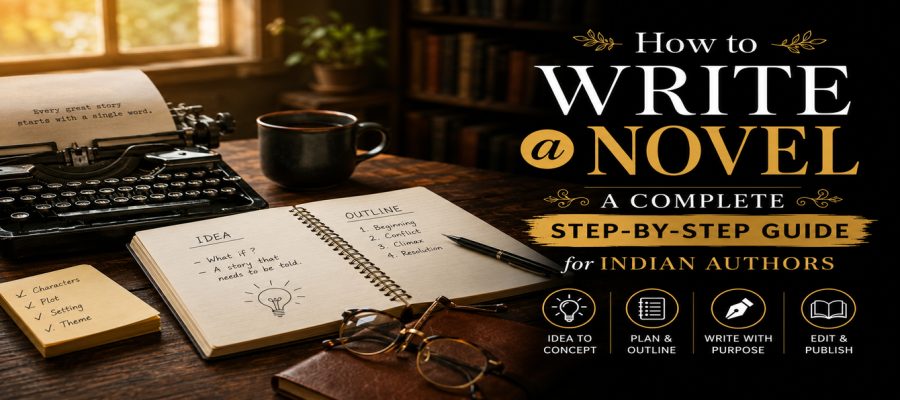
Writing a novel is one of the most sustained acts of creative discipline a human being can undertake, and one of the most rewarding. A novel is not a long short story, not an extended essay, not a series of connected scenes. It is a unified work of narrative fiction with its own internal architecture: structure, plot, character, pacing, theme, and voice working together to produce an experience no shorter form can provide.
This guide is specific to novels, not a general introduction to writing (see our guide on how to write a book for beginners for that), but a focused, step-by-step breakdown of the decisions, techniques, and craft elements specific to long-form fiction. It covers everything from premise and structure through plot beats, character arcs, pacing, revision, and submission, with particular attention to the opportunities and challenges facing Indian novelists writing in English.
What a Novel Is and Is Not
A novel is typically defined as a work of long-form prose fiction of at least 50,000 words, though most published novels in the commercial market run 70,000 to 100,000 words. But word count is the least important defining characteristic.
What defines a novel structurally is scope: a novel has sufficient space to develop multiple characters across time, to build and resolve subplots alongside the main plot, to create a world that the reader inhabits rather than merely visits, and to trace the arc of internal change in its protagonist across events significant enough to produce that change.
A novel that attempts to function as a short story told at length, with a single incident, a single character, a single thread, will feel thin at novel length. The scale of the form demands an ambition appropriate to it: a story large enough to require 80,000 words to tell fully, not a smaller story padded to meet a word count.
What a novel is not:
It is not a series of scenes or chapters without structural connection. The events of a novel must be causally related, each event produces consequences that create the conditions for the next event. A story is not “this happened, then this happened, then this happened.” A story is “this happened, and because of that, this happened, which meant that this had to happen.”
It is not the same as a memoir or personal essay told in the third person. Even autobiographical fiction is shaped by the laws of narrative, causation, consequence, arc, that memoir is not required to follow.
Step 1, Develop a Premise Strong Enough to Sustain 80,000 Words
The premise is the seed of the novel, the central situation, conflict, and character combination that everything else grows from. A weak premise produces a novel that collapses halfway through. A strong premise generates its own momentum: the situation creates characters who must act, whose actions create consequences, whose consequences escalate until a resolution becomes necessary.
What makes a premise strong:
Conflict built in from the start. The best premises contain the seeds of conflict in their very description. A young woman returns to her ancestral village to settle her grandmother’s estate and discovers a secret that rewrites everything she thought she knew about her family. The return, the estate, and the secret all create immediate conflict, between what is known and what must be discovered, between the past and the present, between who the protagonist thought she was and who she must become.
Stakes that escalate. What will be lost if the protagonist fails? The stakes must be meaningful enough to sustain the reader’s concern across hundreds of pages. External stakes (a crime to solve, a war to survive, a marriage to save) are easier to construct than internal stakes (a false belief to shed, a fear to face, a truth to accept), but the strongest novels combine both.
A character whose specific flaws and desires make them uniquely suited to this conflict. The premise and the protagonist should be matched, this character in this situation should feel inevitable. The detective whose personal loss makes her both perfectly equipped and dangerously compromised to solve this particular case. The protagonist whose ambition creates the very situation that will eventually destroy her unless she changes.
Test your premise with one sentence: [Character] wants [goal] because [motivation], but [conflict] stands in the way. If you cannot complete this sentence specifically, not vaguely, the premise is not yet focused enough to begin.
Step 2, Know Your Genre and Its Conventions
Genre is a contract with the reader. When someone picks up a thriller, they bring specific expectations: escalating tension, a crime or threat, a resolution. When they pick up a romance, they expect an emotional journey toward love. When they pick up literary fiction, they expect depth of character, thematic ambition, and prose quality over pace.
Understanding these expectations is not about conforming to formula. It is about knowing which rules you are working within and which you are deliberately subverting, because you cannot subvert a convention you do not know exists.
For Indian authors, the major novel genres and their core requirements:
Literary fiction: Prioritises character depth, thematic complexity, and prose quality. Pace is secondary to substance. The central conflict is often internal or social rather than purely external. The ending typically resists easy resolution.
Commercial fiction / contemporary fiction: Plot-driven, faster-paced, character development in service of story movement. Clear genre conventions guide reader expectations. Endings are more definitively resolved.
Romance: The emotional journey toward love between the protagonists is the primary story. The couple’s relationship must be central throughout, not a subplot. Genre convention requires a satisfying, emotionally earned conclusion.
Mystery thriller: A crime or threat drives the plot. Information is withheld from and gradually revealed to the reader. Tension escalates consistently. The resolution answers the central question raised in the opening.
Mythology fiction: Draws on Indian mythological tradition, the Ramayana, Mahabharata, Puranas, and reimagines its characters, events, or cosmology in a contemporary or alternative-historical setting. Indian readers bring deep familiarity with the source material; surprise and freshness of interpretation are what earn attention.
Young adult: Protagonist is typically 13 to 18. Themes of identity, belonging, first love, and coming-of-age are central. The protagonist solves their own problem, they are not rescued by adults.
Step 3, Create Characters Who Drive the Story
Characters are not vehicles for plot events, they are the origin of plot events. In the strongest novels, the story is what happens when specific people with specific flaws, desires, and histories collide with specific circumstances. Remove those specific people and you do not have a different story, you have no story.
The four things every protagonist must have:
A goal: Something they want or need desperately, specific enough to create direction and urgency. Not “she wants love” but “she wants to win back the man she left before he marries someone else.”
A motivation: Why they want it, the history, the wound, the value, or the fear that makes this particular goal matter so much to this particular person.
A flaw: A quality that both makes them human and creates obstacles, either internal (a fear, a false belief, a damaging pattern of behaviour) or external (a social position, a secret, a past action with ongoing consequences). The flaw must have genuine consequences in the story.
An arc: The internal change the protagonist undergoes as a result of the story’s events. In a positive arc, a character begins with a limiting false belief, is challenged by events, and ends having grown beyond it. In a negative arc (tragedy), they refuse to grow and are destroyed by the flaw instead.
For a complete guide to building characters for your novel, see our article on how to write compelling characters.
Step 4, Choose Your Story Structure
Structure is the architecture of your novel, the framework of events and turning points on which the story hangs. Several structural models exist, each suited to different kinds of stories.
The Three-Act Structure
The most widely used and most universally understood structure in fiction:
Act 1 (approximately 25% of the novel): Introduce the protagonist in their ordinary world. Establish the central character relationships and the world’s rules. The inciting incident, an event that disrupts the status quo and sets the story in motion, occurs early in this act. Act 1 closes with the first major plot point: the event that commits the protagonist to the story’s central conflict and makes return to the ordinary world impossible.
Act 2 (approximately 50% of the novel): The protagonist pursues their goal and encounters escalating obstacles. The midpoint, roughly halfway through the novel, is a significant event that raises stakes, reverses a situation, or reveals information that reframes the story. Act 2 closes with the second major plot point: the protagonist’s darkest moment, when all seems lost and the original approach has completely failed.
Act 3 (approximately 25% of the novel): The protagonist, having been forced to change by Act 2’s events, finds a new approach. The climax, the story’s highest-stakes confrontation, occurs here. The resolution shows the world after the conflict is decided.
The Hero’s Journey
A twelve-stage structure derived by mythologist Joseph Campbell from cross-cultural narrative traditions. The hero begins in the ordinary world, is called to adventure, refuses, is pushed across a threshold, faces tests and allies and enemies, reaches the innermost cave, endures the supreme ordeal, is reborn, and returns transformed with the elixir of wisdom.
Amish Tripathi’s Shiva Trilogy follows this structure almost precisely, Shiva’s journey from the mountains of Tibet to the civilisation of Meluha maps directly onto the Hero’s Journey’s stages. This is part of why it resonated so deeply with readers already familiar with this narrative shape from Indian mythological tradition.
The Four-Act Structure
A variation that splits Act 2 of the three-act structure into two parts, creating a Midpoint that functions as a major structural pivot, the story’s second act begins moving in a significantly different direction from where it started. Useful for novels where the middle threatens to sag, the midpoint creates a structural anchor that prevents the second act from losing momentum.
Step 5, Outline Your Novel
The outline is a map, not a contract. It tells you where you are going so you do not get lost in the middle of Act 2 and abandon the manuscript. It does not prevent discovery and surprise as you write; it prevents collapse.
Two approaches to outlining:
Detailed outline: Plot every scene or chapter in advance, what happens, what character decision or consequence drives the scene, what changes by the scene’s end. Authors who outline in detail tend to write faster and with fewer structural problems in the first draft, because the large structural decisions have been made before the drafting begins.
Beat sheet: Identify only the major structural moments, the inciting incident, the first and second plot points, the midpoint, the climax, and the resolution, and leave the journey between them to be discovered while writing. Authors who work this way find more surprises in the draft; they also typically encounter more structural problems that require significant revision.
Neither approach is superior. What matters is that you know enough of the story before writing to avoid the most common cause of novel abandonment: reaching a point where you do not know what happens next, with no map to consult.
Minimum outline before drafting:
At minimum, know these five things before you begin your first chapter: who your protagonist is and what they want; what the inciting incident is; what the midpoint reversal is; what the darkest moment at the end of Act 2 is; and how the story ends. Five things. That is enough to write a complete novel.
Step 6, Write the First Draft
The first draft of a novel exists to generate raw material, not to be published. Every published novelist has written first drafts they found embarrassing. The quality of the first draft is almost entirely irrelevant to the quality of the finished novel. What matters is completion.
The cardinal rule of the first draft: Write forward. Never edit backwards. The impulse to read yesterday’s work and revise it before writing today’s new material is the most reliable way to spend months writing and never finish Act 1. Write the next scene. Trust revision to fix what the draft gets wrong.
Practical daily practice:
Set a consistent daily word count target, 500 words is realistic for most working Indian authors; 1,000 words is achievable with dedicated time. Track your progress. The accumulating word count is evidence that the novel is real, growing, and approaching completion.
End each session mid-sentence or mid-scene, not at a natural stopping point. The next session begins by finishing what is already in motion rather than starting something new, which significantly reduces the blank-page resistance that derails many writing sessions.
Write placeholder scenes. If a scene is not working, write “[SCENE: Priya confronts her mother, emotional confrontation about the letter, ends with Priya leaving the house]” and move on. Return to it in revision when you understand what the scene needs to accomplish.
Step 7, Manage Pacing Through Your Novel
Pacing is the speed at which the reader experiences the story, and it is one of the most common craft failures in debut novels. Too slow in Act 2 produces a “sagging middle” that readers abandon. Too fast through emotional turning points produces a climax that fails to land because the reader has not been allowed to feel the weight of what is happening.
The scene-sequel rhythm:
Most fictional scenes operate on a two-part rhythm:
Scene: External action, a character pursues a goal, encounters conflict, and either succeeds (partially) or fails. The scene ends with a changed situation.
Sequel: Internal reaction, the character processes what happened, weighs their options, and makes a decision that propels them into the next scene. The sequel shows the emotional and psychological consequences of the scene.
Balancing scene and sequel manages pace: heavy on scenes, the novel feels relentless but emotionally flat. Heavy on sequels, it feels slow and introspective. The ratio should shift through the novel, more sequels in Act 1 as the protagonist processes new circumstances; fewer and shorter sequels in Act 3 as the climax approaches and events move too quickly for lengthy reflection.
Controlling pace through sentence structure:
Short sentences accelerate pace. Long sentences slow it. During action sequences, confrontations, and climactic moments, tighten the prose to short, declarative sentences. During reflection, emotional processing, and atmospheric description, allow longer, more complex constructions. The sentence rhythm of the prose is itself a pacing tool.
Chapter endings:
Every chapter should end on a note that makes the reader reluctant to stop. Not necessarily a cliffhanger, but an unresolved question, a new piece of information that changes the situation, or an emotional moment that demands follow-through. The chapter ending is your most reliable tool for keeping readers up past midnight.
Step 8, Weave Subplots Without Losing the Main Thread
A subplot is a secondary narrative thread that develops alongside the main plot. It may involve a secondary character’s story, a romantic relationship developing in parallel with the central plot, or a thematic exploration of a different aspect of the novel’s central concern.
Subplots serve the main plot: they develop secondary characters, introduce information that becomes relevant to the main plot, provide tonal counterpoint (a lighter subplot against a tense main plot, or vice versa), and illuminate the theme from a different angle. A subplot that does none of these things is not a subplot, it is a distraction.
The subplot test: Remove the subplot from your novel entirely. If the main plot is weakened by its absence, if information it provides becomes unavailable, if character development it achieves is missed, if its tonal function leaves a gap, it is earning its place. If the main plot is unaffected, cut or consolidate the subplot.
Weaving subplots through the draft:
Introduce subplots in Act 1 alongside the main plot, not in Act 2 when the main plot is already established. Resolve subplots before or during the climax, not after, post-climax subplot resolution deflates the ending. A subplot that is introduced and then abandoned is one of the most reliable signals of a structural problem in a novel.
Step 9, Write a Satisfying Ending
An ending is not simply the point at which the story stops. It is the resolution of every promise the novel made in its opening, the answer to the central question, the payoff of the protagonist’s arc, and the demonstration of what the story’s events have changed.
Three criteria for a satisfying ending:
It answers the central dramatic question. Every novel opens with an implicit question, will the detective solve the crime? will the lovers find each other? will the protagonist escape their circumstances?, and the ending must answer it definitively.
It resolves the protagonist’s arc. The internal change the protagonist has been moving toward must be demonstrated through action, not described. The reader should see the protagonist making a choice or taking an action in the ending that they would have been incapable of making in the opening, because of what the story has done to them.
It feels both surprising and inevitable. The best endings are ones the reader did not predict but immediately recognises as the only possible conclusion. They are earned by everything that preceded them, the foreshadowing, the character development, the escalating stakes, so that when they arrive, they feel like revelation rather than invention.
What makes an ending unsatisfying:
Endings that resolve the conflict through coincidence or external intervention rather than the protagonist’s own choices. Endings that introduce new information not foreshadowed earlier in the novel. Endings that resolve the plot but leave the character arc unresolved, or vice versa. Endings that simply stop without providing emotional closure.
Step 10, Revise Your Novel
Revision is where novels are made. The first draft is raw material; the published novel is the result of multiple revision passes, each addressing a different level of the work.
Pass 1, Structural revision: Read the complete draft and address large structural problems first. Does the plot hold together causally? Does the protagonist’s arc complete from beginning to end? Are there scenes or chapters that do not serve the story? Are the subplots woven in and resolved appropriately?
Pass 2, Scene-level revision: Read each scene and ask: what does this character want in this scene? What opposes them? What changes by the scene’s end? A scene where nothing changes is either a problem or a conversation, and most conversations should be scenes.
Pass 3, Prose revision: Read sentence by sentence for clarity, rhythm, and specificity. Cut adverbs where the verb itself can carry the meaning. Replace vague nouns with specific ones. Vary sentence length. Eliminate repeated words within close proximity.
Pass 4, Read aloud: Read the complete novel aloud, or as much of it as time allows. The passages where you stumble, rush, or feel the urge to explain are the passages that need revision. Dialogue that sounds wrong when spoken will sound wrong when read.
For detailed guidance on self-editing your novel before submission, see our complete article on how to self-edit your manuscript.
Novel Word Count and Chapter Length Guide
| Genre | Minimum | Target Range | Maximum |
|---|---|---|---|
| Literary fiction | 70,000 | 80,000 – 100,000 | 120,000 |
| Commercial / contemporary fiction | 60,000 | 75,000 – 95,000 | 110,000 |
| Romance | 50,000 | 60,000 – 80,000 | 100,000 |
| Mystery thriller | 60,000 | 70,000 – 90,000 | 110,000 |
| Young adult | 45,000 | 60,000 – 80,000 | 90,000 |
| Mythology / historical fiction | 70,000 | 80,000 – 110,000 | 130,000 |
| Debut novel (all genres) | 60,000 | 70,000 – 90,000 | 100,000 |
Chapter length: There is no universal rule. Most commercial fiction chapters run 2,000 to 4,000 words, short enough to read in a single sitting, long enough to develop a complete scene. Literary fiction chapters are often longer. Thriller and young adult chapters are often shorter. The right chapter length is the length that serves the story’s pacing.
Writing an Indian Novel in English, Specific Considerations
Indian novelists writing in English have access to material, textures, and storytelling traditions that Western literary fiction cannot replicate, and the most powerful Indian novels exploit this specifically.
The multilingual interior. Most Indian characters do not think, argue, and make love in the same register of English. A character whose first language is Tamil and whose professional life happens in English has a specific kind of interiority, a translation effect, that the best Indian novelists capture through rhythm, idiom, and the selective use of non-English words and constructions. This is not local colour. It is authentic characterisation.
The joint family as dramatic architecture. The specific power dynamics of Indian family structures, between generations, between daughters-in-law and mothers-in-law, between individual ambition and collective expectation, create dramatic situations that require no manufacture. The collision between a character’s personal desire and their family’s claim on their life is one of the most reliably powerful conflicts available to Indian fiction writers.
The weight of caste, class, and history. These are not merely sociological facts. They are lived, felt, daily realities that shape character in specific and observable ways. Fiction that renders this honestly, not as politics but as human experience, resonates with Indian readers in ways that generic social settings cannot.
Mythology as living presence. Unlike in Western fiction where classical mythology is purely historical, Indian mythology is lived culture, stories that practitioners of multiple traditions carry as living reference points. Indian fiction that draws on this material has access to a narrative resonance unavailable to any other literary tradition.
Frequently Asked Questions
1. How long does it take to write a novel?
For most Indian authors writing around a full-time job, completing a first draft takes six to eighteen months at 400 to 500 words per day. The full process, including revision, beta reader feedback, professional editing, and submission, typically takes two to four years from beginning to write to published book. For a detailed breakdown, see our article on how long it takes to write a book.
2. Should I plot my novel in detail before writing, or discover the story as I write?
Both approaches produce published novels. Plotters, those who outline in detail before drafting, typically write faster and encounter fewer structural problems. Pantsers, those who discover the story while writing, often produce more surprising, organically developed material, but frequently need more extensive structural revision. Most experienced novelists work somewhere between the two extremes: knowing the major structural beats before drafting while leaving the scenes between them open to discovery.
3. How do I avoid the sagging middle in Act 2?
Three techniques: ensure the midpoint is a genuine reversal or escalation, not a continuation of Act 1 momentum; introduce at least one subplot that reaches its own crisis point in Act 2; and regularly ask what the worst thing that could happen to the protagonist right now is, and write that thing happening. Act 2 slows when characters are not under sufficient pressure. Escalate the pressure.
4. What point of view should I write my novel in?
The three main options: first person (I), third person limited (she/he, staying close to one character’s consciousness), and third person omniscient (she/he, moving between multiple characters’ perspectives). First person creates the most intimate connection with the protagonist. Third person limited is the most flexible and most widely used. Third person omniscient suits novels with large casts and epic scope. Choose the point of view that gives the reader the closest access to the emotional and psychological experience the story is designed to create.
5. How do I know when my novel is ready to submit to publishers?
Your novel is ready to submit when it is structurally sound (the plot holds together causally from beginning to end), the protagonist’s arc is complete, it has been through multiple revision passes, beta reader feedback has been incorporated, and it has been professionally copy edited and proofread. Submission readiness is not perfection, it is the point at which further revision produces diminishing returns and the manuscript represents your best current work.
6. Can I submit my novel directly to Indian publishers without a literary agent?
Yes, and this is one of the most significant advantages of the Indian publishing market. Several reputable traditional publishers, including Anecdote Publishing House, accept direct submissions from debut and established authors without requiring literary agent representation. For a complete guide to the submission process, see our article on how to get a book published in India.
Begin
Every published Indian novel began with a first chapter written by someone who was uncertain whether they could finish. The discipline of novel writing is not the ability to write brilliantly, it is the ability to return to the manuscript every day and write the next sentence, the next scene, the next chapter, until the story is complete.
When your novel is finished, revised, and ready, Anecdote Publishing House welcomes it. We are a traditional publisher at Ansari Road, Daryaganj, Delhi. We publish at zero cost to the author, distribute to over 100 bookshops across India, and provide full editorial, design, and PR support.