
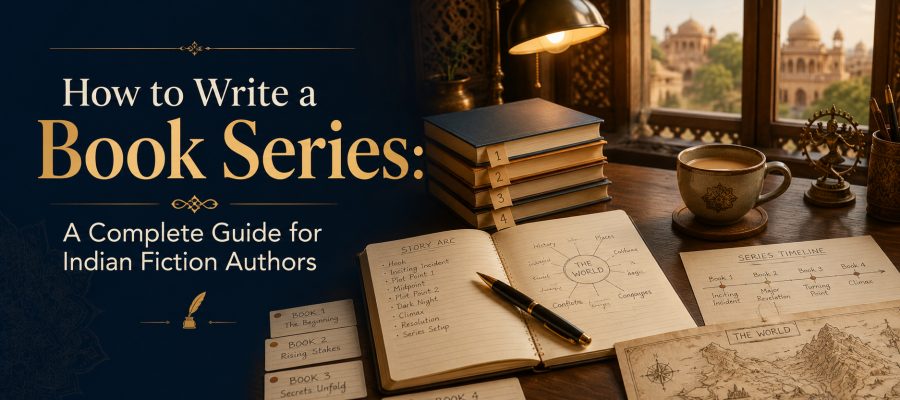
Writing a book series is one of the most commercially powerful and creatively demanding choices a fiction author can make. It is commercially powerful because readers who fall in love with a world, a set of characters, or a recurring premise become a loyal audience that grows with each new installment. It is creatively demanding because every advantage the series format provides, depth of world-building, long-term character development, the accumulation of reader investment across books, depends entirely on consistent, disciplined management of the narrative across multiple volumes.
India’s most successful fiction series, Amish Tripathi’s Shiva Trilogy, Ashwin Sanghi’s interconnected mythology thrillers, Anita Nair’s Inspector Gowda novels, and Anecdote Publishing House’s Change Stories series, all demonstrate that Indian readers are enthusiastic series readers. When a world is built well and characters are developed honestly, readers will follow them across books.
This guide covers every element of writing and planning a series, from choosing the right series type through building your series bible, managing continuity, avoiding the dreaded middle-book collapse, and keeping readers hooked from the final page of one book to the opening of the next.
The Three Types of Book Series, Choose Your Structure
Not all series are the same, and the type of series you choose shapes everything: how you plan, how you write each individual book, and what promises you make to readers.
Type 1, Sequential Series (Same Characters, Chronological)
The most common series type. The same protagonist appears in every book, their story develops chronologically, and each book picks up where the previous one left off, or shortly after. The overarching series arc spans all books and resolves only in the final volume.
Indian examples: Anita Nair’s Inspector Gowda series (Cut Like Wound, Chain of Custody, etc.) follows the same detective through successive cases. Each book has a self-contained mystery that resolves within that volume, while Gowda’s personal life and character development continue across the series.
The challenge: Every book must work as a standalone for new readers, while delivering satisfying development for existing readers who have read previous volumes.
Type 2, Standalone Series (Same World, Different Protagonists)
Each book is set in the same world or shares thematic connections, but focuses on different protagonists. Readers who loved Book 1 will enjoy the world and universe of Book 2 without needing to have read the previous installment.
Indian examples: Anecdote Publishing House’s Change Stories series, Kuroopa (Change Stories Book 1) and A Gutterful Life (Change Stories Book 2), works in this spirit, with each book exploring themes of change and resilience from different perspectives within a shared thematic framework. Ashwin Sanghi’s mythology thrillers share an interconnected universe with recurring background elements, even when protagonists differ.
The advantage: Each book is fully accessible to new readers, making the series easier to enter at any point.
Type 3, Episodic Series (Recurring Premise, Variable Stakes)
The same protagonist and world appear in each book, but the stakes are self-contained rather than escalating toward a final series resolution. Detective fiction traditionally works this way, Poirot, Feluda, and Vish Puri solve a case in each book, but the series has no overarching plot that must conclude.
The advantage: The series can continue indefinitely without a climactic conclusion; individual books are easily accessible.
The Series Arc and the Book Arc, The Most Important Distinction
Track separately: Book arc, resolved by end of this book, and Series arc, which spans multiple books and resolves in the final book. Be clear on which is which so you don’t accidentally resolve a series arc too early or leave book arcs hanging.
This distinction is the most important technical concept in series writing, and the most commonly mismanaged.
The book arc is the story of this specific volume. It has a beginning, middle, and end that are complete within the book. A reader who reads only this book should feel that the story has concluded satisfying, even if it is part of a larger series.
The series arc is the overarching story that spans all books, the large transformation, revelation, or conflict that cannot be resolved in a single volume and that gives the series its larger shape. The series arc should deepen across books without being prematurely resolved.
The failure mode is resolving the series arc in Book 2 of a planned trilogy, leaving Book 3 with nothing to deliver on. The other failure mode is leaving the book arc unresolved, ending Book 1 on a cliffhanger so severe that readers feel cheated rather than eager for the next volume.
The working principle: Each book must feel complete. Each book must also advance the series arc in ways that leave the reader wanting more.
How to Plan Your Series Before Writing Book One
Determine the main plot points, conflicts, and resolutions that will span across multiple books. Consider how each book will contribute to the larger narrative and build towards the series climax. Having a clear series arc will help you stay focused and maintain coherence throughout your writing process.
Before writing a single word of Book 1, answer these planning questions:
How many books will the series contain? A defined endpoint shapes how you distribute narrative material. A planned trilogy has room for a different pacing than an open-ended series. Know whether you are writing toward a conclusion or building an indefinitely extensible world.
What is the series arc? In one sentence: what overarching question, transformation, or conflict will span the entire series? In Amish Tripathi’s Shiva Trilogy, the series arc is: who is Shiva and what is his true purpose? This question is raised in Book 1 and only fully answered in Book 3.
What is the large character transformation across the series? How does your protagonist change across all books, not just within each book? The series-level character arc should be distinct from the book-level arc.
What promises are you making to readers in Book 1? Every series element you introduce in the opening book, a mystery left unresolved, a relationship left undeveloped, a threat left unaddressed, is a promise to the reader. Track these promises carefully, because readers will hold you to them across every subsequent volume.
Building Your Series Bible, The Author’s Secret Weapon
A series bible is basically your secret weapon for keeping your story straight when you’re writing multiple books in the same series. It’s the go-to document that records essential details like characters, settings, plotlines, and specific story rules in one easy-to-find spot. Without it, trust me, you’ll be spending more time flipping back through your own books than actually writing.
Every author writing a multi-book series needs a series bible, a centralised, living reference document that tracks every established fact about your series world, characters, and plot.
The series bible prevents the most common continuity errors: the character whose eye colour changes between books, the city that is three days’ travel in Book 1 and two weeks’ travel in Book 3, the plot thread introduced in Book 2 that is never resolved.
When to create it: Start building your series bible as you write Book 1. Do not wait until Book 2 to begin, by then you will have already established hundreds of details that need tracking.
When to update it: Update your series bible immediately after finishing each book, not six months later when writing the next book. Right away, while everything is fresh. Go through the completed manuscript and note every detail that needs tracking. This takes a few hours but saves weeks of searching through previous books later trying to remember if you said the castle had five towers or six.
Format: The format matters less than the consistency of use. Some authors use dedicated software (Scrivener, World Anvil, Plottr). Others use a Word document or a notebook. Start by dividing your series bible into clear sections. The section structure is what makes it functional.
What to Track in Your Series Bible
What to track in your series bible: Physical descriptions of every character (eye colour, hair, height, distinguishing features). Character backgrounds and histories. Relationship connections. World geography and maps. Magic or tech system rules. Timeline of all events. Political structures. Any detail you mentioned that must stay consistent. Plot threads left open. Foreshadowing planted that needs payoff. Reader knowledge versus character knowledge at each point.
Specifically for Indian series, additional tracking needs:
Language and dialect consistency. If a character from Tamil Nadu speaks in a specific way that signals their background, ensure that consistency across every book. If you introduce a Hindi phrase in Book 1, use it consistently in subsequent books.
Family relationships and honorifics. Indian family trees are often complex, and the specific relationship terms (chacha, mama, nana, didi) must be used consistently. A character who addresses their uncle as chacha in Book 1 should not call him kaka in Book 3 without explanation.
Cultural and religious detail. Festival timings, ritual practices, social customs, these must remain internally consistent within your series world even as they develop.
Series-specific terminology. Any invented terms, titles, or concepts specific to your series world must be defined and tracked for consistent use across books.
How to Write Each Book as a Standalone
The paradox of series writing: each book must be complete in itself while being part of something larger. A new reader who picks up Book 3 should be able to understand and enjoy it without having read Books 1 and 2. A reader who has followed from the beginning should feel that Book 3 delivers on everything the earlier books promised.
The three techniques for standalone satisfaction:
Self-contained plot. The primary conflict of each book should be introduced, developed, and resolved within that book. The series arc may be advanced without being concluded; the book arc must be concluded.
Character re-establishment. Every book should re-establish its central characters efficiently for new readers without boring existing readers with unnecessary repetition. The technique: show character through action and dialogue in early scenes, rather than summarising backstory. A character who is re-established through behaviour feels fresh to both new and returning readers.
Context without explanation. Series background can be communicated through the texture of scenes and dialogue rather than expository summaries. A character who refers casually to events of a previous book signals their history without requiring a full recap. New readers understand that history exists; returning readers are satisfied by the acknowledgement.
The Middle Book Problem, and How to Avoid It
The middle book of a trilogy, or the middle section of a longer series, is the most structurally vulnerable. It must advance the series arc without resolving it, develop characters without completing their transformation, and escalate stakes without delivering the payoff that only the final book can provide.
The failure mode is the “bridge book”, a volume that exists primarily to get the reader from Book 1 to Book 3, with no satisfying story of its own.
How to avoid it:
Give the middle book its own complete and compelling conflict. The series arc is advanced, but the book arc is fully resolved, the reader has a complete and satisfying experience within the middle book regardless of whether they continue the series.
Introduce a major series-level revelation in the middle book that reframes what the reader understood from Book 1. The middle book is the ideal location for the series-level midpoint reversal, information that changes everything the reader thought they understood about the series’ central question.
Advance a secondary character’s arc significantly in the middle book. If your primary character’s arc is constrained by the series arc’s requirements, a secondary character can provide a complete and emotionally satisfying arc within the middle volume.
Managing Continuity Across Multiple Books
Continuity errors, inconsistencies between what you established in one book and what appears in another, are the most trust-destroying mistake a series author can make. Readers who are invested enough in a series to read multiple books are also invested enough to notice when a character’s sister becomes a brother between volumes, or when a fact established as important in Book 1 is contradicted in Book 3.
The practical continuity system:
Keep a scratch notes document while drafting each new book. Whenever you reference something from a previous book, a character detail, a location, a plot point, note it in the scratch document. After completing the draft, compare these references against your series bible.
Read through your completed manuscript before publishing or submitting. Note every new detail established, character descriptions, timeline events, world rules, plot threads opened. Update your series bible. This review takes one to three hours depending on series complexity, but prevents the continuity errors that damage reader trust.
For longer series, consider having a trusted early reader specifically tasked with continuity checking, someone who has read all previous books and is looking specifically for inconsistencies rather than evaluating the book as a whole.
Character Development Across a Series
The greatest advantage the series format offers over a standalone novel is the depth of character development it enables. A character arc that would feel rushed in a single volume can be developed across three, five, or ten books with the gradual authenticity that mirrors how people actually change.
The series-level character arc: What is your protagonist’s fundamental transformation across the entire series, not just within each book? In the Shiva Trilogy, Shiva begins as a tribesman who believes he is nobody special and ends as a god who has understood his own nature. This transformation is too large for one book; it earns its weight across three.
Book-level vs. series-level growth: Each book should show some growth in the protagonist, new understanding, new capability, new relationship with the world around them. But the series-level transformation should not be completed until the final book. A protagonist who has fully transformed by Book 2 has nowhere left to go in Book 3.
Secondary character development: Series fiction allows secondary characters to develop in ways that standalone fiction rarely can. A character who appears as a minor presence in Book 1 can become fully realised across the series, their background revealed gradually, their relationship with the protagonist deepened, their own arc completed in a later volume. This depth is one of the reasons readers become so attached to series.
Indian Fiction Series, What Works and Why
Amish Tripathi’s Shiva Trilogy succeeds because the series arc, the mystery of Shiva’s true nature and purpose, is genuinely compelling across three volumes, and each book delivers a complete narrative experience while advancing the larger question. The world-building is consistent and develops progressively, and the mythology research gives the series an authority that purely invented fantasy cannot replicate.
Anita Nair’s Inspector Gowda series succeeds because Gowda himself is so fully realised, his professional life, his failing marriage, his affair, his relationship with his son, that returning to him in each new book feels like returning to someone genuinely known. The Bengaluru setting is rendered with such consistent and specific atmospheric precision that it becomes a character in its own right.
Anecdote Publishing House’s Change Stories series, Kuroopa and A Gutterful Life, demonstrates how a thematic series (books united by theme rather than shared characters) can build a consistent readership through the emotional promise it makes: that each volume will explore change and resilience with honesty and depth.
What Indian series readers want: Based on the success of India’s most popular series, Indian readers value world authenticity (settings and cultural details that feel genuinely known), character depth that develops across books, and the specific texture of Indian social life rendered with precision, family dynamics, institutional realities, and the specific moral pressures that come from navigating between tradition and modernity.
Frequently Asked Questions
1. Should I plan the entire series before writing Book 1?
You need to know enough to avoid making promises in Book 1 that you cannot keep in later volumes. At minimum: know your series arc (the overarching question or conflict that spans all books), know roughly how many books the series will contain, and know the major promises you are making to readers in the first book. You do not need to have plotted every scene of every subsequent book, but you need the series-level architecture before you begin.
2. How do I handle a reader who starts with Book 3?
Design every book to work as a standalone, using the techniques described above, self-contained book arc, character re-establishment through action rather than summary, context communicated through texture rather than explanation. A reader who starts with Book 3 should understand and enjoy it fully. Ideally, they will then seek out Books 1 and 2.
3. How long should each book in a series be?
Individual books in a series should follow the standard word count expectations for their genre, typically 70,000 to 90,000 words for most Indian commercial fiction. Readers who commit to a series are comfortable with consistent length across books; dramatic inconsistency (Book 1 at 60,000 words, Book 2 at 120,000 words) feels jarring.
4. What is the biggest mistake series authors make?
Failing to update the series bible consistently, which leads to continuity errors that break reader trust. The second most common mistake is making the middle book a “bridge book” with no satisfying story of its own. Both are avoidable with the planning systems described in this guide.
5. Can I publish a series with Anecdote Publishing House?
Yes. Anecdote Publishing House publishes series fiction across all genres, including the Change Stories series (Kuroopa and A Gutterful Life) and Aaditya Sengupta Dhar’s multiple titles. We accept direct submissions from debut and established authors and publish at zero cost to the author with national distribution to over 100 bookshops across India. Submit your manuscript for a free consultation.
Build the Series Readers Will Follow
A well-planned series is one of the most rewarding relationships a reader can have with fiction, and one of the most commercially successful structures an author can build. The investment in planning, the discipline of the series bible, and the care of standalone satisfaction pays dividends across every book.
When your series manuscript is ready, Anecdote Publishing House is here, publishing series and standalone fiction at zero cost to the author, with national distribution and full editorial, design, and PR support.