
Almost everyone who reads regularly has, at some point, thought about writing a book. Most of those thoughts stop there, with the thought. The gap between “I want to write a book” and “I have a finished manuscript” is where almost every aspiring author gets stuck, not because they lack talent or ideas, but because they do not know what the process actually looks like from start to finish.
This guide covers exactly that process, the real, practical steps of writing a book from nothing to a complete manuscript, with specific guidance for Indian authors writing in English. It is written for beginners: people who have never finished a book before, who may not be sure where to start, and who want an honest account of what writing a book actually requires.
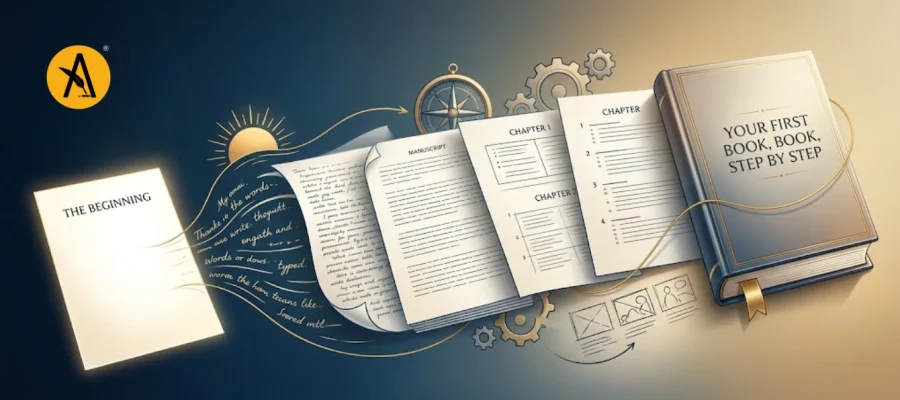
The Three Phases of Writing a Book
Every book, regardless of genre or length, passes through the same three phases:
Phase 1, Before You Write: Finding your idea, deciding what kind of book it is, understanding your reader, creating an outline, and building the writing habit that will carry you through.
Phase 2, The First Draft: Writing your way from page one to the end, managing self-doubt, dealing with writer’s block, and finishing, no matter how imperfect the draft feels.
Phase 3, Revising and Preparing for Publication: Stepping back from the draft, revising it into something worth reading, getting feedback, preparing the manuscript professionally, and deciding how to publish.
Understanding these phases prevents the most common beginner mistake: trying to write and edit simultaneously, or skipping Phase 1 and wondering why the draft collapses halfway through.
Phase 1: Before You Write, Decisions Every Beginner Must Make
Step 1: Find and Commit to Your Idea
The best book ideas are not the most original. They are the ones the author cares about most deeply, ideas that come from genuine experience, obsession, curiosity, or feeling.
Before committing to an idea, ask yourself four questions:
Is this an idea I could sustain for months? A novel takes anywhere from 6 months to 2 years to write. A non-fiction book can take 1 to 3 years to research and draft properly. You need an idea that will still matter to you after the initial excitement fades.
Do I have something genuine to say about this? The best books, in any genre, come from authors with a genuine perspective. Fiction writers who understand the world their characters inhabit. Non-fiction writers who have genuine expertise or experience. What do you know that others do not, or what angle on a familiar subject is authentically yours?
Can I describe it in one sentence? If you cannot articulate your book’s central idea in a single clear sentence, the idea may not yet be clear enough to write. For fiction: a specific character in a specific situation with a specific problem at stake. For non-fiction: a specific argument or insight for a specific reader.
Would I want to read this book? The reader you understand best is yourself. Write the book you have been looking for and could not find.
For Indian authors specifically: Some of the most powerful and underrepresented material for books in English comes directly from Indian experience, the specific dynamics of Indian families, the collision of tradition and modernity in urban life, regional history and mythology, the experience of migration and belonging, the particular moral texture of institutions (the bureaucracy, the army, the corporation) as they function in India. These are not niche subjects. They are rich material that no one else can write the way you can.
Step 2: Know What Kind of Book You Are Writing
Genre is not a cage, it is a contract with the reader. When someone picks up a thriller, they expect certain satisfactions: escalating tension, a crime to be solved or a threat to be neutralised, and a resolution. When someone picks up a romance, they expect an emotional journey toward love. When someone picks up a self-help book, they expect practical insight that will change how they behave or think.
Knowing your genre helps you understand the structure your book needs, the word count it should reach, what readers will expect, and which publishers to approach when the manuscript is done.
The major categories for first-time Indian authors in English:
Fiction: Literary fiction, commercial fiction, contemporary fiction, romance, mystery thriller, historical fiction, mythology fiction, science fiction and fantasy, young adult.
Non-fiction: Memoir, self-help and personal development, business and professional, spirituality and philosophy, narrative non-fiction, biography.
You do not need to place yourself in a single category, but you should know which shelf your book would sit on in a bookshop, and which readers you are writing for.
Step 3: Understand Your Reader
Your book is not for everyone. “Everyone” is not a reader, it is an abstraction. Before you write a word, form a clear picture of one specific person who will love your book: their age, what they read, what they worry about, what they want, why they would pick up your book, and what they need to get from it.
This mental model of your reader will help you make every decision in the writing process, the tone, the level of detail, which scenes to include, which arguments to develop, and when you are being self-indulgent versus genuinely serving the reader.
Step 4: Outline Before You Write
The single most common reason beginner authors abandon their books halfway through is that they run out of road, they reach a point where they do not know what happens next, or where the structure collapses, or where the original idea turns out not to have enough material for a full book.
An outline prevents this. It does not need to be elaborate. What it needs to do is ensure you know, before you start writing:
For fiction: Who the main characters are. What situation they are in at the story’s opening. What the inciting incident is, the event that disrupts the normal world and sets the story in motion. What the central conflict is and what is at stake. How the story escalates toward a climax. How it resolves.
For non-fiction: What the central argument or premise is. Who the intended reader is. What each chapter covers and how the chapters build toward the book’s conclusion. What the reader knows at the end that they did not know at the start.
Your outline is a living document, not a legal contract. It will change as you write, characters will surprise you, chapters will reorganise, arguments will sharpen. That is normal and good. What the outline does is prevent the total collapse that comes from having no map at all.
Step 5: Build a Writing Habit, Before You Need One
A book is not written in one burst of inspiration. It is written in hundreds of small sessions, often when you do not feel like writing, when the words feel wrong, and when other things seem more urgent.
The authors who finish their books are not the ones with the most talent. They are the ones with the most consistent habits.
Before you write your first chapter, decide:
When will you write? Mornings before work is the most common answer for working Indian authors, because the rest of the day has not yet eroded willpower and concentration. But early evening, late night, or lunch breaks work equally well, what matters is consistency.
How long will each session be? 30 minutes of focused, uninterrupted writing every day will complete a novel in roughly a year. 1 hour produces a first draft in 6 to 8 months. The number is less important than the daily commitment.
What is your daily word count target? 500 words per day is realistic for most working adults writing around a full-time job. 1,000 words per day accelerates the timeline significantly. Even 300 words per day, 3 to 4 paragraphs, adds up to a completed novel draft in under a year.
Where will you write? A specific, consistent writing space helps establish the habit, the mind begins to associate that space with focused work. It does not need to be a dedicated study; a corner of the bedroom, a specific café table, or a writing app on a phone can all serve this function.
Phase 2: Writing the First Draft
Step 6: Write the First Draft Without Editing
The single most destructive habit for beginner writers is editing while writing. Reading back what you wrote yesterday, revising it, improving it, and never actually moving forward. Authors who edit while writing often spend months “writing” the same first few chapters, never getting to the middle of their book.
The first draft exists for one purpose: to get the whole story or argument onto the page. It is not meant to be good. It is meant to exist.
Give yourself permission to write badly. A bad sentence can be revised. A blank page cannot.
Practical rules for the first draft:
Do not go back. When you sit down to write, start from where you left off. Do not read yesterday’s work. If you remember something that needs changing, make a note in brackets, [FIX: change Priya’s age to 28 in Chapter 2], and keep moving.
Write forward when you are stuck. If a scene is not working, skip it. Write “[SCENE NEEDED: Vikram confronts his father]” and continue with the next section. You can fill the gap in revision.
Keep the momentum. Momentum matters more than quality in the first draft. The feeling of consistent forward progress, of the book getting longer every day, is itself motivating. The moment you start editing backwards, momentum stops.
Step 7: Deal With Writer’s Block and Self-Doubt
Every writer who has ever finished a book has encountered the moment when the writing feels wrong, the idea seems stupid, the whole project seems like a mistake. This is not a sign that you should stop. It is a predictable phase in the writing process, and knowing it is coming is the best preparation for it.
When the writing feels wrong: Lower your standards deliberately. Write worse than you think you should. The draft does not need to be good, it needs to exist. Give yourself specific permission to write one terrible paragraph. Then another.
When the idea seems stupid: Return to why you started. What excited you about this book in the first place? What would it mean to have finished it? What would you want a reader to take from it?
When you do not know what happens next: Return to your outline. If the outline does not help, ask: what does my main character want most right now, and what is the worst thing that could happen to them? Write that thing happening.
When other obligations press in: Protect your writing time as you would protect any professional commitment. The people in your life who matter will support this, but you have to treat it as non-negotiable first.
For a deeper guide on managing the psychological challenges of writing, see our article on how to overcome writer’s block.
Step 8: Finish the Draft, No Matter What
This is the step that separates published authors from perpetual beginners. Every writing advice resource says it, and every writing advice resource is correct: finishing the first draft is the single most important thing you can do.
Nobody cares about the book you almost wrote. A finished draft, however imperfect, can be revised, improved, and eventually published. An unfinished draft is nothing.
When the end of your book feels impossibly far away, use two strategies:
Think smaller. Do not think about finishing the book. Think about finishing this chapter. This scene. This paragraph. This sentence. The book is made of sentences, and you only need to write one at a time.
Remind yourself that revision exists. Every problem you can see in your draft right now, the chapter that is too slow, the argument that is not quite right, the character who feels flat, can be fixed in revision. The only thing that cannot be fixed is an empty page.
Phase 3: Revising and Preparing for Publication
Step 9: Rest, Then Revise
When you finish your first draft, do not immediately start revising it. Put it away for at least two weeks, ideally four to six weeks, before reading it again.
This rest period is not optional. The purpose is to create enough distance between you and the draft that you can read it as a reader rather than as the writer who produced it. When you read it immediately after finishing, you read what you intended to write, not what you actually wrote. After rest, you read what is actually on the page.
When you return to the draft, read it from beginning to end without stopping to fix anything. Make notes in the margin, things that are not working, things that need more development, structural problems, characters who disappear, arguments that are not adequately supported. Then address the large structural problems first before moving to sentence-level prose.
Revision is typically done in multiple passes: structural revision first, then chapter-level revision, then scene-level, then prose. Do not try to fix everything at once.
Step 10: Get Feedback From Beta Readers
After your own revision, share the manuscript with three to five trusted readers from your target audience, people who read regularly in your genre and who will give you honest, specific feedback.
Beta readers are not proofreaders (who check grammar and spelling) or editors (who work professionally). They are readers who tell you whether the book works, whether the story is engaging, whether the argument is clear, whether the characters feel real, whether they kept reading or put the book down.
Ask specific questions: Where did you stop reading and have to push yourself to continue? What did you not understand? Which character confused you? What felt missing?
Incorporate the feedback that resonates with your own sense of the book. You do not need to act on every suggestion, but patterns across multiple readers (three people say Chapter 4 is slow; two say they do not understand the protagonist’s motivation) indicate real problems worth addressing.
Step 11: Professional Editing and Proofreading
Before submitting to a publisher or publishing independently, your manuscript needs professional editing and proofreading.
Copy editing addresses sentence-level clarity, grammar, consistency, and style. A copy editor is not rewriting your book, they are catching the errors, inconsistencies, and unclear sentences that inevitably accumulate in any long document.
Proofreading is the final pass for typos, punctuation errors, and formatting inconsistencies. It happens after all other editing is complete.
A manuscript full of grammatical errors signals to publishers that the author has not taken the work seriously. Whether you publish traditionally or independently, professional editing and proofreading are non-negotiable for a book you want readers to take seriously.
Step 12: Decide How to Publish
Once your manuscript is complete, revised, and professionally edited, you face the final decision: how to publish it.
Traditional publishing: A traditional publisher, including Anecdote Publishing House, selects your manuscript, funds all production (editing, design, printing, distribution), and pays you royalties. Zero cost to the author. The selection process is competitive, but most Indian traditional publishers accept direct submissions without requiring a literary agent, which means you can approach them directly.
Traditional publishing is the right choice for most first-time authors who want professional validation, national bookshop distribution, and the support of an editorial team without bearing financial risk.
Self-publishing: You fund and manage all production yourself (typically Rs. 30,000 to Rs. 1,50,000 for professional quality), retain full creative control, and distribute primarily through Amazon KDP and other digital platforms. Higher royalty percentage per copy, but distribution is primarily digital and online.
For first-time Indian authors, we recommend submitting to traditional publishers first. If your manuscript is strong and well-prepared, traditional publishing offers the most supportive path to a professionally published book at zero financial risk.
To learn more about how to submit your manuscript to Indian publishers, see our complete guide on how to publish a book in India.
Word Count Guide for First-Time Indian Authors
One of the most common questions from beginner writers is how long their book should be. These are the standard word counts for each major genre:
| Genre | Minimum Word Count | Standard Word Count | Maximum |
| Literary fiction | 70,000 | 80,000 – 100,000 | 120,000 |
| Commercial fiction | 60,000 | 75,000 – 90,000 | 110,000 |
| Romance | 50,000 | 60,000 – 80,000 | 100,000 |
| Mystery thriller | 60,000 | 70,000 – 90,000 | 110,000 |
| Young adult | 50,000 | 60,000 – 80,000 | 90,000 |
| Self-help | 30,000 | 40,000 – 60,000 | 80,000 |
| Memoir | 50,000 | 60,000 – 90,000 | 100,000 |
| Business / non-fiction | 25,000 | 40,000 – 60,000 | 80,000 |
| Spirituality / philosophy | 30,000 | 40,000 – 70,000 | 90,000 |
A manuscript significantly shorter than the minimum or longer than the maximum for its genre is a red flag for publishers. If your draft is very short, ask whether you have adequately developed your characters, scenes, and argument. If it is very long, look for material that is not earning its place.
Frequently Asked Questions
1. How long does it take to write a book?
For most first-time authors writing around a full-time job, a complete first draft takes 6 months to 18 months. The full process, including revision, beta reader feedback, and professional editing, typically takes 1 to 3 years before a manuscript is ready to submit to publishers. Authors who write full-time can compress this significantly. The most important factor is not speed but consistency: a daily writing habit of even 30 minutes produces a book far faster than occasional writing marathons.
2. How many words should I write per day?
500 words per day is a realistic daily target for most beginners writing around a full-time job. At 500 words per day, 5 days per week, you will complete a 70,000-word first draft in approximately 6 months. 1,000 words per day halves that timeline. The number matters less than the consistency, writing every day, even briefly, is more productive than writing in large irregular bursts.
3. Do I need to have a story fully planned before I start writing?
Not fully, but you need to know enough to avoid collapsing halfway through. There are two broad types of writers: outliners (who plan in detail before writing) and pantsers (who discover the story as they write). Most successful authors are somewhere between the two. For a beginner, a basic outline, the central premise, key characters, major plot points, and roughly how the story ends, provides enough structure to complete a first draft without getting lost.
4. What should I do if my writing feels bad?
Keep writing. The first draft is supposed to be imperfect, its purpose is to exist, not to be good. Every published author has written first drafts they found embarrassing. The quality of a finished book has almost nothing to do with the quality of the first draft, it has to do with the quality of the revision. Bad writing can be fixed. A blank page cannot.
5. Do I need special software to write a book?
No. A book can be written in any word processor, Microsoft Word, Google Docs, and LibreOffice are all perfectly adequate. Specialist writing software like Scrivener offers useful organisational tools (scene-by-scene structure, research organisation, word count tracking by chapter) and may help authors who find managing a long document in a standard word processor difficult. But the software does not write the book. The writer does.
6. Should I show my writing to people while I am still writing the first draft?
Generally, no. Sharing early drafts with readers before the book is complete exposes work to feedback that cannot yet be addressed, and premature feedback often discourages writers from continuing. Finish the first draft, revise it yourself, and then share it with trusted beta readers. The exception is a writing group or workshop where the expectation is specifically to share work-in-progress for developmental feedback.
7. How do I know when my manuscript is ready to submit to publishers?
Your manuscript is ready to submit when it is complete (not a partial draft), revised through multiple passes, read by beta readers whose feedback you have incorporated, professionally copy edited and proofread, and formatted to industry standard. There is no perfection in manuscript preparation, at some point, further revision produces diminishing returns. Submit when you have done everything you can with it.
8. Can I write a book while working a full-time job?
Yes, and most first-time authors do. The key is a consistent daily writing habit, even if each session is brief. 30 to 45 minutes of focused writing before work, during lunch, or after the household quiets down in the evening adds up over months to a completed first draft. The challenge is treating this time as non-negotiable rather than as something you do when everything else is done.
9. What do Indian publishers look for in a first manuscript?
Indian publishers evaluate first manuscripts on the same criteria as all manuscripts: a compelling premise, well-developed characters or clear argument, genre-appropriate structure and pacing, and writing quality that demonstrates genuine craft and multiple revisions. Your debut status matters less than the quality of the work. For a detailed guide, see our article on what publishers look for in a manuscript.
10. What should I do after I finish writing my book?
After completing and revising your manuscript, the next step is preparing your submission package, a query letter, synopsis, and sample chapters, and submitting to publishers who publish in your genre. Anecdote Publishing House accepts direct submissions from debut and established authors across fiction, non-fiction, self-help, romance, mystery thriller, young adult, spirituality, family and relationship, contemporary fiction, and society and culture. We publish at zero cost to the author, distribute to over 100 bookshops across India, and provide full editorial, design, and PR support. Submit your manuscript for a free consultation.
Begin
The best moment to start writing your book is now. Not when you have more time, a better idea, a quieter house, or a more confident sense that you can do it. Now.
Every published Indian author, from Chetan Bhagat writing his first novel while working at a bank to Amish Tripathi writing The Immortals of Meluha while running a family business, started with a blank page and a decision to fill it. That decision is the entire difference between the published and the unpublished.
When your manuscript is written, revised, and ready, Anecdote Publishing House is here. We are a traditional publisher based on Ansari Road, Daryaganj, Delhi, we publish at zero cost to the author, distribute to over 100 bookshops across India, and provide full editorial, design, and PR support.