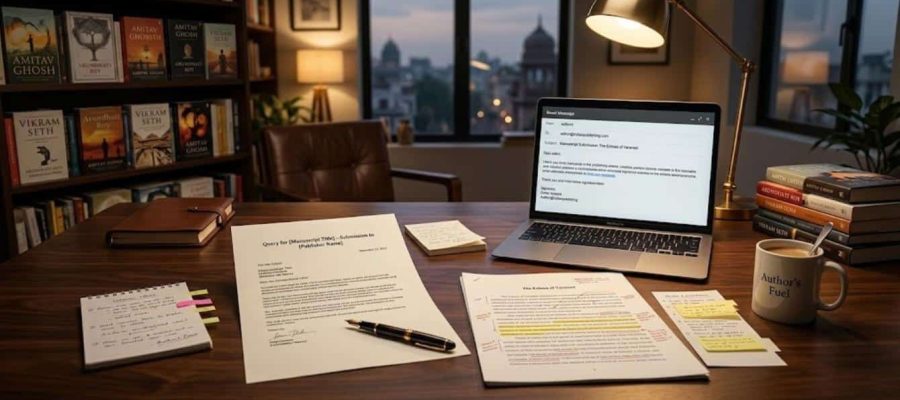
Before an editor reads a single page of your manuscript, they read your query letter. This one document, rarely longer than a single page, determines whether your manuscript receives the attention it deserves. A brilliant manuscript with a poorly written query letter will not be read. A well-written query letter for an equally strong manuscript will.
This is not a comfortable truth for writers who have spent months or years working on a book, only to discover that the first real test of that work is a 250-word letter. But it is the reality of how traditional publishing in India, and internationally, works. Understanding the query letter, what it must accomplish and how to write one that does, is the starting point for any author who wants to pursue publication with a traditional house.
At Anecdote Publishing House, every submission we receive begins with a query. We read each one. What follows in this guide is drawn from the experience of reading queries across genres and from editorial conversations about what makes a submission package compelling.
A query letter is a formal, professional introduction of you and your manuscript to a publisher or literary agent. It is typically one page in length, single-spaced, and contains specific information about the manuscript, the author, and the reason this publisher is the right home for the work.
What a query letter is not: a summary of every theme in your book; a place to explain how long you spent writing it; an opportunity to include praise from people who know you; a cover letter in the conventional sense; or a document that should run to two or more pages regardless of how much you feel needs to be said.
The purpose of the query letter, in its most precise definition, is not to secure a publishing contract. It is to earn the right to have your manuscript read. Nothing more. If the query is compelling, the manuscript will be requested. The manuscript then has to do the work of securing the contract.
This distinction matters because it changes how you approach the letter. You are not trying to explain the entire book. You are trying to make an editor want to read it.
The answer to this question is specific and not negotiable: write a query letter when your manuscript is complete and fully revised.
Not when you are eighty per cent through the first draft. Not when the manuscript is done but you plan to do one more round of edits next month. Not when the story is finished but several characters still feel underdeveloped.
When you query, you are telling a publisher that this manuscript is ready to be considered for publication. If a publisher reads your query and requests the full manuscript within the hour, you must be able to send it. It must be your best work as it currently stands.
The practical reason for this is straightforward. Editors are busy professionals who read queries and manuscripts in addition to their other editorial responsibilities. If they request a manuscript and you tell them it will be ready in another few weeks, their enthusiasm for the work will have moved on. If you send a manuscript that is not yet at the standard your query implied, the relationship begins with disappointment.
This is also why the quality of the manuscript matters more than the quality of the query letter. A query letter can only create an opportunity. The manuscript must fulfil it.
Every query letter sent to a traditional publisher in India should contain four components. These do not have to appear in a fixed order, but all four must be present.
The hook is the opening of your query, and it must capture the editor’s attention immediately. There are several approaches that work.
You can open with a logline, a single sentence that captures the essential premise of the manuscript. You can open with a compelling question that the manuscript answers. You can open with a brief, striking observation about the subject of the book. What you should not do is open with a biographical introduction of yourself, a statement about how long you have been writing, or a generalisation about the market for books like yours.
A strong hook for a literary novel about partition might read: “A family divided by the border of 1947 must find each other across the distance of fifty years and two countries.” A strong hook for a narrative non-fiction work might read: “For three generations, one family in rural Rajasthan has carried the same secret, and their story reveals how caste shapes inheritance in ways no law has yet addressed.”
The hook does not summarise the book. It makes the reader want to know what happens.
This paragraph, typically the longest in the query letter, tells the editor what the book is about. For fiction, it introduces the central character, the conflict that drives the narrative, and the stakes of that conflict. It does not summarise every plot development or reveal the ending. For non-fiction, it articulates the central argument or question of the book, the evidence or narrative through which it is explored, and why that exploration matters.
The book paragraph should be between 100 and 200 words. It must be written in the same voice as the manuscript. If your novel has dark, lyrical prose, the book paragraph should have the same quality. If your non-fiction work is clear and direct, the book paragraph should be clear and direct.
At the end of the book paragraph, include the practical details: the title of the manuscript in full capitals, the genre, and the word count. For example: “THE WEIGHT OF WATER is a work of literary fiction, complete at 82,000 words.”
The author paragraph introduces you. It should be brief, two to four sentences at most, and should include only information that is relevant to the manuscript or to your credibility as a writer.
If you have publishing credits, name them. If you have won a writing award or been shortlisted for one, mention it. If you have professional expertise that directly informs the subject matter of a non-fiction work, state it. If you hold a degree in a field relevant to the manuscript, you may include it.
What you should not include: the fact that your friends and family love the book; information about your non-literary professional background unless it is directly relevant; how many years you have been writing; or a detailed account of what inspired you to write this particular book. The inspiration belongs in the manuscript, not the query letter.
If this is your first manuscript and you have no publishing credits, say so simply and move on. Every published writer began without credits. Editors know this.
The final element of a query letter is a sentence or two explaining why you are submitting to this particular publisher. This is not obligatory in every submission, but it is always appreciated and, when done well, is the element that most clearly distinguishes a researched submission from a mass mailing.
Meaningful personalisation references something specific: a book in the publisher’s catalogue that is in conversation with yours; a public statement by an editor about what they are looking for; the publisher’s stated editorial identity and how your manuscript speaks to it.
What is not meaningful personalisation: “I think my book would be perfect for your list”; “I have been following your publishing house for a long time”; “I read your submission guidelines carefully.” These statements tell the publisher nothing they do not already know.
At Anecdote Publishing House, we value submissions that demonstrate an understanding of our editorial identity: depth, originality, and lasting relevance. A query that articulates why a specific manuscript speaks to those values tells us the author has engaged with who we are as a publisher.
The query letter should be formatted as a professional business document. Font: Times New Roman or Arial at 12 points. Spacing: single. Length: no more than one printed page, or approximately 200 to 400 words.
Send the query letter in the body of the email, not as an attachment, unless the publisher’s submission guidelines specify otherwise. The subject line of the email should follow the format specified in the guidelines. If no format is specified, use: Query | Title | Genre.
Address the query to a specific person wherever possible. “Dear Editorial Team” is acceptable where no specific name is provided. “Dear Sir/Madam” sounds impersonal and dated. If the publisher’s guidelines name a specific editor who handles submissions in your genre, address the query to that editor by name.
Comparable titles, often referred to as comp titles, are books that are similar to your manuscript in genre, tone, or theme, and which have been published and sold within the past three to five years. Including them in your query is a way of helping the publisher understand where your book sits in the market and how it might be positioned and sold.
Good comp titles are books that have found a readership and that your manuscript genuinely resembles in meaningful ways. They are not necessarily your favourite books, or the books you most admire, or the most prestigious books in your genre.
A useful form for comp titles in a query is: “For readers of [Book] and [Book], [Your Title] explores…” This positions the manuscript within an existing readership rather than simply citing famous titles by association.
Avoid comparing your manuscript to books published more than five years ago, as these do not reflect the current market. Avoid comparing your manuscript to the most famous or commercially dominant books in a genre. Avoid listing more than two or three comp titles.
If no precise comp titles exist for your manuscript, it is better to omit them than to force comparisons that do not reflect the work accurately.
Writing more than one page. The query letter is one page. Publishers receive large volumes of submissions. A two-page query is not more informative; it suggests the author does not understand professional publishing practice.
Summarising the entire plot. A query letter is not a synopsis. Every plot development, every character, every twist in a 90,000-word novel cannot and should not be described in a one-page letter. Choose the essential elements and make them compelling.
Including unsolicited materials. If the guidelines ask for a query letter and sample chapters, send a query letter and sample chapters. Do not add a full synopsis, a marketing plan, a list of planned sequels, or cover art ideas that were not requested.
Addressing the query to no one, or to “whom it may concern.” Research the publisher. Find the correct address and the correct contact person wherever possible.
Describing the manuscript as unique. Every query letter describes the manuscript as unique. This word has been emptied of meaning in the context of query letters. Show the editor what is distinctive about the work through the book paragraph, not through adjectives applied to the manuscript itself.
Mentioning that the book has been rejected elsewhere. A history of rejections from other publishers is not relevant to the current submission and should not be included.
Including praise from non-publishing professionals. The fact that your writing group, your family, or your colleagues find the manuscript compelling is not a relevant credential in a query letter to a professional publisher.
Not following the submission guidelines precisely. Every publisher publishes submission guidelines for a reason. Ignoring them signals that you either did not read them or did not consider them important. Neither impression is useful.
Dear [Editor’s Name],
[Opening hook: one to two sentences that capture the essential premise of the manuscript or open with a compelling observation.]
[Book paragraph: 100 to 200 words introducing the central character or argument, the conflict or question at the heart of the work, and the stakes. Conclude with the title in full capitals, genre, and word count.]
[Author paragraph: two to four sentences about the author’s relevant credentials, publishing history, or professional expertise. If no credits exist, a single sentence acknowledging this and moving on is sufficient.]
[Personalisation: one to two sentences explaining why this publisher is the right home for this manuscript, with specific reference to the publisher’s catalogue or editorial identity.]
I have included [materials requested in the submission guidelines] as part of this submission. Thank you for your time and consideration. I look forward to hearing from you.
Sincerely, [Full Name] [Contact Information]
| Section | Purpose | Approximate Length |
|---|---|---|
| Hook | Captures editorial attention immediately; establishes the essential premise | One to two sentences |
| Book Paragraph | Describes the manuscript: central character or argument, conflict, stakes, genre, word count | 100 to 200 words |
| Author Paragraph | Introduces the author: relevant credentials, publishing credits, professional expertise | Two to four sentences |
| Personalisation | Explains why this publisher is the right home for this manuscript | One to two sentences |
| Closing | Professional, brief, references materials included | Two to three sentences |
| Total Length | Entire query letter | 200 to 400 words, one page maximum |
Response times from Indian publishers vary significantly. Most major publishers indicate a response window of eight to twelve weeks. Some take longer. If no timeline is specified in the submission guidelines, a single polite follow-up after three months is professionally acceptable.
A response may take one of four forms. The first is a request for the full manuscript or for additional materials, which means the query has done its job. The second is a personalised rejection, which is rare and represents genuine editorial engagement with your work. The third is a standard form rejection. The fourth is silence beyond the stated response window, which most publishers’ guidelines acknowledge as indicating they will not be proceeding.
In each case, the manuscript remains yours. It may be revised and submitted elsewhere. The query letter may be revised and strengthened for subsequent submissions. The process of finding the right publisher for the right manuscript requires patience and persistence. Both are professional qualities in the same way that craft is a professional quality.
A query letter is a one-page professional document sent to a publisher or literary agent to introduce a manuscript and request that it be considered for publication. It contains a brief description of the book, information about the author, and a reason the author is submitting to this particular publisher.
One page, single-spaced, between 200 and 400 words. No longer. Publishers and agents read a very high volume of queries; brevity signals professionalism.
Follow the specific submission guidelines of each publisher. Some publishers request a query letter and sample chapters. Others accept direct manuscript submissions with a covering letter. Never send materials that were not requested.
For non-fiction, the book paragraph should articulate the central argument or question of the work, the evidence or narrative through which it is explored, and why it matters to the reader. Include any professional expertise or research credentials that are directly relevant to the subject matter. A non-fiction submission may also be accompanied by a detailed book proposal.
Yes. Simultaneous submissions are standard practice in Indian publishing. If your manuscript is offered by another publisher while under consideration elsewhere, it is considered professional practice to notify all publishers currently reviewing the submission.
A comp title, short for comparable title, is a published book that is similar to your manuscript in genre, tone, or theme. Including one or two comp titles helps the publisher understand where your book sits in the market. Choose books published within the past three to five years that have found a readership and that genuinely resemble your manuscript.
No. Many traditional publishers in India accept direct submissions from authors without requiring literary agent representation. A query letter is the appropriate first step for both direct submissions and agent queries. Check each publisher’s submission guidelines for their specific requirements.
Do not include: praise from people who are not publishing professionals; a history of rejections from other publishers; a marketing plan unless it has been requested; a detailed account of the inspiration behind the book; a comparison of your manuscript to the most famous books in your genre; or any materials that were not specified in the submission guidelines.
Briefly acknowledge that this is your first manuscript, then focus the author paragraph on any professional expertise relevant to the manuscript’s subject matter. Many debut authors have no publishing credits. Editors know this. The quality of the manuscript is the primary consideration.
Yes. Anecdote Publishing House accepts manuscript submissions that include a query letter and sample materials. Our submission guidelines are available on our website. We consider manuscripts that offer depth, originality, and lasting relevance.
The publisher’s editorial team reads the query. If the manuscript is of interest, they will request the full manuscript or additional sample materials. If not, they will send a decline. Response times vary from eight weeks to several months depending on the publisher. Do not follow up before the stated response period has elapsed.
A query letter is a one-page pitch that introduces the manuscript and makes the case for why the publisher should read it. A synopsis is a full narrative summary of the manuscript, including the ending. Both are usually required, but they serve different purposes and should be prepared as separate documents.
The query letter is not the enemy of the writer. It is a skill, and like every other skill in writing, it improves with practice and careful attention to craft. The writer who approaches the query letter with the same seriousness they brought to the manuscript itself will produce a document that gives the work the best possible chance of reaching the reader it was written for.
If you have completed a manuscript that you believe in and that you have revised to the highest standard you are capable of, the query letter is the final act of professionalism before the manuscript takes over. Write it with care. Address it to the right person. Follow the guidelines precisely. Send it.
At Anecdote Publishing House, we look forward to reading your submission. Our guidelines for manuscript consideration are available on our website.
Anecdote Publishing House is a traditional literary publisher headquartered in Delhi, established in January 2021 by Sagar Azad. Sagar Azad is a recipient of the Young Achievers Award (2021), the Icons of Asia Award for Young Entrepreneur of the Year (2022), and the Pride of Nation Award for Best Startup in Literature and Book Publishing Industry (2023). The publishing house publishes Indian and international authors across print, e-books, and audiobooks.