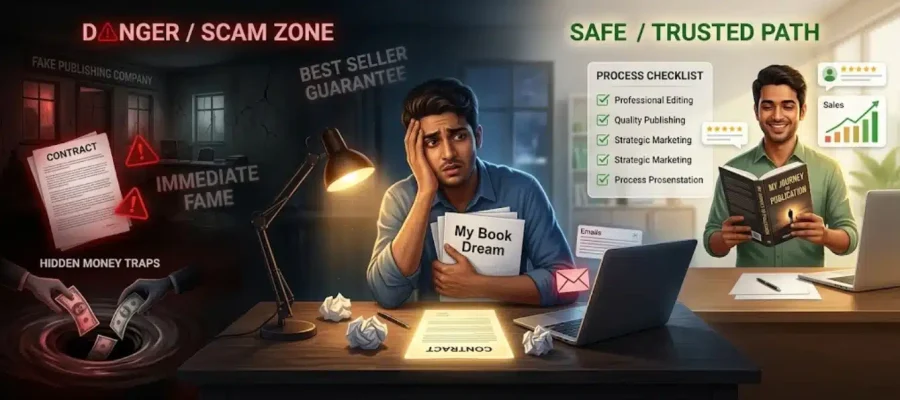
Aspiring authors are among the most frequently targeted victims of commercial fraud. The dream of seeing your name on a published book is powerful, and publishing scammers understand this better than anyone.
The publishing industry in India has expanded enormously over the past decade, bringing genuine opportunity for authors alongside a significant increase in the number of companies designed to exploit rather than serve them. These companies earn their revenue not from selling books to readers, but from extracting fees from authors, often using the language of legitimate publishing to do it.
This guide explains every major type of publishing scam, the specific warning signs that identify each one, and the questions you should ask before giving any company your manuscript or your money.
The One Rule That Protects You From Almost Everything
Before examining specific scam types, there is a single principle that cuts through most of the complexity:
Money flows toward the author in legitimate publishing. If money flows away from you before your book sells, investigate very carefully.
In traditional publishing, the publisher pays you, in the form of royalties and sometimes an advance. In legitimate self-publishing platforms (Amazon KDP, Pothi.com, Draft2Digital), you pay nothing upfront and the platform earns a percentage of sales. Professional services companies (editors, cover designers) charge you for specific services at market rates.
The companies that exploit authors are those that present themselves as publishers but earn their money from author fees rather than book sales. Their business model does not depend on your book selling, they profit regardless of outcome. This is why they accept almost any manuscript, invest minimally in production quality, and have no incentive to genuinely market or distribute your book.
The principle “money flows toward the author” does not mean that every company that charges fees is a scam. Professional editors, cover designers, and formatters charge for their services legitimately. Reputable self-publishing companies offer transparent, itemised service packages. The distinction is whether fees are associated with genuine, quality-controlled professional services, or whether they are extracted through misleading representations of what the company is and what it will do for you.
Scam Type 1: Vanity Presses Pretending to Be Traditional Publishers
A vanity press is a company that charges authors fees to publish their manuscripts. Unlike legitimate self-publishing platforms (which charge nothing upfront and earn through sales), vanity presses present themselves as publishers while actually selling services to authors.
The defining characteristic of a vanity press is that it accepts any manuscript regardless of quality, because its income comes from author fees, not from sales. Quality control is irrelevant to its business model.
How Vanity Presses Approach Indian Authors
Vanity presses in India often contact authors directly, by phone, email, or social media, with enthusiastic praise for a manuscript they could not possibly have evaluated. Common approaches include:
- Cold phone calls claiming to be from a well-known publisher or a company “associated” with one
- Emails praising your blog, social media posts, or previously published writing and expressing interest in publishing your “next book”
- Claims of having discovered your manuscript through a third party or writing community
Once contact is made, the pitch escalates: your manuscript has “great potential,” you are exactly the type of voice the market needs, they are accepting a limited number of new authors. Then comes the request: to proceed, you need to pay for editing, production, marketing, or a “contribution toward costs.”
The Loadstar Example
Writer Beware has documented multiple Indian authors losing significant sums to companies in India. One reader reported: “Don’t publish with Loadstar. They take 95K from you and forget about your book. The word forget is in the literal sense of the word.” This type of complaint, company takes large upfront fee, delivers minimal service, becomes unavailable, is the standard pattern of vanity press exploitation.
Red Flags for Vanity Presses Posing as Traditional Publishers
- They contacted you without you submitting your manuscript
- They praise your manuscript with unusual enthusiasm without having properly evaluated it
- They claim to be a “traditional” publisher but ask for any payment before publication
- They make decisions about publishing your book extremely quickly, sometimes within days of first contact
- They cannot provide physical copies of books they have previously published
- Author reviews online mention poor quality, hidden fees, or difficulty reaching anyone after payment
For a full breakdown of what legitimate publishing costs vs. what vanity services charge: see our guide to how much it costs to publish a book in India.
Scam Type 2: “Hybrid” Publishers That Are Actually Vanity Presses
“Hybrid publishing” is a legitimate model in which author and publisher share costs and profits, with the publisher providing professional services, distribution, and marketing in exchange for the author’s investment. However, the term “hybrid publisher” is also routinely used by vanity presses as a rebranding strategy to sound more legitimate.
The distinction between a genuine hybrid publisher and a vanity press using “hybrid” language is:
A genuine hybrid publisher: Vets manuscripts (does not accept everything), provides professional editorial and design services at a demonstrable quality level, has genuine distribution relationships, and earns from book sales as well as from the author’s upfront contribution.
A vanity press calling itself hybrid: Accepts all manuscripts, provides minimal or outsourced-to-the-lowest-bidder production quality, does not have meaningful bookstore distribution relationships, and earns almost entirely from author fees.
Warning Signs That a “Hybrid” Publisher Is a Vanity Press
- They accept your manuscript with minimal or no evaluation
- They cannot show you physical copies of previously published books at a professional quality
- Their “distribution” consists of listing your book on Amazon India, which any author can do themselves for free
- Authors who have published with them report poor communication after payment, substandard production quality, and minimal sales
- There is no reversion clause in the contract, you cannot get your rights back if the company fails to deliver
As Writer Beware has documented, companies including PublishEdge (operated by Zaang Entertainment Pvt Ltd, based in India) have used misleading comparisons with traditional publishing and charged for services while delivering minimal value.
Scam Type 3: Fake or Predatory Literary Agents in India
Literary agents act as intermediaries between authors and publishers, evaluating manuscripts and representing authors in contract negotiations. Legitimate agents earn a commission on book sales, typically 15%, and only make money when you do. They never charge reading fees, submission fees, or any upfront payment.
In India, a well-documented pattern of predatory “literary agencies” has emerged, as tracked by Writer Beware.
The Purple Folio Pattern
Writer Beware documented widespread author complaints about Purple Folio, an Indian literary agency that charged upfront fees and failed to deliver promised results. One Indian author reported: “Unfortunately I am one of the aspiring Indian authors who has been duped of Rs 20,000 as an upfront payment by a literary agency. The lady kept telling me that she had sent my manuscript to so many publishers.” Another reported: “After reading my manuscript the lady asked me to pay Rs 40,000 for editing.”
The Book Bakers Pattern
Writer Beware documented that The Book Bakers, an Indian literary agency, charges an upfront fee (documented at Rs. 16,000), which is highly nonstandard practice. The same documentation notes that the agency signed authors without properly reading their submissions, and that several authors reported they were not connected with publishers after paying.
Red Flags for Predatory Agents in India
- They charge any upfront fee, reading fees, submission fees, editing fees, assessment fees
- They accept your work quickly without requesting the full manuscript or properly evaluating it
- They cannot name publishers they have successfully placed books with
- Authors who have worked with them cannot be contacted for independent verification
- They provide vague updates about submission activity without specific publisher names and dates
- They offer to refer you to editors or designers for an additional fee, this is a financial conflict of interest
The rule: Legitimate literary agents earn their income from commissions on book deals. If an agent charges you any fee before a book deal is made, they are not operating as a legitimate literary agent.
Scam Type 4: Manuscript Assessment and Editing Scams
Professional editing is a genuine and important service. The scam version uses the language of professional editing to extract fees for low-quality or non-existent work, often as a gateway to subsequent publishing fees.
How This Scam Operates
An author submits their manuscript to what appears to be an agent or traditional publisher. Rather than a decision about publication, they receive an enthusiastic response explaining that the manuscript has “great potential” but needs professional editing before it can be considered, conveniently offered by the same company for a substantial fee.
After paying, the author receives either minimal editing work, a generic report that could apply to any manuscript, or editing from an unqualified contractor. The original publication offer then either disappears or leads to another round of fees.
Warning Signs
- An “agent” or “publisher” who praises your manuscript and then refers you to editing services, collecting a referral fee or charging for their own editing arm
- An offer to publish contingent on completing their paid editing first
- Editing quotes that are dramatically below market rates, suggesting outsourcing to unqualified contractors
- No sample edit offered before payment is requested (reputable editors provide sample edits of the first 10 pages so you can assess their work)
Scam Type 5: Book Marketing and Promotion Scams
Marketing scams target authors after publication, typically promising specific results, sales targets, bestseller rankings, review counts, in exchange for substantial fees.
Common Book Marketing Scam Types
Guaranteed bestseller packages: No company can guarantee bestseller status or a specific number of sales. Amazon bestseller rankings are a measure of relative sales velocity in a category, not absolute sales volumes, and they change hourly. Any company that “guarantees” bestseller status is making a promise they cannot keep.
Paid review services: Reviews that are purchased violate Amazon’s terms of service and can result in your account being suspended. Legitimate review-building involves sending advance reading copies to genuine readers and asking for honest reviews.
“Exclusive” book club features: Some companies claim to feature your book to tens of thousands of book club members for a fee. As documented by Kharis Publishing’s warning guide, these clubs often have inflated follower counts with zero genuine engagement, followers that are fake and will not purchase your book.
Press release services with inflated claims: A press release to 400 “media outlets” sounds impressive until you discover those outlets consist of obscure wire services that no journalist reads. Genuine PR for a book involves building relationships with books editors at specific publications and pitching individually.
Social media promotion services claiming large followings: Verify engagement, not follower counts. A social media account with 100,000 followers and zero comments on posts has a fake following that will not drive any meaningful book sales.
Red Flags for Marketing Scams
- Guaranteed sales targets or guaranteed bestseller status
- Upfront fees with no trackable metrics or outcome reporting
- “Exclusive” opportunities with artificial urgency and pressure to decide immediately
- Large claimed audiences with no verifiable engagement or author testimonials who can be independently contacted
Scam Type 6: Contract Traps and Rights Grabs
Even with a legitimate-seeming publisher, a contract can contain clauses that permanently damage your interests. Understanding the key clauses to look for protects you regardless of which publisher you work with.
The “Life of Copyright” Trap
Some contracts grant the publisher rights to your book for “the life of the copyright”, meaning your book’s entire 70+ year copyright period. A legitimate traditional publishing contract limits the license to a specific period (typically 3 to 10 years) or until specific conditions are met.
Always look for: A clear reversion clause specifying when rights return to you, typically when the book goes out of print, when sales fall below a minimum threshold, or after a specific period.
The “All Rights” Trap
Some contracts grant “all rights” in “all formats in all territories forever.” A legitimate contract specifies which rights are licensed (print rights, eBook rights, audio rights), in which territories (India, South Asia, worldwide), and for how long.
Always look for: Specific enumeration of the rights being licensed. Rights not listed should remain with you.
The ISBN Ownership Trap
If the publisher registers the ISBN in their name rather than yours, they control the book’s commercial distribution. If you leave the publisher, the book’s distribution history is tied to their ISBN, you would need to create a new edition with a new ISBN to republish independently.
Always look for: Confirmation that your ISBN will be registered in your name as the author.
The “No Royalty Statement” Trap
Some contracts do not specify when or how royalty statements will be provided. Without clear terms, publishers can delay or obscure sales reporting indefinitely.
Always look for: A specific royalty payment schedule (quarterly, bi-annually) and a right to request an audit of sales records.
Getting Contract Help in India
Before signing any publishing contract, seek independent review. Options for Indian authors include:
- The Society of Authors (UK), available to international members for contract review
- Independent literary lawyers in India who specialise in publishing contracts
- Published author communities who can share their contract experiences informally
Scam Type 7: AI-Generated Solicitation Emails
A growing pattern documented by Writer Beware involves highly personalised emails that appear to come from editors at major publishers, expressing interest in an author’s work and asking whether they have representation.
These emails are generated using AI tools that scrape author information from social media, Goodreads, Amazon author pages, and writing communities, producing messages that quote your actual book title, mention specific characters, or reference your writing bio. The personalisation makes them appear credible when they are in fact scam solicitations.
Major publishers like Penguin Random House, HarperCollins, Hachette, and others do not send unsolicited emails to authors whose manuscripts have not been submitted through official channels. Any email expressing interest in your work that you did not initiate through a submission should be treated with significant scepticism and verified through the publisher’s official website before any response.
What to Do If You Receive a Suspicious Solicitation
- Do not respond with personal details, manuscript files, or contact information
- Verify the sender’s email domain against the publisher’s official website
- Search “[Publisher name] + [editor name]” to confirm the person exists in the role claimed
- Contact the publisher’s official submissions team through their website to verify whether the communication is legitimate
- Report suspicious emails to Writer Beware so other authors can be warned
Scam Type 8: Predatory Anthology and Writing Contest Schemes
Anthology scams invite authors to contribute a short story or poem to a “prestigious” anthology, then charge a fee to receive the published copy, or to have your contribution “featured” more prominently. The anthology itself is typically produced at minimal cost with the fee income from contributors providing the profit.
Writing contest scams charge entry fees for competitions with fictitious prizes, judged by judges who do not exist, with “winning” notifications sent to most or all entrants, followed by an offer to publish the “winning” work for a fee.
Red Flags for Anthology and Contest Scams
- You are invited to submit without having entered the competition
- Every entrant receives a “winner” or “highly commended” notification
- The prize is publication rather than a cash payment
- Receiving the published anthology or your recognition requires paying a fee
- The contest organisers cannot be independently verified
- The anthology publisher is the same company promoting the contest
The 10-Point Due Diligence Checklist Before Signing With Any Publisher
Before agreeing to any publishing arrangement, traditional, self-publishing service, or hybrid, complete this checklist:
1. Does money flow toward you or away from you? A traditional publisher pays you. If any publisher asks you to pay them to publish your book, you are dealing with a paid service, investigate whether it is legitimate and fairly priced.
2. Can they show you physical copies of previously published books? Ask to hold and examine books they have recently published. Quality problems that look acceptable on screen are often visible in print.
3. Who owns the ISBN? Your ISBN must be registered in your name. If it is in the publisher’s name, you lose distribution freedom.
4. What does the reversion clause say? There must be a clear, specific, enforceable mechanism for rights to return to you if the publisher fails to meet its obligations.
5. Can you independently verify author testimonials? Contact authors listed on their website directly, not through the publisher’s provided links. Ask for honest accounts of the experience.
6. What is their actual distribution? “Listed on Amazon” is not distribution. Ask: which physical bookstores stock their books? Can you visit one and verify?
7. Are their royalty terms transparent and in writing? Royalties should be specified as a clear percentage of a clearly defined base (MRP, net receipts, etc.), paid on a specific schedule, with a right to audit.
8. Is there a clear refund policy if they fail to deliver? Any service contract should specify what happens if the company does not deliver the promised services.
9. Have they been flagged by Writer Beware or the Alliance of Independent Authors (ALLi)? Search “[Company name] + Writer Beware” and “[Company name] + ALLi” before agreeing to anything. These organisations maintain independent watchdog databases.
10. Have they been reviewed honestly by authors on independent platforms? Search for reviews on Google, Goodreads, and author communities on Reddit and Facebook. Filter for recent reviews. A pattern of similar complaints, poor quality, missing royalties, unavailable after payment, is conclusive.
Anecdote Publishing House is a traditional publisher, we never charge authors. If you’d like a free, no-obligation review of your manuscript: submit your manuscript to Anecdote.
Is Book Publication in India Real or Fake? How to Tell the Difference
Legitimate book publication in India is real, well-established, and has been happening for over a century. Publishers like Anecdote Publishing House publish thousands of Indian authors every year, with genuine editing, genuine printing, and genuine distribution to bookshops across the country.
The scam risk comes from predatory companies that use publishing language, ‘publisher’, ‘publishing house’, ‘independent publisher’, ‘hybrid publisher’, to describe what is essentially a paid printing or document-formatting service with no real editorial selection and no real distribution.
The Three Tests for a Real Publisher
Test 1: The Money Test: Does the publisher ask you for money? A real traditional publisher never does. If you are asked to pay anything — for editing, for design, for printing, for a ‘package’ — you are not dealing with a publisher.
Test 2: The Distribution Test: Can they name specific bookshops where your book will be physically stocked? ‘Available on Amazon’ is not distribution. Real distribution means a physical book on a physical shelf in a store that customers walk into.
Test 3: The Author Test: Can you speak to an existing author on their list about their experience? A real publisher should be proud to connect you with their authors. If they refuse or can’t, treat it as a serious red flag.
What Vanity Publishers and Pay-to-Publish Services Actually Do
Vanity publishers and pay-to-publish services accept every manuscript submitted to them, because they are selling a service, not making an editorial judgment. They typically charge ₹50,000–5,00,000 for ‘publishing packages’ that include a cover design, formatting, an ISBN, and placement on Amazon. What they usually don’t include: genuine editing (or any editing at all), physical bookshop distribution, or any financial stake in the success of your book.
The simplest protection: if money flows from you to the company, you are the customer — not the author.
Signs That Book Publication in India Is Real
Before signing with any company, check whether it can show real evidence of publishing work:
- Does it have professionally produced books available for purchase and in physical bookstores?
- Can you independently contact authors who have worked with the company?
- Does it clearly explain royalties, distribution, timelines, ISBN ownership, and copyright rights?
- Is there a written contract with a fair rights-reversion clause?
- Does it have a proper manuscript submission and editorial review process?
- Are its promises realistic, rather than guarantees of bestseller status, celebrity endorsements, or thousands of sales?
Be especially careful when a company accepts your book within a few days, praises it excessively without meaningful editorial feedback, or pressures you to make a payment immediately. Fake publishers often create urgency because they want your money before you have time to research them.
The simplest test is this: ask how the company makes its money. A genuine traditional publisher depends on readers buying books. A professional service provider earns through clearly defined services. But a fake or predatory publisher mainly depends on collecting fees from hopeful authors. Knowing this difference can protect both your manuscript and your publishing rights.
Confused about the difference between a real publisher and a paid publishing service? Read our guide on the real difference between a traditional publisher and a vanity publisher — which covers every route in plain language.
How to Verify a Legitimate Publisher in India
A legitimate traditional publisher in India has specific, verifiable characteristics. Use these checks when evaluating any traditional publisher:
Their books are in physical bookstores. Go to a Crossword, Oxford Bookstore, or local bookshop in your city and check whether their books are stocked. A publisher whose books do not appear in any physical store does not have genuine trade distribution.
They are findable through independent sources. Legitimate publishers appear in industry directories, are mentioned in The Hindu Books or other mainstream media coverage of literature, and have authors who are publicly known and contactable.
They do not contact you unsolicited. Traditional publishers receive submissions, they do not cold-call or email authors with offers before receiving a manuscript.
Their authors speak publicly and positively. Genuine publishers have authors who attend book events, are mentioned in press coverage, and will speak honestly about their experience when approached independently.
They have a clear submission process. Most traditional publishers have submission guidelines on their website specifying exactly what they want to receive and how.
Once you have checked these warning signs, compare book publishing companies in India by their editorial support, contracts and distribution.
Once a company passes these checks, compare it with other publishing houses in India on editorial support, contract clarity, and distribution.
Anecdote Publishing House is a traditional publisher based in Delhi NCR that publishes at zero cost to the author across fiction, non-fiction, self-help, romance, mystery thriller, young adult, spirituality, and society and culture. Our books are distributed to over 100 bookshops across India. We do not contact authors unsolicited, we do not charge any fees, and we publish only manuscripts we have selected through our editorial review process. You can submit your manuscript for a free consultation here.
For authors deciding whether to publish traditionally or independently, see our complete comparison in traditional publishing vs. self-publishing in India.
Frequently Asked Questions
1. How do I know if a publisher is legitimate or a scam?
The clearest test: does a publisher calling itself a “traditional” publisher ask you to pay anything before your book is published? If yes, it is not a traditional publisher. Legitimate traditional publishers earn from sales, they pay you, not the other way around. For any paid service company, verify: who owns your ISBN, what is the reversion clause, can you verify author testimonials independently, and are they flagged by Writer Beware or ALLi?
2. Is it normal for a literary agent in India to charge upfront fees?
No. Legitimate literary agents earn a commission on book deals, typically 15%, and only make money when you do. Any agent who charges reading fees, submission fees, editing fees, or any upfront payment before securing a book deal is not operating as a legitimate literary agent. Writer Beware has documented multiple Indian agencies charging upfront fees and failing to deliver results.
3. What is a vanity press and how is it different from a self-publishing company?
A vanity press calls itself a publisher but earns its revenue from author fees rather than book sales. It accepts any manuscript because quality is irrelevant to its income. A legitimate self-publishing company provides transparent, itemised services (editing, design, formatting, distribution) at market rates, the author pays for specific services, retains all rights, and understands exactly what they are purchasing. The distinction: a vanity press presents itself as a “publisher” selecting your work; a legitimate service company is honest that it is providing services you have hired it for.
4. What should I look for in a publishing contract?
The most important clauses: a specific reversion clause (when rights return to you), enumeration of which specific rights are licensed, confirmation that your ISBN will be in your name, a clear royalty payment schedule, and a right to audit sales records. Do not sign any publishing contract without having it reviewed by an independent professional, a literary lawyer or the contracts service of an author organisation.
5. If I’ve already signed with a vanity press, can I get out?
Possibly. Read your contract thoroughly for a termination clause, most contracts contain one. Write a formal written request to terminate the contract, clearly invoking the termination clause. Request a written confirmation and the reversion of all rights to your work. Document all communication. If the company refuses or delays, file complaints with consumer protection authorities in India (National Consumer Helpline, NCDRC), and consider legal advice from a consumer advocate or literary lawyer.
6. Are self-publishing companies in India like Notion Press, Pothi.com, and BlueRose scams?
No, these are legitimate service companies operating transparently in India’s self-publishing market. They charge fees for specific, itemised services (editing, design, formatting, distribution), they clearly state what you are paying for, and authors retain their rights. The concern is not companies like these, it is companies that charge similar fees while falsely claiming to be traditional publishers, providing sub-standard services, or including hidden contract terms that strip authors of rights.
7. How do I verify a publisher independently before submitting?
Search the publisher’s name on Google with “Writer Beware” and “scam.” Check the Alliance of Independent Authors (ALLi) self-publishing industry ratings if they offer services. Search for their books on Amazon India and Flipkart to verify they are real and available. Visit a physical bookstore and check whether their books are stocked. Contact authors from their catalogue directly through social media and ask for honest accounts of the experience.
8. Do legitimate publishers ever contact authors unsolicited?
Very rarely, and almost never for debut authors. Traditional publishers receive manuscripts, they do not cold-call or email authors with publishing offers before receiving a submission. If you receive an unsolicited email, phone call, or social media message from someone offering to publish your book, treat it with strong scepticism. Major publishers do not discover manuscripts through unsolicited outreach. Verify any such contact through the publisher’s official website before responding.
9. What is the Alliance of Independent Authors (ALLi) and how does it help Indian authors?
ALLi is an international organisation that represents self-publishing authors and maintains a watchdog service rating self-publishing companies by their treatment of authors. Their ratings identify companies as “Recommended,” “Watchdog Advisory,” or “Caution” based on accumulated author reports. Indian authors can search the ALLi database for any service company they are considering. Their website is at selfpublishingadvice.org.
10. What should I do if I think I’ve been targeted by a publishing scam?
Stop all communication and do not transfer any additional money. Gather all documentation, emails, contracts, receipts, correspondence. Report to: the National Consumer Helpline in India (1800-11-4000), the Consumer Forum in your district, Writer Beware (sfwa.org/other-resources/for-authors/writer-beware/) to warn other authors, and ALLi’s Watchdog Desk. If you have signed a contract, consult a lawyer about your options for termination and recovery of fees paid.
11. Is “partnership publishing” the same as traditional publishing?
No. “Partnership publishing” is a term used by some companies to describe a model where the author contributes financially to the publication, making it a form of paid or hybrid publishing, not traditional publishing. Traditional publishing is defined by the publisher funding the entire production at no cost to the author. Any arrangement where the author pays is not traditional publishing, regardless of what language the company uses to describe it.
12. How do I find legitimate professional editors and cover designers in India?
Reputable sources for finding professional freelancers include Reedsy’s freelance marketplace (profiles with verifiable credentials and client reviews), Upwork (portfolio and review history visible), and referrals from published authors in your genre. Before hiring any editor, always request a sample edit of your first ten pages. Before hiring any designer, review their portfolio of previously published books in your genre. Never pay without a signed agreement specifying services, deliverables, timeline, and revision terms.
13. Is book publication in India real or fake?
Book publication in India is real, India has a large, active, and commercially significant publishing industry. Traditional publishers like Penguin Random House India, HarperCollins India, and independent publishers like Anecdote Publishing House publish hundreds of Indian authors annually, with real editing, real printing, and real distribution to bookshops. The ‘fake’ dimension of the question comes from a large number of vanity and pay-to-publish services operating alongside legitimate publishers. These companies pose as publishers but charge authors upfront fees, they are service providers, not publishers. The test: a real publisher never asks you for money.
14. What are the most common publishing scams in India?
The most common publishing scams targeting Indian authors include:
- Vanity / pay-to-publish services masquerading as traditional publishers, charge ₹50,000–5,00,000+ for ‘packages’ with no real editorial selection or distribution.
- Fake literary agents asking for ‘reading fees’, legitimate agents earn commission on sales, not upfront fees.
- Book marketing companies guaranteeing bestseller status, no company can guarantee this.
- ‘Award’ schemes that charge entry fees and guarantee recognition, legitimate literary awards don’t charge to enter.
- ISBN registration services, ISBNs are available through the Raja Rammohun Roy National Agency for ISBN at no cost to authors.
15. How do I check if a publishing company in India is legitimate?
To verify any Indian publishing company:
- Search for their published authors online, do those authors have books available in real bookshops and on Amazon?
- Contact one or two of their published authors directly and ask about their experience.
- Check if the company is a member of the Federation of Indian Publishers (FIP), the industry body for legitimate Indian publishers.
- Ask for their distribution agreement, which distributor carries their books?
- Never sign a contract that requires you to pay for any part of the production or distribution process.
Your Manuscript Deserves Better Than a Scam
The publishing industry in India has genuine opportunities for authors, both through traditional publishers and through reputable self-publishing services. The scams described in this guide are real, documented, and affect many aspiring authors every year.
Protection is knowledge: knowing what legitimate publishing looks like, what red flags indicate exploitation, and what questions to ask before committing to any arrangement.
If you are looking for a traditional publisher that publishes at zero cost to the author, with physical distribution to over 100 bookshops across India and full editorial, design, and PR support, Anecdote Publishing House accepts direct manuscript submissions. We do not charge fees, we do not contact authors unsolicited, and we publish only manuscripts we select through our editorial review process.