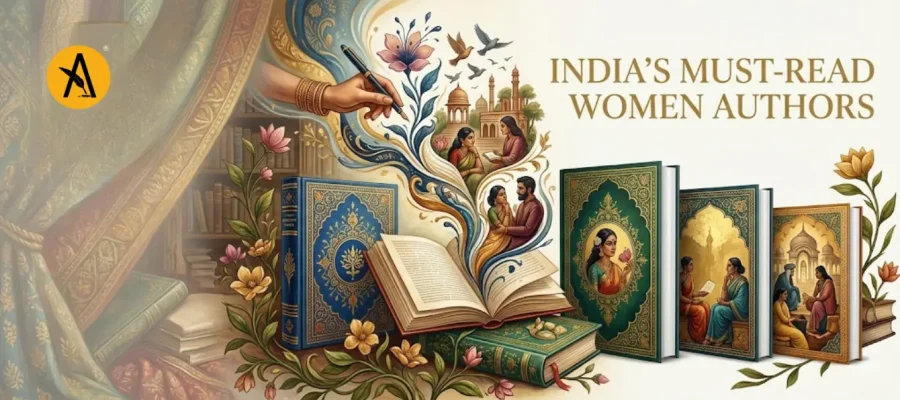
The best books by Indian female authors span every genre, literary fiction, romance, thriller, professional non-fiction, spiritual memoir, and the list has never been richer than it is right now.
Books by Indian women authors are increasingly visible in mainstream publishing but the strongest titles are often found with independent publishers and on word-of-mouth recommendation rather than in airport bookshops.
Indian women have been writing, and have been read, for a very long time. From the Bhakti poet-saints like Mirabai and Akka Mahadevi whose songs have survived centuries, to the Urdu short story writers like Ismat Chughtai who wrote with startling boldness in the mid-twentieth century, to the contemporary novelists winning international prizes and reshaping global literary conversation, Indian women’s writing is one of the richest traditions in world literature.
And yet it remains significantly under-read, even within India. This guide is a corrective: a wide-ranging, genuinely useful reading list covering the best books by Indian women across literary fiction, commercial fiction, memoir, poetry, non-fiction, and more.
Indian Female Authors to Explore Across Genres
Indian female authors are writing far beyond one category. You can move from literary fiction to romance, historical fiction, memoir, children’s books, crime and contemporary social fiction without leaving this reading list. Use the genre labels in the recommendations below to find the kind of voice and pace you want first.
Anecdote’s Picks: Books by Indian Women Authors We’ve Published
Books by Indian female authors form a significant part of Anecdote’s catalogue, here are three titles from women authors we’re proud to have published.
Mahadevi: Priyanka Kaintura Sharma | Anecdote Publishing House
A groundbreaking exploration of the divine feminine, weaving celestial mythology with nine stories of women, real and fictional navigating power, purpose, and spirit in contemporary India.
Best for: Readers interested in Hindu philosophy, mythology, the Shakti tradition, and the divine feminine; feminist readers drawn to spirituality.
Why it’s special: Mahadevi moves between mythology and contemporary reality in a genuinely original way, making both feel more immediate, human, and meaningful.
Who should read it: Readers of Devdutt Pattanaik looking for a more literary, story-led exploration of Indian mythology and feminine spiritual power.
Have the Women Left Venus?: Geet Mala Jalota | Anecdote Publishing House
A must-read for women entering or re-entering the workforce, revealing unspoken truths about work culture, written for first-generation earners, returning professionals, and anyone navigating an Indian workplace that wasn’t built with them in mind.’
Best for: Professional women in their 20s–40s; HR professionals; career mentors; women returning to work after a break.
Why it’s special: Honest, research-informed, and fills a genuine gap, most Indian professional non-fiction is written by men, for men. Geet Mala Jalota writes specifically from and for the female professional experience.
The Shattered Ceiling: Geet Mala Jalota | Anecdote Publishing House
‘Ten candid interviews with trailblazing women in Indian industry, on career choices, work-life integration, leadership, and what it actually took to reach the top in fields that weren’t expecting them.’
Best for: Women in leadership or aspiring to it; anyone who wants real stories rather than motivational generalisation.
Why it’s special: Specific and honest in a genre that often settles for inspiring platitudes.
Anmol: Devi Raghuvanshi | Anecdote Publishing House
‘Kiran rises from a patriarchal upbringing to become a respected JNU professor, and faces the most defining sacrifice of her life in the name of love. A literary romance about a woman’s long, costly journey to selfhood.’
Best for: Readers who want fiction that engages seriously with women’s agency, social reality, and the cost of choosing yourself.
Why it’s special: The love story is inseparable from Kiran’s larger story of self-determination, which makes it emotionally weightier than a romance where love is the only thing at stake.
Anecdote actively publishes women authors across all genres — submit your manuscript to Anecdote for a free editorial consultation.
The Literary Pinnacle, Prize-Winning and Critically Acclaimed Fiction
Arundhati Roy, The God of Small Things
The most celebrated novel by an Indian woman, and one of the most celebrated novels in any language. The God of Small Things won the Booker Prize in 1997 and has sold millions of copies worldwide. It tells the story of the twin siblings Rahel and Estha in Kerala, and the tragedy that unfolds when love crosses the boundaries imposed by caste and social expectation. Roy’s prose is unlike anyone else’s, lyrical, specific, politically charged, and structured around a devastating sense of what time and society do to people. Her second novel, The Ministry of Utmost Happiness (2017), takes a panoramic view of contemporary India’s fractures and consolations.
Start with: The God of Small Things, there is simply no substitute for this novel.
Kiran Desai, The Inheritance of Loss
Kiran Desai won the Booker Prize in 2006 for this novel set partly in the Himalayan foothills, tracing the life of a retired judge whose granddaughter falls in love with a young man involved in the Gorkhaland independence movement, while his cook’s son navigates illegal immigration in New York. The novel moves between these worlds with emotional intelligence and political precision, examining what colonialism, globalisation, and social aspiration do to ordinary people across generations.
Start with: The Inheritance of Loss
Banu Mushtaq, Heart Lamp
In 2025, Banu Mushtaq became the first Kannada author and the first short story collection to win the International Booker Prize, for Heart Lamp: Selected Stories, translated from Kannada by Deepa Bhasthi. The recognition brought long-overdue global attention to Kannada women’s literary writing, a rich tradition that has been producing significant work for decades without the international visibility it deserves. Heart Lamp explores the lives of Muslim women in Karnataka with a directness and emotional range that is genuinely extraordinary.
Start with: Heart Lamp: Selected Stories
Geetanjali Shree, Tomb of Sand
Geetanjali Shree’s Ret Samadhi, published in English as Tomb of Sand, translated by Daisy Rockwell, won the International Booker Prize in 2022, becoming the first Hindi novel and the first Indian-language novel to win the prize. An 80-year-old widow’s late-life rebellion against her family’s idea of who she should be becomes a meditation on the borders between countries, genders, and the self. Shree’s prose (in Rockwell’s translation) is experimental, playful, and profound.
Start with: Tomb of Sand (Ret Samadhi)
Jhumpa Lahiri, The Interpreter of Maladies
Jhumpa Lahiri won the Pulitzer Prize for Fiction for her debut story collection, which follows Indian and Indian-American characters navigating the specific dislocations of immigrant life, between cultures, between generations, between the world they came from and the world they are trying to belong to. The Namesake, her first novel, follows a Bengali family across generations in America with even greater scope. Lahiri later learned Italian and began writing in that language, extending her exploration of language and identity into a new dimension.
Start with: The Interpreter of Maladies
The Mid-Century Pioneers, Writers Who Changed What Was Possible
Ismat Chughtai
Ismat Chughtai is one of the most important Urdu writers of the twentieth century, and one of the bravest. Her short stories, collected in The Quilt and Other Stories and elsewhere, address female sexuality, desire, and the suffocation of women within domestic life with a boldness that got her tried for obscenity by the British colonial government in 1944. The Quilt, her most famous story, is a delicate and daring exploration of female sexuality and the way women’s intimacy is invisible to the men around them. Her prose is sharp, funny, and utterly without sentimentality.
Start with: The Quilt and Other Stories
Mahasweta Devi
One of India’s most important political writers in any language or gender, Mahasweta Devi wrote in Bengali about the lives of adivasi communities, bonded labourers, and the dispossessed in a body of work that combined documentary precision with fierce moral passion. Her stories, collected in Breast Stories and Imaginary Maps among others, use the female body as a site of political violence and resistance. Her novel Hajar Churashir Maa (Mother of 1084) about a mother whose son died in the Naxalite uprising is one of the essential texts of Indian political fiction.
Start with: Imaginary Maps (translated by Gayatri Chakravorty Spivak) or Hajar Churashir Maa
Kamala Das
Kamala Das, who also wrote as Madhavikutty in Malayalam, is one of the most important Indian poets of the twentieth century, and her autobiography, My Story, is one of the most startlingly honest accounts of a woman’s inner life ever written in India. Her confessional poems, collected in The Old Playhouse and Other Poems and Summer in Calcutta, address female desire, marriage, loneliness, and the body with a directness that shocked and thrilled her contemporaries and continues to do so.
Start with: My Story (memoir) or The Old Playhouse and Other Poems
If My Story interests you, discover more Indian memoirs and autobiographies that bring personal experiences to the page.
Contemporary Literary Fiction and Narrative Non-Fiction
Anita Nair, Cut Like Wound and Ladies Coupe
Anita Nair is one of India’s most accomplished and versatile contemporary literary writers. Ladies Coupe, a novel built around six women sharing a train compartment and the stories they tell each other, is warm, sharp, and structurally inventive. Her Inspector Gowda thriller series, beginning with Cut Like Wound, brings the same quality of characterisation to Bengaluru crime fiction. The Better Man is a quieter, more lyrical novel about a man returning to his village after years in the city.
Start with: Ladies Coupe for literary fiction; Cut Like Wound for crime fiction.
Manju Kapur, Difficult Daughters and A Married Woman
Manju Kapur’s literary fiction explores the lives of Indian women navigating desire, marriage, and independence within families and societies that offer them very little room. Difficult Daughters, set around the Partition of India, won the Commonwealth Writers Prize and follows Virmati, a young Punjabi woman whose love for a married professor has irreversible consequences. A Married Woman addresses a contemporary woman’s discovery of her own sexuality outside her marriage. Kapur’s writing is clear-eyed, emotionally precise, and refuses easy consolation.
Start with: Difficult Daughters
Meena Kandasamy, When I Hit You
Meena Kandasamy’s autofictional novel about being in a violent marriage is one of the most important Indian feminist novels of recent decades. The narrator, a young writer who marries an ideologically driven man, documents the systematic dismantling of her identity and the strategies she uses to survive. Kandasamy’s prose is formally bold (the narrator discusses narrative strategies as she deploys them) and politically urgent. The Women’s Prize shortlisting brought it to international attention it fully deserved.
Start with: When I Hit You
Chitra Banerjee Divakaruni, The Palace of Illusions
Already covered in our mythology section below, but worth listing here as literary fiction too: Divakaruni’s Mahabharata retelling from Draupadi’s perspective is simultaneously one of India’s finest feminist mythological novels and one of its best literary historical fictions.
Commercial Fiction and Women’s Fiction
Preeti Shenoy
One of India’s most widely read commercial fiction authors, Preeti Shenoy writes about love, loss, mental health, and reinvention with emotional directness that has found a very large readership. Life is What You Make It, which deals with bipolar disorder within a love story, is her landmark novel. A Hundred Little Flames, set in Kerala and Mumbai, has a quieter, more multigenerational feel. The One You Cannot Have addresses unrequited love with unusual precision.
Start with: Life is What You Make It
Sudha Murty, Wise and Otherwise
Sudha Murty is one of India’s most beloved authors of accessible non-fiction and story collections, books about real people she encountered through decades of philanthropic work with the Infosys Foundation. Wise and Otherwise, her most widely read collection, distils a lifetime of observation about human nature, generosity, and the surprising ways dignity and kindness appear in unlikely places. Her writing is warm, specific, and carries genuine moral weight.
Start with: Wise and Otherwise
If you enjoy reflective non-fiction and want more books focused on personal growth, browse these self-help books by Indian authors.
Indu Sundaresan, The Twentieth Wife
Indu Sundaresan’s Taj Mahal Trilogy traces the stories of powerful women in Mughal India, The Twentieth Wife follows Mehrunnisa’s passionate and politically complicated love for Emperor Jahangir, and her eventual rise as Nur Jahan, one of the most powerful women of the Mughal era. Sundaresan blends historical research with the emotional depth of the best romance fiction.
Start with: The Twentieth Wife
Poetry by Indian Women
Kamala Das
Already covered above, the essential starting point for Indian women’s poetry in English.
Eunice de Souza
One of India’s most important English-language poets, de Souza wrote with dark wit and precise observation about the specific experience of Indian Catholic women navigating faith, family, and desire. Fix and Women in Dutch Painting are among her most celebrated collections.
Imtiaz Dharker
Dharker’s poetry, including Postcards from god and I Speak for the Devil, deals with home, belonging, faith, violence, and the female body with visual precision and emotional intensity. Her work has been widely anthologised in the UK and India.
Erika, A Thriller, and Hiraeth, Home That Never Was, Mansi Narula Kashyap
Anecdote Publishing House‘s own Editor-in-Chief, Mansi Narula Kashyap, is herself an awarded Indian woman author. Her psychological thriller Erika, A Thriller won an award at the Coimbatore Literary Awards Ceremony and became a bestseller on Kindle. Her poetry collection Hiraeth, Home That Never Was, a deeply personal exploration of belonging, loss, and longing, was awarded Best Poetry and Best Debut Book at Aghaaz. Hiraeth takes its title from the Welsh concept of a grief for a home that never was or can never be returned to, and Kashyap’s poems explore the experience of displacement and longing with both precision and emotional depth.
Both books represent the kind of debut Indian women’s writing that deserves more readers than it typically reaches, writing that is literary in ambition, emotionally honest, and rooted in a distinctly Indian experience of the world.
Available through: Anecdote Publishing House
Memoir and Personal Writing
My Story, Kamala Das
The autobiography of one of India’s greatest poets, written with a frankness that was, and remains, startling. Das writes about her marriage, her desires, her writing life, and her identity with a courage that made her a target of moral outrage and a hero to generations of Indian women writers who came after her.
That Long Silence, Shashi Deshpande
Deshpande’s novel is narrated by Jaya, a woman who examines her marriage and her own silence within it with unsettling honesty. One of the foundational texts of Indian feminist fiction in English.
The Far Field, Madhuri Vijay
Madhuri Vijay’s debut novel, winner of the JCB Prize for Indian Literature, follows a young woman from Bangalore who travels to Kashmir seeking to understand a family secret. It is a novel about guilt, complicity, and the limits of what one person can understand about another’s suffering. One of the finest debut Indian novels of recent years.
Start with: The Far Field
Mythology Retold by Indian Women
The Palace of Illusions, Chitra Banerjee Divakaruni
The Mahabharata retold from Draupadi’s perspective, her complicated loves, her political agency, her marginality within a story that is ostensibly about the men around her. Divakaruni’s retelling gives Draupadi an interior life and a voice the original text only glimpses. One of the essential feminist mythological retellings in Indian fiction.
Start with: The Palace of Illusions
Karna’s Wife, Kavitha Kane
Kavitha Kane’s mythology series gives voices to the women at the margins of India’s great epics, Karna’s Wife (Uruvi), Sita’s Sister (Shrutakirti), Menaka’s Choice. These are popular rather than literary retellings, but Kane’s research is solid and her characterisation is sympathetic.
Start with: Karna’s Wife (The Outcast’s Queen)
Social Fiction and Issue-Driven Novels
When I Hit You, Meena Kandasamy
Already covered above. The most formally ambitious and politically important Indian women’s novel on the subject of domestic violence in recent decades.
Eating Wasps, Anita Nair
A novel structured around the lives of different women, connected by a single event in a small Kerala town. Nair examines how violence, silence, and desire operate in women’s lives with the same precision she brings to her Inspector Gowda series.
Talking of Muskaan, Himanjali Sankar
One of India’s first YA novels to address LGBTQ+ identity and mental health in school, already covered in our young adult guide but essential here too as one of the important voices in social fiction for young Indian women readers.
If Talking of Muskaan interests you, discover more Indian books for young adults across social fiction, fantasy and other genres.
Emerging Indian Women Writers to Watch
Madhuri Vijay, The Far Field (JCB Prize winner) is already a landmark. Whatever she publishes next will be essential reading.
Deepa Bhasthi, The translator of Banu Mushtaq’s International Booker Prize-winning Heart Lamp is herself a significant literary voice whose essays and fiction deserve wider readership.
Shubhangi Swarup, Latitudes of Longing is a multigenerational, ecologically conscious novel that has attracted significant critical attention and deserves a wider readership.
Avni Doshi, Her debut novel, Burnt Sugar (shortlisted for the Booker Prize in 2020), examines the complex and often toxic relationship between a mother and daughter in Pune with unflinching honesty.
Mansi Narula Kashyap, Anecdote Publishing House’s own Editor-in-Chief and awarded author of the psychological thriller Erika, A Thriller and the poetry collection Hiraeth, Home That Never Was. Both works represent the best of contemporary Indian women’s debut literary writing, precise, honest, and emotionally intelligent.
Related Reading: Many of India’s most beloved romance writers are women — see our complete list of romance novels by Indian authors for more.
Indian Women Authors, At a Glance
| Author | Best Known For | Where to Start |
|---|---|---|
| Priyanka Kaintura Sharma | Divine feminine, mythology and contemporary women’s stories | Mahadevi |
| Arundhati Roy | Literary fiction, political essays | The God of Small Things |
| Kiran Desai | Literary fiction | The Inheritance of Loss |
| Banu Mushtaq | Short fiction in Kannada | Heart Lamp (International Booker 2025) |
| Geetanjali Shree | Literary fiction in Hindi | Tomb of Sand (International Booker 2022) |
| Jhumpa Lahiri | Literary fiction, diaspora | The Interpreter of Maladies |
| Ismat Chughtai | Urdu short fiction | The Quilt and Other Stories |
| Mahasweta Devi | Political fiction in Bengali | Imaginary Maps |
| Kamala Das | Poetry and memoir | My Story |
| Anita Nair | Literary and crime fiction | Ladies Coupe |
| Manju Kapur | Literary women’s fiction | Difficult Daughters |
| Meena Kandasamy | Autofiction, political fiction | When I Hit You |
| Preeti Shenoy | Commercial women’s fiction | Life is What You Make It |
| Sudha Murty | Story collections, non-fiction | Wise and Otherwise |
| Chitra Banerjee Divakaruni | Mythology retelling | The Palace of Illusions |
| Madhuri Vijay | Literary fiction | The Far Field |
| Avni Doshi | Literary fiction | Burnt Sugar |
| Mansi Narula Kashyap | Thriller, poetry | Erika, A Thriller; Hiraeth (Anecdote Publishing House) |
1. Who is the most famous Indian woman author?
Arundhati Roy is the most internationally recognised Indian woman author, The God of Small Things won the Booker Prize and has sold millions of copies worldwide. Within India, Sudha Murty is one of the most widely read authors across age groups, with a vast catalogue of accessible fiction and non-fiction.
2. Which Indian woman author won the International Booker Prize?
Banu Mushtaq won the International Booker Prize in 2025 for Heart Lamp: Selected Stories, translated from Kannada by Deepa Bhasthi, the first Kannada work and the first short story collection to win the prize. Geetanjali Shree’s Tomb of Sand (translated by Daisy Rockwell) won the International Booker Prize in 2022, the first Hindi novel to win. Kiran Desai won the Booker Prize (not International Booker) in 2006 for The Inheritance of Loss.
3. Which Indian women writers write in regional languages?
Many of India’s most important women writers work in regional languages. Banu Mushtaq and Vaidehi write in Kannada. Mahasweta Devi wrote in Bengali. Kamala Das wrote in both English and Malayalam (as Madhavikutty). Geetanjali Shree writes in Hindi. Sarah Joseph writes in Malayalam. Many of the most important works of Indian women’s literature are in regional languages and are accessible in English translation.
4. Who are the best Indian women authors for literary fiction?
For literary fiction: Arundhati Roy, Kiran Desai, Geetanjali Shree, Manju Kapur, Anita Nair, Meena Kandasamy, Madhuri Vijay, and Avni Doshi represent the strongest contemporary field. For classics and mid-century writing: Ismat Chughtai, Mahasweta Devi, and Kamala Das are essential.
5. Who are the best Indian women authors for commercial fiction and romance?
Preeti Shenoy is the most widely read Indian woman commercial fiction author. Indu Sundaresan writes historical romance set in Mughal India. Anuja Chauhan writes witty, warm romantic comedy. Sudha Murty’s accessible story collections have found an enormous commercial readership.
6. Are there Indian women authors who write thriller and psychological fiction?
Yes. Anita Nair’s Inspector Gowda series (beginning with Cut Like Wound) is the strongest Indian women’s crime fiction. Mansi Narula Kashyap’s Erika, A Thriller, published by Anecdote Publishing House, won an award at the Coimbatore Literary Awards Ceremony and became a Kindle bestseller. Meena Kandasamy’s When I Hit You has strong psychological thriller elements within its autofiction framework.
7. Where can I find books by Indian women authors published by smaller Indian publishers?
Major online retailers (Amazon India, Flipkart) carry most Indian women’s books. For titles published by smaller publishers, the publishers’ own websites are often the most reliable source. Anecdote Publishing House’s catalogue, including Mansi Narula Kashyap’s works, is available at anecdotepublishinghouse.com/all-books/.
8. Who are the best Indian women authors?
The most celebrated Indian women authors across literary history include Arundhati Roy (The God of Small Things — Booker Prize 1997), Anita Desai (Fasting, Feasting; In Custody), Kiran Desai (The Inheritance of Loss — Booker Prize 2006), and Shashi Deshpande (That Long Silence). Among contemporary popular fiction writers: Anuja Chauhan (The Zoya Factor) and Preeti Shenoy (It Happens for a Reason). From Anecdote’s catalogue: Geet Mala Jalota (professional non-fiction), Devi Raghuvanshi (literary romance), Harshada Pathare (YA fiction), Sirjandeep Kaur Ubha (crime fiction), and Priyanka Kaintura Sharma (Mahadevi divine feminine, mythology and contemporary women’s stories).
9. Are there good professional non-fiction books by Indian women authors?
Yes, and this is a growing category. Geet Mala Jalota’s two books (Have the Women Left Venus? and The Shattered Ceiling, both published by Anecdote) are specifically written for Indian professional women and are among the very few Indian professional non-fiction titles from a female perspective. Sudha Murthy’s books deal with values and wisdom rather than career strategy, but are widely read by professional women for inspiration.
10. Who are some Indian female authors to start with?
A useful starting point includes writers such as Arundhati Roy, Chitra Banerjee Divakaruni, Anita Desai, Sudha Murty and Preeti Shenoy, but the right first author depends on genre. Literary-fiction readers may choose differently from romance, memoir or historical-fiction readers, so use the categories above to narrow your choice.
11. How do I choose a book by an Indian woman author?
Choose by genre first, then read the short description and sample if available. This keeps the decision focused on the book itself rather than treating women authors as one single style of writing.
Read More Indian Women’s Writing
India’s women writers, in English, Hindi, Kannada, Malayalam, Bengali, Urdu, Tamil, and every other language on the subcontinent, are producing some of the most powerful and distinctive literature being written anywhere in the world. The best way to find more of it is to read widely, follow literary prizes (particularly the JCB Prize for Indian Literature, the DSC Prize for South Asian Literature, and the International Booker Prize), and seek out the publishers who are actively championing new Indian women’s voices.
If you’re building a reading list for this stage of life, explore our picks of Indian books to read in your 20s across fiction and non-fiction.
Anecdote Publishing House publishes Indian writing across fiction, non-fiction, self-help, romance, thriller, young adult, and spirituality, including works by women authors. Browse our complete catalogue and our authors page to discover new voices.
If you are a woman author with a completed manuscript, submit it for a free consultation. We publish at zero cost to the author, distribute to over 100 bookshops across India, and provide full editorial, design, and PR support.