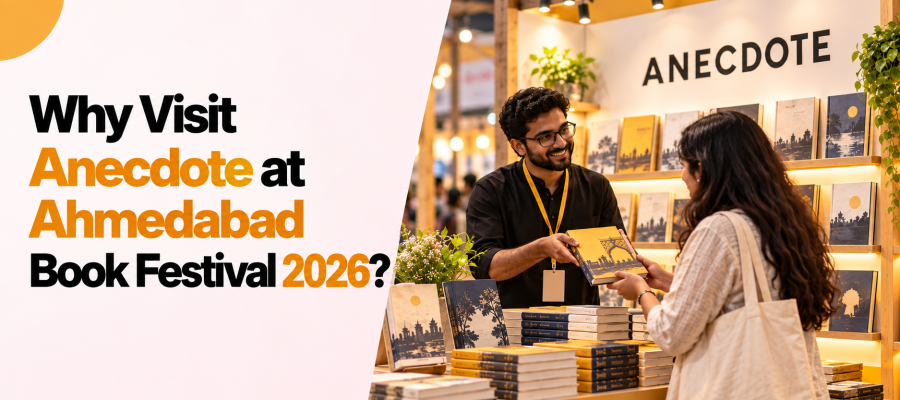
A book fair becomes more useful when you stop treating every stall as a shop window. The real value often lies in slowing down, asking a thoughtful question and discovering why a particular kind of writing belongs on your reading list.
Visiting Anecdote at Ahmedabad Book Festival 2026 offers that opportunity. Anecdote Publishing House will bring its complete catalogue, giving readers a chance to browse across genres, speak with the publishing team and understand the ideas, interests and creative journeys represented by its authors.
The festival runs from 24 October to 1 November 2026. The National Book Trust, India listing confirms the wider Sabarmati Riverfront venue, while a current Amdavad Municipal Corporation announcement identifies the Riverfront Event Centre near Tagore Hall, Paldi. This article focuses on the Anecdote experience; use the separate Ahmedabad festival visitor guide for travel and event-planning details.
Why Meet Anecdote at Ahmedabad Book Festival 2026?
A website helps readers search efficiently, but a physical display allows different books to be considered beside one another. You can examine their presentation, move between subjects and discuss what you actually enjoy rather than relying entirely on an algorithm or a broad bestseller label.
Anecdote is a selective traditional publisher. Its stated purpose is to connect quality readers with quality writers, supported by an ecosystem that includes editorial, proofreading and design work. The Anecdote About page also describes a commitment to creative contribution throughout the journey from writer to reader.
At the fair, this approach can become a conversation rather than a corporate statement. Readers can ask how different parts of the catalogue developed, what themes are represented and how to explore beyond a familiar genre without being pushed towards a generic choice.
Explore the Complete Catalogue in One Place
Anecdote has confirmed that its complete catalogue will be available at the festival. That makes the visit useful for readers who want breadth, not merely a display of a few recent or highly visible publications.
The complete online catalogue spans fiction, mystery and suspense, romance, poetry, self-development, spirituality, society and culture, nonfiction and reading for younger audiences. At the fair, these areas can be explored according to interest, reading mood or purpose.
This article intentionally does not name or rank individual books. Detailed recommendations belong in the separate Ahmedabad Anecdote reading guide, where readers can compare verified titles without turning this experience-focused article into another catalogue list.
Browse by mood, not only by genre
Readers do not always arrive with a category in mind. Someone may be looking for a thoughtful gift, a fast-moving weekend read, a reflective collection or a book capable of sustaining a group discussion.
Describe the experience you want and ask the team which sections may be worth examining. The final decision remains subjective, but a focused conversation can make a large catalogue easier to navigate.
Compare before purchasing
Take time to read descriptions, contents pages and short samples. Compare the language, format, length and tone rather than selecting on cover design alone.
If you are buying for another person, explain what they already enjoy. A useful recommendation begins with demonstrated interests, not assumptions based solely on age, profession or relationship.
Reader Conversations That Go Beyond a Sales Question
The most productive question at a publishing stall is rarely “Which is your best book?” A better conversation begins with what you read, what you avoid and what you hope a book will offer.
You might ask about writing that combines ideas with narrative, fiction that approaches contemporary India, poetry suited to slow reading or books that can open a discussion within a family. These questions give the team something specific to work with while leaving you free to inspect the options yourself.
Readers can also ask about the backgrounds represented across the Anecdote authors page. Authors come to writing through different professions, regions and intellectual interests, and that context can help readers understand why two books in a similar category may feel very different.
Planned Author Meetings, Signings and Reading Sessions
Anecdote is planning author meetings, book signings and reading sessions for the fair. These activities can give readers a closer view of how a work moved from an initial idea towards publication.
Participating authors, dates, timings, approved activity venues and registration requirements have not yet been finalised. The activities should not be assumed to take place inside the Anecdote stall, and access to the fair does not guarantee access to an individual session if separate capacity or registration rules are later announced.
Making an author meeting worthwhile
Prepare one concise question about writing, research, character, theme or creative process. A focused question usually produces a more useful exchange than asking for a complete explanation of the book.
Respect the queue and the time available to other visitors. Ask before recording, and do not assume that a meeting includes manuscript feedback, personal mentoring or an extended private conversation.
Book-signing etiquette
Check whether outside copies are permitted and whether a limit applies to the number of books signed. If personalisation is available, write the required name clearly so the queue can move smoothly.
Photographs should be taken only when the author and event team permit them. Keep the signing table clear and follow instructions about where to wait.
Listening during a reading session
A reading can reveal rhythm, tone and emphasis that are less obvious on the page. Arrive before the announced start, silence your phone and allow the session to finish before beginning a separate conversation.
If there is a question period, connect your question with the passage or discussion. This keeps the exchange relevant for the wider audience.
What Different Visitors Can Gain
| Visitor | A useful way to explore | Questions worth asking |
| Individual reader | Describe a recent book you enjoyed and the mood you want next | Which catalogue sections approach this interest differently? |
| Family | Compare interests before choosing separately or together | Which sections could support shared reading or conversation? |
| Student | Explore one academic interest and one unfamiliar subject | Which books connect ideas with accessible storytelling? |
| Teacher or librarian | Consider themes, language and discussion potential | Which catalogue areas may support classroom or library browsing? |
| Reading group | Look for themes that permit more than a plot summary | Which books could generate contrasting interpretations? |
| Gift buyer | Begin with the recipient’s established preferences | What should I examine before deciding whether this suits them? |
| Aspiring author | Learn about the publisher before discussing a manuscript | Where can I find the official submission process and requirements? |
The table offers starting points, not guaranteed recommendations. Suitability depends on the actual reader, and visitors should inspect a book before purchasing it for themselves or someone else.
A Useful Stop for Families and Students
Families can use the catalogue as a way to discuss reading preferences. Instead of choosing everything for a child or younger reader, invite them to compare descriptions, subjects and visual presentation, then explain what interests them.
Parents and guardians remain responsible for assessing suitability. Anecdote should not be expected to provide a universal age label where the publication itself does not establish one.
Students can approach the display with two questions: what supports an existing interest, and what introduces a new one? This method keeps the visit purposeful without turning it into another assignment.
Those interested in publishing careers may also ask how editors, proofreaders, designers, marketers and booksellers contribute between manuscript and finished book. That broader view helps explain why publishing is collaborative even when a single author’s name appears on the cover.
Information for Book Clubs, Libraries and Reading Communities
Reading communities often need books that produce conversation rather than unanimous agreement. Ask about themes, structures and viewpoints that might support discussion across several meetings.
Librarians and group coordinators can explain their audience, language preferences and typical reading pace. They may also use the visit to understand the range of the catalogue before making any later enquiry about availability or quantities.
No institutional discount, bulk arrangement or special fair offer should be assumed. Any purchase condition must be confirmed directly and supported by the current fair or publisher information.
Community organisers interested in future communication can use the Anecdote contact page. A conversation at the fair can introduce an idea, but follow-up details are better recorded through the appropriate official channel.
Guidance for Aspiring Authors
For an aspiring author, meeting a publisher can clarify the difference between admiring a finished catalogue and preparing a manuscript for professional consideration. The most useful aim is to understand fit and process, not to secure an immediate decision in a busy event setting.
Anecdote is a selective traditional publisher. Aspiring authors can review the official Get Published page and ask where current submission information should be sent. A stall conversation does not guarantee manuscript assessment, acceptance, publication or a response within a particular period.
Questions an aspiring author can ask
- Which genres or kinds of proposals can be submitted through the current process?
- What material should accompany a manuscript enquiry?
- Should a writer submit a complete manuscript or an initial proposal?
- Where are updated submission instructions published?
- What helps the team understand a manuscript’s intended reader?
- How should an author follow up after submitting through the official route?
Keep the exchange concise, especially if other visitors are waiting. Do not hand over the only copy of a manuscript or assume that unsolicited printed material can be accepted at the fair.
Plan a Focused Anecdote Visit
| Before the fair | At the Anecdote display | After the visit |
| Browse the catalogue and note two interests | Begin with one clear reading question | Record titles or categories you want to reconsider |
| Check News and Events for location updates | Examine descriptions and short samples | Follow the official channel for activity updates |
| Set a book budget | Confirm edition, price and availability | Use the submission page for manuscript enquiries |
| Prepare one question for a planned activity | Follow queue, photography and session instructions | Contact the team only where further detail is needed |
The Anecdote stall number and exact location have not yet been confirmed. Follow Anecdote News and Events shortly before travelling rather than relying on an old graphic or an unofficial forwarded message.
Frequently Asked Questions
1. Will Anecdote Publishing House attend Ahmedabad International Book Festival 2026?
Yes. Anecdote’s participation is confirmed, and its complete catalogue will be available for visitors to browse.
2. Why should readers meet the Anecdote team instead of browsing only online?
An in-person visit allows readers to compare physical editions and explain the kind of reading experience they want. The online catalogue remains useful for creating a shortlist before the fair.
3. Does this article recommend individual Anecdote books?
No. Individual recommendations are kept in the separate Ahmedabad reading guide so this article can focus on conversations, activities and the visitor experience.
4. Can families visit the Anecdote display together?
Yes. Families can compare interests and allow each reader to participate in the choice, while parents or guardians assess suitability for younger readers.
5. Can students ask about careers in publishing?
They can ask general questions about the roles involved in producing and presenting books. A fair conversation should not be treated as a promise of employment, internship or formal career counselling.
6. Is Anecdote a traditional publisher?
Yes. Anecdote Publishing House is a selective traditional publisher. Manuscript consideration should follow its official submission route.
7. Can aspiring authors pitch a manuscript at the stall?
They may ask concise questions about fit and submission procedure, but should not expect an immediate assessment. Use the Get Published page or another official route specified by the team.
8. Will authors be available for meetings?
Anecdote is planning author meetings, but participating names and arrangements remain pending. Check the confirmed announcement before planning a visit around a particular author.
9. Will book signings and reading sessions take place at the stall?
The approved venues have not been finalised, so the activities must not be described as stall-based. Follow the published schedule once available.
10. Is registration required for Anecdote activities?
Registration requirements have not yet been announced. Free entry to the wider festival should not be interpreted as guaranteed admission to every individual activity.
11. Are special Anecdote discounts or giveaways confirmed?
No additional Anecdote-specific discount, bundle or giveaway has been confirmed. Check current displayed prices and official purchase conditions at the fair.
12. How can visitors find the final Anecdote location and schedule?
Use Anecdote News and Events for publisher-specific updates and the organiser’s current channels for the wider programme. Recheck both shortly before travelling.
Meet the People Behind the Catalogue
Visiting Anecdote Publishing House at Ahmedabad International Book Festival 2026 is an opportunity to do more than collect another shopping bag. It allows readers to explore a complete publishing list, ask better questions and understand how writers, editors, designers and publishing professionals help a book find its audience.
Browse the complete catalogue before your visit, then arrive with one or two interests rather than a rigid list. Follow News and Events for the final location and activity announcements, and let the conversation lead you towards the part of the catalogue most relevant to you.