Every published book starts with exactly the same thing: a blank page and a person willing to fill it.
If you are reading this, you have an idea, perhaps a story you have been carrying for years, a message you believe the world needs to hear, or a life experience worth sharing. That is the beginning. Everything else is process, discipline, and making one good decision after another about how to get from where you are to the moment you hold a published book with your name on it.
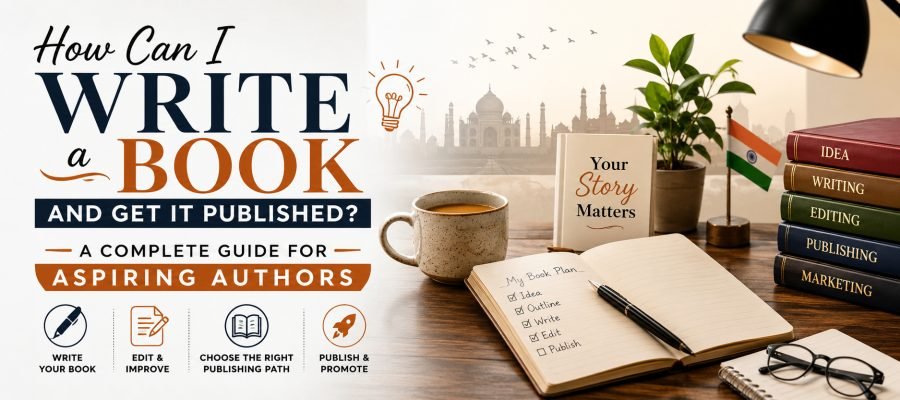
This guide covers the entire journey, from developing your book idea and building a writing habit to finishing your first draft, editing it properly, choosing a publisher, and getting your book into readers’ hands. It is written specifically for aspiring authors in India who are starting from scratch.
Part One: Writing Your Book
Step 1: Find Your Book Idea and Define Your Purpose
Before you write a single sentence, you need to answer one question: why are you writing this book?
This is not a philosophical question. It is a practical one. The answer to “why” will keep you writing when you are 20,000 words in and doubting everything. It will help you make decisions about structure, tone, and content. And it will ultimately determine what kind of book you write and who you write it for.
Ask yourself:
- Am I writing to entertain? (Fiction, narrative non-fiction)
- Am I writing to educate or inform? (How-to books, guides, business books)
- Am I writing to share my experience? (Memoir, biography)
- Am I writing to explore ideas? (Essays, philosophy, spirituality)
- Am I writing to inspire? (Self-help, motivational)
The purpose does not have to be pure, most books serve more than one of these goals. But identifying your primary intention shapes every decision that follows.
Developing Your Book Idea
If you already have an idea, test it with these questions:
- Can you summarise the book in one or two sentences? If you cannot explain what your book is about in a short, clear statement, the idea may not be focused enough yet.
- Is there a genuine audience for this book? Are there readers who want to read something like this?
- Are you genuinely passionate about this topic or story? Writing a full book takes months. Mild interest is not enough to carry you through.
If you do not yet have a clear idea, start by writing freely about subjects and experiences that matter deeply to you. The right book idea is usually the one you feel compelled to write, not the one you think will sell.
Step 2: Choose Your Genre and Know Your Target Reader
Genre is not just a label, it is a contract between the author and the reader. When a reader picks up a thriller, they expect tension, pace, and a satisfying resolution. When they pick up a self-help book, they expect practical advice, relatable examples, and a sense that their life will be better for having read it. When these expectations are met, readers are satisfied. When they are violated without good reason, readers feel deceived.
Choosing your genre early guides your creative decisions throughout the writing process.
Major Genre Categories for Indian Authors
| Genre | What Readers Expect | Example Indian Authors |
|---|---|---|
| Literary Fiction | Rich prose, complex characters, thematic depth | Arundhati Roy, Kiran Desai |
| Commercial Fiction | Compelling plot, accessible writing, clear resolution | Chetan Bhagat, Durjoy Datta |
| Romance | Emotional arc, satisfying relationship resolution | Preeti Shenoy, Ravinder Singh |
| Mystery/Thriller | Tension, clues, a satisfying reveal | Ashwin Sanghi, S. Hussain Zaidi |
| Self-Help/Motivational | Actionable advice, relatable stories, transformation | Robin Sharma, Shiv Khera |
| Spirituality/Philosophy | Wisdom, reflection, inner transformation | Sadhguru, Devdutt Pattanaik |
| Young Adult Fiction | Coming-of-age themes, relatable teenage protagonist | Various debut Indian authors |
| Memoir/Biography | Authentic personal narrative, emotional truth | Multiple Indian authors |
Identify Three Books Similar to Yours
Before you write your book, identify three published books that are similar to what you want to create, not to copy them, but to understand what readers of your genre expect and love. Study how they open, how they structure chapters, what pace they maintain, and how they end. This is the fastest way to understand your genre’s unwritten rules.
Step 3: Decide Between Fiction and Non-Fiction
The writing process differs significantly depending on whether you are writing fiction or non-fiction. Understanding these differences before you begin saves you from making structural mistakes midway through.
Writing Fiction
Fiction is built on character, conflict, and consequence. The story must feel real and emotionally true, even if the events and people are invented. Before you begin writing:
- Know your main character deeply, not just their physical description, but their internal motivation, their greatest fear, and what they want more than anything in the world
- Know the central conflict, the obstacle between your character and what they want
- Know roughly how the story ends, you do not need every scene mapped out, but knowing where you are going makes the journey far less likely to stall
Word count targets for Indian fiction authors:
- Debut novels: 70,000 to 90,000 words is the standard range most publishers expect
- Young adult fiction: 55,000 to 80,000 words
- Romance: 50,000 to 90,000 words
Writing Non-Fiction
Non-fiction is built on a clear argument, organised information, and practical value for the reader. Before you begin:
- Identify the specific problem your book solves, or the specific knowledge it imparts
- Outline your chapters as a logical sequence of ideas, each chapter should answer a question or address a sub-problem
- Gather your research, examples, and evidence before you start writing, going back and forth between writing and research stalls momentum
Word count targets for Indian non-fiction authors:
- Self-help/motivational: 40,000 to 70,000 words
- Business/professional: 50,000 to 80,000 words
- Memoir/biography: 60,000 to 90,000 words
- Spirituality/philosophy: 50,000 to 75,000 words
Step 4: Create Your Outline
An outline is a map. It does not prevent you from taking unexpected turns, but it means you always know where you are relative to your destination. Authors who begin writing without any sense of structure often find themselves stuck at the midpoint of their book with no idea how to move forward.
How to Outline a Fiction Book
A simple fiction outline covers three areas:
Beginning (approximately 25% of the book): Introduce the protagonist, establish their ordinary world, and present the inciting incident, the event that sets the story in motion and forces the protagonist to act.
Middle (approximately 50% of the book): The protagonist pursues their goal, encounters escalating obstacles, faces setbacks, and reaches a crisis point where all seems lost.
End (approximately 25% of the book): The protagonist confronts the central conflict, makes a decisive choice, and reaches a resolution, which may be triumphant, tragic, or somewhere between.
Within this broad structure, outline each chapter as a brief two-to-three sentence summary of what happens. This keeps you moving forward when you sit down to write, you always know what the current chapter needs to accomplish.
How to Outline a Non-Fiction Book
For non-fiction, your outline is essentially your table of contents with a brief description of each chapter’s purpose:
- Write your central argument or promise in one sentence (what this book will help the reader achieve or understand)
- List the ten to fifteen key points, lessons, or arguments your book needs to make
- Group related points into chapters
- Within each chapter, list the sub-topics, examples, and evidence you will use
- Note the chapter’s conclusion, what the reader should know or be able to do by the end of it
Step 5: Build a Writing Habit That Actually Works
Writing a book is not an act of inspiration. It is an act of discipline. Waiting for the perfect moment, the perfect mood, or the perfect idea to arrive before you sit down to write is how books remain permanently unfinished.
The authors who complete books do not write when they feel like it. They write because they have built a routine that makes writing as automatic as brushing their teeth.
The Two Rules of Consistent Writing
Rule 1: Write at the same time every day. Consistency builds momentum. Your brain begins to associate a specific time with writing, and the resistance to starting diminishes significantly once the routine is established. It does not matter whether you write at 5 am, during your lunch break, or at 10 pm, what matters is that it is always the same time.
Rule 2: Set a daily word count target and treat it as non-negotiable. For first-time authors, a realistic daily target is 500 to 1,000 words. At 500 words a day, you produce a 60,000-word first draft in four months. At 1,000 words a day, you reach the same milestone in two months. These are achievable numbers even for authors with full-time jobs and family responsibilities.
Bestselling author Jerry Jenkins, who has written more than 200 books, advises: set a weekly page target, enter it in your calendar, and treat it as sacred. As J.K. Rowling has said about writing time: be ruthless about protecting writing days. Something in your calendar will need to be sacrificed to create that space.
Finding Time to Write in India
Many aspiring Indian authors feel they do not have time to write a book. The reality, as writing coach Savannah Gilbo notes, is that most people have more available pockets of time than they realise, they simply have not identified them. A busy executive with 45 minutes free during lunch can write an entire first draft in those daily pockets over several months, as Gilbo documented with a client.
Where Indian authors typically find writing time:
- Early morning before the household wakes
- Commute time (voice recording ideas or dictating on the phone)
- Lunch break at work
- After children are asleep in the evening
The best time is the time you can reliably protect.
Dealing With Writer’s Block
Writer’s block is almost always caused by one of three things:
Not knowing what happens next, which is a structural problem, solved by going back to your outline and making decisions before you sit down to write.
Fear of writing badly, which is solved by remembering that your first draft does not need to be good. It needs to exist. Every author writes bad first drafts. The draft is raw material, not a finished product.
Perfectionism at the sentence level, the habit of editing while writing. The solution is a strict personal rule: do not edit during your drafting sessions. Write forward only. Editing is for revision, not for the first draft.
Step 6: Write Your First Draft Without Stopping
The first draft of your book will not be good. This is not a problem, it is expected.
Every professional author knows that first drafts are messy, inconsistent, and full of problems. The goal of a first draft is not quality. The goal is completion. You cannot revise a blank page.
Practical Rules for Writing Your First Draft
Do not go back and rewrite. If you wrote something yesterday that you now think is wrong, make a note and keep moving forward. You will fix it in revision. Going back to rewrite during the drafting phase is the most common reason authors never finish their books.
Lower your standards for the draft. Permit yourself to write sentences you know are clumsy, descriptions you know need more detail, and dialogue that sounds unnatural. Mark them and move on. The important thing is that the scene exists.
Do not stop to research in the middle of a draft. If you are writing a non-fiction book and you need a statistic you do not have, write [INSERT STAT HERE] and keep going. Research interruptions break your momentum and can turn a 30-minute writing session into a three-hour research session with 50 words to show for it.
Track your progress visibly. Keep a simple word count log, a spreadsheet, a notebook entry, or a sticky note on your desk. Watching the number grow is a powerful motivator.
Step 7: Revise, Then Revise Again
The first draft is finished. This is a genuine achievement and worth acknowledging. Now the real work of writing begins.
Revision is where books are made. The difference between a draft and a publishable manuscript is almost always revision, multiple rounds of it, across different levels of the text.
The Revision Process
Step back before you revise. After completing your first draft, put the manuscript aside for at least a week, two weeks or more is better. When you return to it, you read it more clearly as a reader would, rather than as the author who knows what was intended. Distance reveals problems that are invisible when you are too close to the work.
Read the full draft before changing anything. Read your complete draft in one or two sittings, making notes in the margins but not making changes. This gives you a sense of the whole before you lose yourself in the parts.
Revise in passes, not all at once. Trying to fix everything in a single revision pass leads to exhaustion and missed problems. Instead:
- Pass 1: Big-picture revision, Does the structure work? Does the argument or story hold together? Are there chapters that need to be moved, cut, or written?
- Pass 2: Scene/chapter level, Does each chapter open with purpose and end with impact? Is the pacing consistent?
- Pass 3: Paragraph and sentence level, Is every sentence as clear and strong as it can be? Are there redundant passages?
- Pass 4: Final read-through, Reading aloud to catch anything that survived the previous passes
Get feedback from trusted readers. Beta readers, people from your target audience who read your draft and give honest feedback, catch issues that self-editing misses. Writing communities on platforms like Goodreads connect authors with beta readers in their genre.
Step 8: Get Professional Editing
After you have revised your manuscript to the best of your ability, it needs professional editing before submission to any publisher or platform.
Self-editing has limits. No matter how capable a writer you are, you cannot fully evaluate your own work objectively. You know what you intended to say, which makes it nearly impossible to see where you have not said it clearly. Professional editors bring objectivity, industry knowledge, and technical expertise that no amount of self-revision can replace.
The three types of editing are described in detail in our guide on mistakes in published books, developmental editing, copy editing, and proofreading each address a different layer of the manuscript.
If you are pursuing traditional publishing with a house like Anecdote Publishing House, your manuscript goes through the publisher’s editorial team after acceptance. However, the stronger and cleaner your manuscript is at submission, the higher your chances of being selected.
Part Two: Getting Your Book Published
Step 9: Choose Your Publishing Route
At this point, you have a revised, edited manuscript. The second half of your journey begins: getting it published.
As we cover in detail in our guide on how can I publish my book, there are three main publishing routes available to Indian authors:
Traditional publishing, a publisher selects your manuscript, funds the entire production, and pays you royalties. You pay nothing upfront. This route gives you professional editorial support, physical bookstore distribution across India, and the credibility of being selected by an established house.
Self-publishing, you fund and manage the entire publishing process yourself, retaining complete creative control and higher royalties per copy. Platforms like Amazon KDP make this accessible, though the marketing and distribution responsibility rests entirely with you.
Hybrid publishing, a shared investment model. Research any hybrid publisher carefully before signing a contract.
The right route depends on your goals. If you want zero upfront cost, professional support, and physical distribution, traditional publishing is the answer. If you want complete control and faster timelines, self-publishing is the route.
Step 10: Prepare Your Submission Package
If you are pursuing traditional publishing, you need to prepare a submission package before approaching any publisher. This is the professional presentation of your manuscript and yourself as an author.
A standard submission package contains:
The Query Letter
A one-page pitch to the publisher covering:
- Your book’s genre and word count
- A compelling three-to-five sentence synopsis that communicates the book’s premise, conflict, and audience
- A brief note on market positioning, what makes your book different from comparable titles already published
- A short author biography with any relevant background
The query letter is your first impression. It must be compelling, concise, and tailored to each publisher you approach. A generic query letter that has clearly been sent to every publisher simultaneously signals that you have not done your research.
The Synopsis
A one-to-two page complete summary of your book, including the ending. The synopsis is not a teaser. It is a business document that allows the publisher to assess whether the book holds together structurally. For fiction, include the central conflict, the protagonist’s arc, and how the story resolves. For non-fiction, include the central argument, the major points of each chapter, and the book’s conclusion.
Sample Chapters
Most publishers ask for the first three chapters or the first 40 to 50 pages as part of the initial submission. These must be your best work. If your opening chapters are not representative of the quality of the full manuscript, revise them before submitting.
Step 11: Submit to the Right Publishers
Researching publishers before submitting is not optional. Sending your manuscript to publishers who do not publish your genre wastes everyone’s time and produces automatic rejections.
Before submitting to any publisher, verify:
- Do they publish books in my genre?
- Do they accept direct submissions from authors, or do they require a literary agent?
- Have they published debut authors, or do they require a track record?
- What do authors who have worked with them say about the experience?
- Are their books available in bookstores across India?
In India, unlike the American and British publishing markets, most traditional publishers accept direct submissions without requiring a literary agent. This makes the process significantly more accessible for first-time authors.
Anecdote Publishing House accepts direct manuscript submissions across fiction, non-fiction, self-help, romance, mystery thriller, young adult, spirituality, and society and culture. You can submit your manuscript for a free consultation here. Our team reviews every submission and reaches out to discuss whether your book is a fit for our publishing list.
You can also browse our published authors page to understand the range of voices and genres we work with, and our genre catalogue to assess the fit.
Handling Rejection
Rejection is the universal experience of every author who has submitted to traditional publishers. J.K. Rowling was rejected by twelve publishers before Harry Potter was accepted. Chetan Bhagat faced rejections before Five Point Someone found its home.
Practical advice for managing the submission process:
- Submit to several publishers simultaneously unless a publisher specifically requires exclusive submission
- Keep a simple log: publisher name, date submitted, response
- If a publisher provides feedback with a rejection, take it seriously, publishers rarely give feedback unless they see genuine potential in the work
- Rejection does not mean the book is unpublishable. It may mean the genre is not a current priority, the list is full, or the timing was not right
Step 12: Build Your Author Platform and Market Your Book
Publishing your book is the beginning of its commercial life, not the end of your work. Books that find large audiences almost always do so because their authors invested in marketing, before launch, during launch, and consistently after.
Start Building Your Platform Before the Book Is Published
An author platform is your visibility as a writer, the channels through which readers who do not yet know you can discover you and your work.
The most effective platforms for Indian authors currently are:
Instagram (Bookstagram India): India’s book community on Instagram is large, active, and engaged. Regular posts about your writing process, the ideas in your book, and your author life build a following that converts to readers. Start this at least six months before your publication date.
LinkedIn: Particularly powerful for non-fiction authors, business books, professional development, self-help, where the reader and the professional are often the same person.
Author website: A simple, professional page with your biography, your book’s details, and a way for readers to contact you. Even a basic website establishes your credibility as a serious author.
Before Launch
- Send advance reading copies (ARCs) to book bloggers, Bookstagrammers, and journalists who cover books at least four to six weeks before your launch date
- Ask them to post reviews on the launch day or launch week
- Create a launch plan: what events will you host, what social posts will you publish, who will you reach out to?
On Launch Day and the Week After
- Share the launch across every platform you are present on
- Ask friends, colleagues, and early readers to leave honest reviews on Amazon India and Goodreads
- Host a physical book launch event if possible, bookstore launches, literary cafe events, and library readings drive both immediate sales and local press coverage
After Launch: The Long Game
Book marketing is not a launch event. It is a sustained effort over months and years.
- Participate in literary events: the New Delhi World Book Fair, the Kolkata Book Fair, the Jaipur Literature Festival, and regional events give direct access to engaged readers
- Reach out to books editors at publications like The Hindu, Hindustan Times, and regional newspapers for review consideration
- Speak at book clubs, universities, and professional events, every speaking engagement is an opportunity to introduce new readers to your book
- Keep your social media presence active, not just promotional posts, but content about the ideas in your book, your writing life, and your next project
At Anecdote Publishing House, we have our own PR infrastructure and participate in prestigious literary events across India to support every author we publish. You can learn more about the support we provide on our About Us page.
Frequently Asked Questions
1. How long does it take to write a book?
It depends on the genre, your daily writing habit, and how much revision is needed. A first draft of a 70,000-word novel written at 500 words a day takes approximately five months. Add two to three months for revision and editing, and a typical first-time author who writes consistently can complete a submission-ready manuscript in eight to twelve months. Non-fiction books are often faster to draft because the structure is more defined, but research can extend the timeline.
2. Do I need any qualifications to write a book in India?
No formal qualifications are required to write or publish a book in India. Fiction writing requires storytelling craft, which is developed through reading widely and writing consistently. Non-fiction writing requires genuine expertise or experience in your subject area, which you likely already have if you have chosen the right topic. Many successful Indian authors have no formal writing credentials, they had a story worth telling and the discipline to finish it.
3. How do I get over writer’s block?
The most effective solution to writer’s block is to identify its source. If you do not know what happens next, return to your outline and make decisions before your next writing session. If you are afraid of writing badly, remind yourself that first drafts are supposed to be imperfect, the goal is to keep moving forward. If perfectionism is stopping you from writing at all, set a timer for 20 minutes and commit to writing continuously without stopping to evaluate or edit. Momentum builds momentum.
4. Should I write in English or my native language?
Write in the language in which you think most naturally and powerfully. India’s literary tradition is rich in regional languages, and a book that resonates emotionally in Kannada, Tamil, Hindi, or any other Indian language will reach its intended audience more effectively than a technically correct but emotionally distant translation into English. Many Indian publishers, including traditional houses, publish in regional languages. For writers whose audience spans both regional and English-reading communities, writing in both or pursuing translation is also an option.
5. How long should my book be?
Word count varies by genre. Fiction for adults typically runs 70,000 to 100,000 words. Young adult fiction is usually 55,000 to 80,000 words. Non-fiction books aimed at a general audience typically run 40,000 to 70,000 words. Memoir and biography are typically 60,000 to 90,000 words. These are guidelines, not rules, but submitting a manuscript significantly shorter or longer than genre norms raises questions about whether the book is complete or whether the author understands their market.
6. Do I need to finish the entire book before approaching a publisher?
For fiction and memoir, yes, a complete manuscript is required before most traditional publishers will consider it seriously. For non-fiction, some publishers accept a detailed book proposal with a strong sample chapter, but the stronger your complete manuscript, the better your submission. At Anecdote Publishing House, we review complete manuscript submissions and provide a free consultation to discuss whether your book is a fit.
7. How do I find beta readers for my manuscript?
Beta readers are readers from your target audience who read your manuscript before professional editing and provide honest feedback. You can find them through: writing communities on Goodreads, Facebook writing groups for Indian authors, local writing workshops and literary events, and online forums for your genre. When choosing beta readers, prioritise people who read widely in your genre, they will give you the most useful feedback about whether your book meets reader expectations.
8. What is the difference between an editor and a proofreader?
An editor works at the level of structure, argument, character, pacing, and clarity, they help you make the book as strong as it can be. A proofreader works at the surface level after editing is complete, catching typos, grammatical errors, and formatting inconsistencies. Most manuscripts need both, in that order. Never send a manuscript for proofreading before it has been edited, proofreading an unedited draft is an expensive and ineffective use of your budget.
9. How do I know when my manuscript is ready to submit?
Your manuscript is ready when: it is complete (beginning, middle, and end), it has been through at least two full rounds of revision, it has been read by at least one or two beta readers whose feedback you have incorporated, it has been professionally copy edited and proofread, and you can summarise it clearly in a single paragraph. If you feel genuine anxiety when imagining a professional reading it, not nervousness, but the specific anxiety of knowing there are significant unresolved problems, it is not ready yet.
10. What genres does Anecdote Publishing House publish?
Anecdote Publishing House publishes across fiction, non-fiction, self-help, motivational, romance, mystery thriller, young adult, religion and philosophy, spirituality, family and relationship, contemporary fiction, and society and culture. You can browse our genre catalogue and our published authors to assess whether your book is a fit, and submit your manuscript here for a free consultation.
11. Can I write a book while working a full-time job in India?
Yes. Many published Indian authors wrote their first books while holding full-time jobs. The key is protecting your writing time consistently, even 30 to 45 minutes each day at the same time produces measurable progress. Writing at 500 words a day, a working professional in India can complete a first draft in four to five months without compromising professional or family commitments. The writing habit is more important than the quantity of daily time.
12. What happens after a publisher accepts my manuscript?
After acceptance, the publisher will offer you a publishing contract covering royalties, rights, advance (if applicable), and production timeline. Once the contract is signed, your manuscript enters the publisher’s editorial process, developmental editing, copy editing, and proofreading, followed by cover design, interior layout, ISBN registration, printing, and distribution. The production and launch timeline typically runs six to eighteen months from contract signing, depending on the publisher’s schedule and the extent of editorial work required.
Your Story Deserves to Be Written, and Read
You now have the complete roadmap: from finding your book idea and building a writing habit, through finishing and revising your manuscript, to choosing a publisher and marketing your book to the readers who need it.
The most important step is the next one. Start your outline today. Set your first writing session for tomorrow morning. Send your manuscript submission this week.
If you have a manuscript ready and want to explore traditional publishing, Anecdote Publishing House accepts direct submissions and provides a free consultation. Our books are distributed to over 100 bookshops across India, and we provide editorial, design, and PR support for every author we publish.