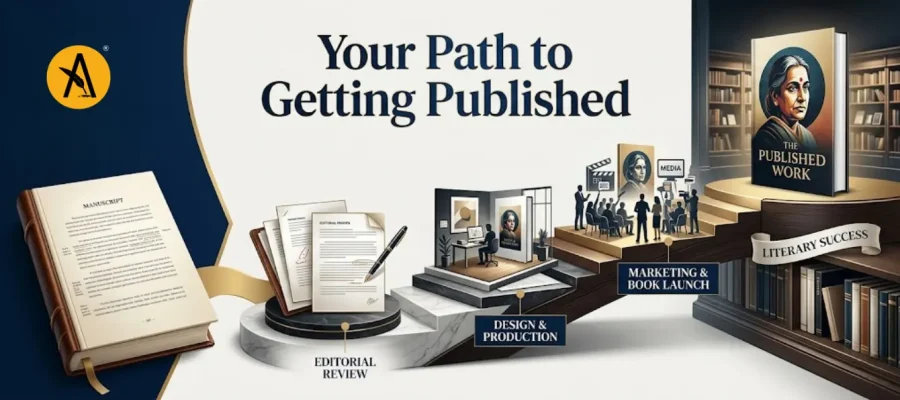
Getting a book published in India is more accessible than most first-time authors believe, and more demanding than most expect. The path from completed manuscript to published book requires preparation, the right strategic decisions, and the patience to move through a process that cannot be rushed.
This guide covers the complete process: how to assess your manuscript, choose the right publishing route, prepare your submission package, approach publishers, understand contracts, and navigate the entire journey from the desk where you wrote to the bookshop where your book will eventually sit.
The Three Publishing Routes Available to Indian Authors
Before beginning the process, understand the three routes:
Traditional publishing: A publisher selects your manuscript, funds all production costs, editing, cover design, printing, distribution, and pays you royalties. Zero cost to the author. The selection process is competitive. This is the route this guide primarily addresses, because it is the most credible pathway for most authors and the one most debut authors aspire to.
Self-publishing: You fund and manage all production yourself, editing, cover design, formatting, printing or digital upload, and distribute primarily through Amazon KDP, Flipkart, and other platforms. You retain higher royalties per copy but bear all costs and responsibility for marketing. Typical costs range from Rs. 15,000 to Rs. 1,50,000 for professional quality.
Vanity and subsidy publishing: You pay a company to publish your book. These companies market themselves as publishers but are charging for services rather than selecting manuscripts based on quality. The books rarely reach bookshops and the “publishing deal” carries none of the credibility of traditional publishing. See our guide on common publishing scams to avoid before approaching any company that requires payment.
The remainder of this guide focuses on traditional publishing, the route that costs the author nothing and offers the most professional support.
Step 1, Finish and Revise Your Manuscript
No publisher should see your first draft. The manuscript you submit must be complete, revised through multiple passes, and in the best condition you can make it on your own before any external feedback.
What “finished” means: A complete manuscript has a beginning, middle, and end. It is not a partial draft, the first three chapters of a longer work, or a document still missing its conclusion. Publishers require complete manuscripts for fiction. For non-fiction, a detailed proposal with sample chapters is acceptable, but the proposal itself must be polished.
What “revised” means: Your manuscript should have gone through at least two to three rounds of self-revision after the first draft. Read it aloud, this reveals awkward sentences, rhythm problems, and passages that do not work in ways that silent reading misses. Cut material that does not serve the story or argument. Tighten scenes, strengthen character motivations, clarify structural weaknesses.
Word count check: Before submission, verify that your manuscript’s word count falls within the standard range for its genre. Manuscripts significantly shorter or longer than genre norms signal inexperience to acquisitions editors. See the full word count guide by genre in our writing timeline article.
Step 2, Get Professional Editing and Beta Reader Feedback
Beta readers first: Before spending on professional editing, share your manuscript with three to five readers from your target audience, avid readers in your genre who will give you honest, specific feedback on whether the story works, where it loses them, which characters feel real, and whether it delivers on its premise. Incorporate patterns of feedback from multiple readers before moving to editing. See our complete guide on how to find beta readers in India.
Professional copy editing: After beta reader feedback and revision, a professional copy editor addresses sentence-level clarity, consistency, grammar, and style. This is not the same as proofreading (which catches typos) or developmental editing (which addresses structure). Copy editing is the minimum professional preparation before submission to any publisher.
Why this matters: Publishers and acquisitions editors read manuscripts with professional eyes. A manuscript full of grammatical inconsistencies, unclear sentences, or structural problems signals that the author has not done the work of preparation. The strongest manuscripts arrive having already been through serious revision and external feedback.
Step 3, Choose Your Publishing Route
For most debut authors with a completed, revised, professionally edited manuscript, the recommended sequence is:
First: Submit to traditional publishers who accept direct submissions from authors without requiring a literary agent. Several reputable Indian publishers, including Anecdote Publishing House, accept direct author submissions. This costs nothing and, if successful, provides professional editorial support, cover design, printing, national bookshop distribution, and PR, all at zero cost to the author.
If needed: Consider approaching literary agents, who can submit to larger publishers that require agent representation (such as Penguin Random House India and HarperCollins India for most categories). Agents typically charge 15% of royalties and advances earned, they profit only when you do. Their value is access to publishers who will not read unagented manuscripts, plus contract negotiation expertise.
Important: India is one of the few markets where authors can still submit directly to publishers without requiring a literary agent, a significant advantage for debut authors. Many reputable Indian publishers and independent publishers accept direct submissions and evaluate them fairly. Do not assume you need an agent to get published.
Step 4, Research Publishers That Match Your Book
Submitting your manuscript to the wrong publisher wastes both your time and theirs. Before submitting anywhere, research to ensure the publisher:
Publishes your genre. Every publisher has a catalogue focus. A publisher that primarily publishes non-fiction business books is not the right home for a romance novel. Read the publisher’s recent catalogue, the books they have published in the past two to three years, to understand what they are actively looking for.
Accepts direct submissions. Not all Indian publishers accept manuscripts directly from authors. Some require agent representation. Check the submissions page of each publisher’s website carefully. Do not submit to a publisher that does not accept unsolicited manuscripts, it will be ignored.
Is a genuine traditional publisher. A traditional publisher pays the author, not the other way around. Any company asking you to pay for publication is a vanity or subsidy publisher, not a traditional publisher, regardless of the language they use.
Major Indian publishers accepting or worth approaching:
Penguin Random House India, HarperCollins India, Westland Books, Pan Macmillan India, Hachette India, Rupa Publications, Jaico Publishing, Aleph Book Company, Speaking Tiger, Srishti Publishers, Leadstart Publishing, and independent publishers including Anecdote Publishing House, among many others. Each has specific genre focuses, submission requirements, and response timelines. Always check the current submissions page before approaching.
Anecdote Publishing House publishes fiction, non-fiction, self-help, romance, mystery thriller, young adult, religion/philosophy/spirituality, family and relationship, contemporary fiction, and society and culture. Books are distributed to over 100 bookshops across India. Anecdote accepts direct submissions from debut and established authors, no literary agent required, and publishes at zero cost to the author.
Step 5, Prepare Your Submission Package
Most Indian publishers require some combination of the following. Read each publisher’s specific guidelines, requirements vary, and follow them exactly.
The Query Letter
A query letter is a one-page professional letter that introduces your book and yourself to an editor or agent. It is not a synopsis, it is a pitch. It needs to do three things: hook the reader with your book’s premise, communicate what the book is and who it is for, and establish that you are a credible author.
Standard structure:
- Opening hook: Your book’s premise in one to two compelling sentences. The most interesting aspect of your story or argument.
- Book description: Genre, word count, and a two to three paragraph description of the book, what happens, who the protagonist is, what is at stake.
- Comparable titles: One to two recently published books similar to yours in genre and tone. This shows you understand the market your book sits in.
- Author bio: Relevant credentials, previous publications if any, why you are the right person to have written this book.
- Closing: A brief professional close.
For a full template and examples, see our complete guide on how to write a query letter.
The Synopsis
A synopsis is a concise summary of your entire manuscript, including the ending. It is not a back-cover blurb and it is not meant to build suspense. Its purpose is to demonstrate to an editor that your plot or argument holds together from beginning to end.
Length: Most publishers request a synopsis of 500 to 1,500 words (approximately one to three pages). Prepare a one-page version and a two to three page version so you can match each publisher’s specific requirements.
What to include: All major plot points, the central conflict, the protagonist’s arc, and the resolution. For non-fiction: the book’s central argument, the evidence and reasoning supporting it, and what the reader knows at the end that they did not at the start.
For a full guide with fiction and non-fiction templates, see our article on how to write a book synopsis.
Sample Chapters
Most publishers request the first three chapters or the first 10,000 to 50 pages of the manuscript. Some request the complete manuscript from the outset.
Always send the opening chapters, not what you consider your strongest chapter if it falls later in the book. Publishers want to evaluate how the book begins, because readers make purchasing decisions based on openings. If your opening chapters are weak, revise them before submitting.
Author Bio and Platform
A brief professional biography covering relevant writing credentials, previous publications, and any professional expertise relevant to the book. For non-fiction, your credentials in the subject matter are especially important. For fiction, writing community involvement, previous publication in literary journals or competitions, and any public platform (blog, newsletter, social media following) are worth mentioning.
Step 6, Submit and Follow Up
Submit to multiple publishers simultaneously unless a publisher’s guidelines specifically request exclusive submission. Simultaneous submission is standard practice in Indian publishing and globally. Note in your query letter that you are submitting simultaneously.
Keep a submissions tracker. A simple spreadsheet listing each publisher, submission date, what you sent, the stated response timeline, and the outcome. Publishing timelines are long, response times in India range from four to sixteen weeks, and many publishers do not respond to every submission. Your tracker prevents you from losing track of where you are with each submission.
Follow up once and politely. If a publisher stated a response timeline in its submission guidelines and that timeline has passed, a single polite follow-up email is appropriate. Something as simple as: “I submitted [manuscript title] on [date] and noted your guidelines indicate responses within [X weeks]. I wanted to enquire whether you have had an opportunity to consider it.” Do not send multiple follow-ups.
Rejection is normal. Every published Indian author has faced rejection, including authors who went on to significant commercial success. Amish Tripathi self-published his first novel after publishers were not interested in mythological fiction at the time. Ashwin Sanghi wrote under a pseudonym before The Krishna Key made him a bestseller. Rejection is not a verdict on the quality of your work; it is information about fit, timing, and market conditions. Revise, strengthen the submission package if needed, and submit to the next publisher on your list.
Step 7, Understand the Contract Before You Sign
If a publisher offers you a contract, read it carefully before signing. The key clauses to understand:
Royalty rate: The percentage of the book’s cover price or net receipts you receive per copy sold. Standard Indian traditional publishing royalties for debut authors typically range from 7.5% to 12.5% of the book’s cover price for print, and 25% of net receipts for digital.
Advance: Some publishers offer an advance against royalties, an upfront payment that is then earned back through book sales before the author begins receiving ongoing royalty payments. Not all Indian publishers offer advances to debut authors.
Rights: The specific rights the publisher is acquiring, print rights, digital rights, audiobook rights, translation rights, and territory (India only, South Asia, world English). Understand exactly which rights you are licensing and for how long.
Reversion clause: The clause that specifies under what conditions the rights revert back to you, typically if the book goes out of print or falls below a minimum sales threshold. This is important for the long-term ownership of your work.
Option clause: A clause giving the publisher the right of first refusal on your next book. Understand the terms, what they can request, the timeframe, and what happens if they decline.
If in doubt about contract terms, the Society of Authors (UK-based but accessible to Indian authors) offers guidance, or you can consult a literary lawyer for significant deals.
Step 8, The Production and Publication Phase
Once you sign a contract with a traditional publisher, the work moves into production:
Editorial development: Your acquiring editor will work with you on structural and content revisions. This process can take one to three months. The editor’s goal is to make the book as strong as possible for its market.
Copy editing and proofreading: The manuscript goes through professional copy editing (sentence-level clarity and consistency) and proofreading (final check for typos and errors) once the content revisions are complete.
Cover design: The publisher’s design team creates the cover. Most traditional publishers retain final say on cover design, though good publishers consult with authors. The cover is a crucial commercial asset, publishers have market knowledge about what works in specific categories.
Printing and distribution: The publisher arranges printing, ISBN assignment, and distribution to bookshops and online retailers. Anecdote Publishing House distributes to over 100 bookshops across India and provides PR support through its in-house agency.
Timeline from contract to publication: With Indian traditional publishers, the typical timeline from signing a contract to the book being available in bookshops is six months to eighteen months, depending on the publisher’s schedule and the extent of editorial work required.
What to Do After Publication
Publication is not the end of the process, it is the beginning of the book’s life in the world.
Participate in your publisher’s PR efforts. Respond promptly to media requests, provide author copies for review, engage with literary events and festivals your publisher arranges. The more visible and responsive you are, the more your publisher can do for you.
Build your author platform. A website, a social media presence (particularly on Instagram, where India’s bookstagram community is most active), and an email newsletter all build long-term readership. Authors who engage consistently with their readers before and after publication build larger and more loyal audiences.
Collect and engage with reviews. Encourage early readers to leave reviews on Amazon India and Goodreads. Reviews build discoverability and social proof. Respond to reader messages with warmth and gratitude.
Begin your next book. The most effective thing a published author can do for their first book’s long-term success is to write a second one. Publishers invest more in authors with multiple books. Readers who find an author they love immediately seek more of their work.
Common Mistakes Indian Authors Make
Submitting too early. Sending a first draft or an incompletely revised manuscript to publishers is the most common and most costly mistake. Once a publisher rejects your manuscript, you cannot resubmit the same work to the same editor without invitation. Submit only when the manuscript is in its best possible condition.
Sending a generic query letter. A query letter that could have been sent to any publisher, with no reference to the publisher’s specific catalogue, no comparable titles, and a vague description of the book, signals that the author has not done the research required to submit professionally.
Approaching vanity publishers as if they were traditional publishers. Companies that charge fees for publication are not traditional publishers. The fee itself is the product; the publishing is a secondary service. No amount of persuasive marketing language changes this structure. See our guide on common publishing scams to avoid.
Ignoring submission guidelines. Publishers set submission guidelines for operational reasons. Ignoring them, sending a full manuscript when three chapters were requested, using the wrong format, or addressing an email incorrectly, demonstrates that the author either cannot follow instructions or has not read the guidelines carefully enough to do so.
Giving up after the first rejection. A single rejection from a single publisher tells you very little about your manuscript’s publishability. Successful Indian authors have typically submitted to many publishers before acceptance. Keep a list, keep submitting, and keep revising in response to any specific feedback you receive.
Frequently Asked Questions
1. Do I need a literary agent to get published in India?
For most Indian publishers, particularly independent publishers and mid-size houses, no. India is one of the few markets where authors can submit manuscripts directly to publishers without requiring an agent. Several publishers, including Anecdote Publishing House, welcome direct author submissions. For the largest publishers (Penguin Random House India, HarperCollins India for most categories), agent representation is typically required or strongly preferred.
2. How long does it take to get a book published in India?
From submitting a manuscript to holding a published book, the realistic timeline with traditional publishing is twelve to twenty-four months, accounting for response time (four to sixteen weeks per submission), potential multiple submissions before acceptance, editorial development after acceptance (one to three months), and production (six to twelve months). Self-publishing can move faster, from completed manuscript to available book in as little as two to four months.
3. How much do Indian publishers pay authors?
Traditional publishers pay royalties, typically 7.5% to 12.5% of the cover price per copy for print, at zero cost to the author. Some offer advances against royalties for debut authors; others do not. Digital royalties are typically around 25% of net receipts. Self-publishing offers higher royalty percentages per copy (35% to 70% on platforms like Amazon KDP) but the author funds all production costs.
4. What is the difference between traditional publishing and vanity publishing?
In traditional publishing, the publisher pays all costs and pays the author royalties. The publisher’s business model is selling books to readers. In vanity publishing, the author pays the publisher for services. The publisher’s business model is selling services to authors. Traditional publishing is selective, publishers accept manuscripts they believe can find a readership. Vanity publishing accepts any manuscript that comes with payment.
5. Can a debut author get published by a traditional publisher in India?
Yes, many Indian traditional publishers, including Anecdote Publishing House, specifically welcome debut authors. Anecdote has published multiple debut authors across genres including fiction, thriller, self-help, spirituality, romance, and young adult. The key requirements are the same as for any author: a completed, revised, professionally edited manuscript that fits the publisher’s genre focus.
6. What should my submission package include?
A standard Indian publisher submission package includes: a query letter (one page introducing your book and yourself), a synopsis (one to three pages summarising the complete manuscript including its ending), the first three chapters or approximately the first fifty pages, and a brief author biography. Some publishers request additional materials, always check the specific submission guidelines on the publisher’s website.
7. What genres does Anecdote Publishing House publish?
Anecdote Publishing House publishes fiction, non-fiction, self-help and motivational, romance, mystery thriller, young adult, religion/philosophy/spirituality, family and relationship, contemporary fiction, and society and culture. Books are distributed to over 100 bookshops across India. Anecdote accepts direct submissions from debut and established authors and publishes at zero cost to the author, with full editorial, cover design, printing, distribution, and PR support.
Submit Your Manuscript
The journey from idea to published book is long, demanding, and entirely possible. Every Indian author who has published began exactly where you are, with a manuscript and the question of what to do next.
Anecdote Publishing House is a traditional publisher based at Ansari Road, Daryaganj, Delhi. We publish at zero cost to the author, distribute to over 100 bookshops across India, and provide full editorial, design, printing, and PR support through our in-house agency. We accept direct submissions from debut and established authors, no literary agent required.