
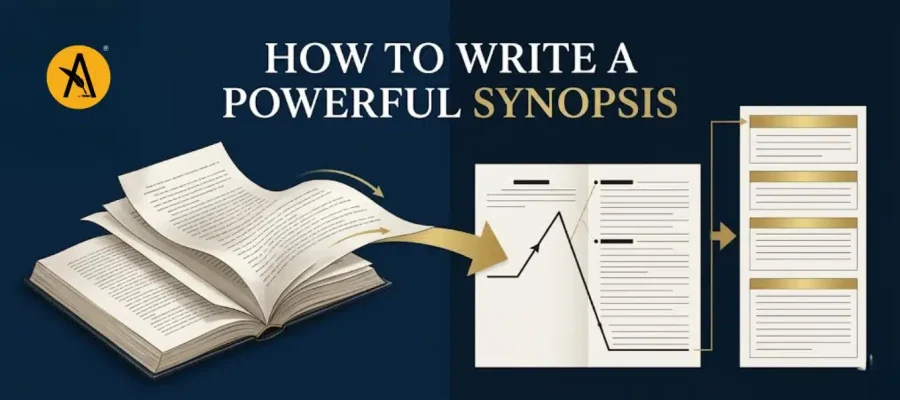
A book synopsis is one of the most difficult single documents an author has to write, and one of the most important. After years of work on a novel or non-fiction book, you are asked to compress it into one or two pages that capture everything essential: the characters, the plot, the themes, the emotional arc, and the ending.
Many authors spend weeks on their synopsis and still feel it does not do their book justice. That feeling is normal. The synopsis is a different kind of writing from the book itself, it is a business document as much as a creative one, and it requires a different approach.
This guide explains what a synopsis is, why publishers require it, what it must contain for fiction and non-fiction, how long it should be, genre-specific advice, and the most common mistakes that get synopses rejected before the manuscript is ever read.
What Is a Book Synopsis and Why Does It Matter?
A book synopsis is a complete summary of your manuscript, beginning, middle, and end. It tells the publisher exactly what happens in your book, who the main characters are, what the central conflict is, how the plot develops, and how it resolves. Unlike back-cover copy, which teases readers, a synopsis withholds nothing. It reveals the ending.
Publishers use the synopsis to assess your manuscript’s structural soundness before investing time in reading the full book. A synopsis that reveals a satisfying, logically consistent narrative arc signals that the manuscript is likely to deliver on its premise. A synopsis that is confusing, incomplete, or trails off without resolution signals problems in the manuscript itself.
As Jane Friedman, one of the most respected publishing industry commentators, has written, the synopsis “must convey a book’s entire narrative arc. It shows what happens and who changes, and it has to reveal the ending.”
For Indian authors submitting to Indian publishers directly, which is the standard practice, since most Indian publishers accept direct submissions without requiring a literary agent, the synopsis is typically requested alongside the query letter and sample chapters. It is the second document a publisher reads after your query letter, and it determines whether they request the full manuscript.
Synopsis vs. Query Letter vs. Blurb, What Is the Difference?
These three documents are often confused. Understanding the difference between them helps you write each one correctly.
Query letter: A one-page pitch letter that introduces your book’s premise and asks the publisher to consider it. It does not reveal the ending. Its purpose is to make the publisher want to read more.
Synopsis: A one-to-two-page complete narrative summary of the manuscript, including the ending. Its purpose is to demonstrate that the manuscript’s structure is sound and that the story or argument holds together from beginning to end.
Blurb (back-cover copy): A short, marketing-oriented description of the book written to persuade readers to buy it. It is deliberately incomplete, it creates intrigue without resolution. This is written after publication, not during submission.
The critical distinction: Your query letter teases. Your synopsis reveals. Your blurb sells. Each serves a different reader with a different purpose.
What a Synopsis Must Always Include
Regardless of genre, every synopsis must contain:
1. Your protagonist (and for fiction, your antagonist or central conflict force). Not just their name, who they are at the start of the story. Their situation, their desire, their core vulnerability or flaw. Give the publisher a person to follow through the synopsis.
2. The inciting incident. The event that sets the story in motion, the moment when the protagonist’s normal world is disrupted and the narrative truly begins.
3. The central conflict. What does the protagonist want, and what is standing in the way? For non-fiction, what problem does the book address?
4. The major plot developments. The key events that escalate the conflict and move the story toward its climax. You do not need every subplot, you need the essential spine of the narrative.
5. The climax. The point of highest tension where the central conflict comes to a head.
6. The resolution, including the ending. How does the conflict resolve? What does the protagonist gain, lose, or learn? This is non-negotiable. A synopsis without an ending is incomplete and signals either an unfinished manuscript or an author who does not understand what a synopsis is for.
7. The emotional or thematic arc. For literary and upmarket fiction, how does the protagonist change internally? What does the story mean beyond its plot events?
How Long Should a Synopsis Be?
For most Indian publishers, a synopsis of 500 to 800 words, one to two pages single-spaced, is appropriate. Some publishers specify length in their submission guidelines; always follow their stated requirements first.
As a practical matter, prepare two versions:
Short synopsis (500 words / one page): Your tightest, most essential version. This is what most publishers prefer and what you should send unless the guidelines request otherwise.
Long synopsis (800–1,000 words / two pages): A version with slightly more detail, additional character depth, secondary plot threads, emotional nuance. Some publishers request this; also useful if your novel has a complex structure that genuinely requires more explanation.
The short version is harder to write and more useful. Practice writing the short version first; the long version can always be expanded from it.
How to Write a Fiction Synopsis, Step by Step
Step 1: List Your Major Plot Points First
Before writing a single word of the synopsis itself, make a list of the narrative events that absolutely cannot be left out. Be ruthless. Include only events that directly advance the central conflict or reveal something essential about the protagonist’s character. Leave out most subplots, secondary characters who appear briefly, and scenes that are well-written but not structurally essential.
A novel of 80,000 words has many scenes. Your synopsis has 500 words. Each word must earn its place.
Step 2: Write in Third Person, Present Tense
Synopses are written in the third person and present tense regardless of the person or tense of the novel itself. This is publishing industry convention.
Even if your novel is written in first person (“I walked into the café and saw him”), your synopsis reads: “Priya walks into the café and sees Arjun for the first time since the accident.”
Present tense creates immediacy. Third person maintains professional distance. Both are expected.
Step 3: Open With Character and Situation
Your synopsis should open with a brief, specific introduction of your protagonist and their situation at the story’s beginning. Two to three sentences are enough, enough to give the publisher a person to follow.
Example: “Meera Nair is a 35-year-old oncologist in Kochi who has spent the last decade building a career that her family views as a substitute for the marriage she has refused. When her estranged father is admitted to her own ward with terminal cancer, Meera is faced with caring for the man whose abandonment shaped everything she became.”
This opening gives us a person (Meera, specific details), her world (Kochi, oncologist, family conflict), and the inciting event (father’s diagnosis) in two sentences.
Step 4: Move Through the Story Chronologically
Proceed through the major plot events in chronological order. For each major event, answer: what happens, why it matters, and what it costs the protagonist emotionally or practically.
Avoid lists of events without emotional consequence. The synopsis is not a timeline, it is a narrative. Each event should feel like it leads to the next.
What to include: Inciting incident, major complications, turning points, the midpoint (a major shift or revelation), the dark moment (the protagonist’s lowest point), the climax.
What to leave out: Most secondary character subplots, scenes that are well-written but structurally minor, backstory that is not essential to understanding the plot.
Step 5: Name Characters Sparingly, Only the Essential Ones
Introduce a character by name only if they are essential to the plot and appear multiple times in the synopsis. If you name a character once and never return to them, cut the name or refer to them by function (“the detective,” “her mother,” “his business partner”).
A synopsis full of character names, most of whom appear only once, is disorienting to read. Publishers need to follow one or two main characters clearly, not hold twelve names in their heads simultaneously.
Step 6: Include the Ending
Tell the publisher how your book ends. What happens in the final confrontation, decision, or revelation? How does the protagonist’s situation change from the beginning to the end? What, if anything, has been resolved?
A synopsis that trails off with “the story reaches its climax” or “the question of whether Meera can forgive her father remains” is incomplete. The publisher wants to know whether the story lands, whether you can close what you opened. The ending is often the part of the synopsis that most convincingly demonstrates that the manuscript is ready.
How to Write a Non-Fiction Synopsis, Step by Step
Non-fiction synopses work differently from fiction. Instead of a narrative arc, you are showing an argument structure and demonstrating that the book delivers on its promise.
Step 1: State the Central Problem or Question
What specific problem does your book address, for which specific reader? Open with a clear statement of the book’s premise, the problem it solves or the insight it delivers, in one or two sentences.
Example: “Most Indian professionals in their forties find that the career skills that brought them success in their thirties, technical expertise, institutional loyalty, hard work, actively prevent further advancement. Midcareer Momentum addresses the specific strategic and psychological shifts required for the transition from professional competence to leadership authority.”
Step 2: Present the Book’s Core Argument or Structure
How does your book deliver on its opening promise? Walk the publisher through the book’s argument or structure, the chapters, parts, or sections that move the reader from the problem to the solution.
For a chapter-by-chapter book, a brief one-sentence summary of each chapter is acceptable. For a more argument-driven structure, describe the logical progression of the argument from opening to conclusion.
Step 3: Establish Why This Book, Why Now, Why You
Non-fiction synopses need to answer three questions that fiction synopses do not require as explicitly:
Why this book? What does it offer that existing books on this subject do not? What gap does it fill?
Why now? Is there something about the current moment, in India’s economy, culture, professional landscape, that makes this book particularly relevant?
Why you? What credentials, professional experience, or direct expertise make you the right person to write this book? This is more important for non-fiction than for fiction, publishers are partly buying your authority as a voice on this subject.
Step 4: End With What the Reader Gains
Conclude by describing what a reader gains from your book. What do they know, believe, or be able to do at the end that they could not at the start?
Genre-Specific Synopsis Advice
Literary fiction: Emphasise the protagonist’s internal transformation as much as the external plot. What does the character understand at the end that they did not at the beginning? The thematic resonance of the story matters, include a sentence or two on what the novel is exploring as an idea, not just as a series of events.
Commercial and contemporary fiction: Plot mechanics and emotional stakes should both be present clearly. Publishers need to see that the story moves and that readers will care about the outcome. Pacing should be visible in the synopsis itself, write at roughly the speed the story moves.
Romance: Both protagonists need to be introduced and their perspectives represented. The synopsis should show the “meet,” the central obstacle keeping them apart (external or internal), the escalation of both romantic tension and conflict, and the resolution that brings them together. The emotional arc of the relationship is as important as the plot arc.
Mystery and thriller: Hit the major reveals and twists. Name the antagonist and their motivation. Show how the tension escalates. A mystery synopsis should demonstrate that the mystery makes sense, that the solution, when reached, is fair and satisfying rather than arbitrary.
Self-help and non-fiction: Lead with the problem, present the book’s framework or solution clearly, and end with what the reader gains. The chapter structure should be visible. The author’s credibility should be established.
Spirituality and philosophy: Combine the clarity of non-fiction with the emotional depth of literary writing. Establish the spiritual premise or question clearly, walk through the book’s approach or framework, and describe what transformation the reader undergoes by the end.
Fiction Synopsis Template
Use this structure as a starting point. Replace all bracketed content entirely.
[TITLE], Synopsis
[TITLE] is a [genre] novel of approximately [word count] words.
[PROTAGONIST’S NAME] is [brief specific description, age, occupation, situation, and one essential character detail]. [One sentence describing the protagonist’s normal world and what they want at the story’s opening.]
When [inciting incident, the event that disrupts the protagonist’s world and sets the story in motion], [PROTAGONIST] must [the central challenge or task the protagonist faces as a result].
[Two to three sentences on the major escalations of conflict, what happens that makes the situation more complex or difficult. What does the protagonist try? What goes wrong? What do they discover?]
[One sentence on the turning point or midpoint, the moment when the protagonist’s understanding of their situation fundamentally shifts.]
[One to two sentences on the climax, the confrontation, decision, or revelation where the central conflict comes to a head. What is at stake? What does the protagonist risk?]
[One to two sentences on the resolution, what happens as a result of the climax? What does the protagonist gain, lose, or understand? How is the opening tension resolved?]
[Optional one sentence on thematic resonance for literary fiction: what does the story illuminate as an idea or about the human condition?]
Non-Fiction Synopsis Template
[TITLE], Synopsis
[TITLE] is a [category, self-help/memoir/non-fiction/etc.] book of approximately [word count] words, written for [specific audience description].
[One to two sentences: The specific problem or question the book addresses. Why this problem matters to the reader you have named.]
[One to two sentences: What the book’s central argument or framework is. What it promises to deliver that existing books do not.]
[Two to three sentences: How the book is structured to deliver on this promise. Walk through the major sections, parts, or argument stages briefly.]
[One to two sentences: Why this book is particularly relevant now, and why you are the right person to write it.]
[One sentence: What the reader gains by the end of the book.]
The Most Common Synopsis Mistakes
1. Leaving out the ending. This is the most common mistake and an immediate red flag for publishers. A synopsis without an ending signals an unfinished manuscript, a lack of understanding of what a synopsis is, or an unwillingness to commit to your story’s conclusion. Include the ending. Always.
2. Writing a synopsis before the manuscript is complete. A synopsis written before the manuscript is finished will not match the manuscript by the time it is done. Write the synopsis after the manuscript is complete and revised.
3. Summarising every chapter. A synopsis is not a chapter-by-chapter summary. It is a narrative distillation of the essential arc. Trying to include every chapter leads to a fragmented document that reads like a table of contents rather than a story.
4. Including too many character names. Every new name is a cognitive burden for the reader. Introduce a character by name only if they appear repeatedly in the synopsis. Secondary characters should be described by function (“her mother,” “the detective,” “the business rival”) unless their name is essential.
5. Writing in past tense. Synopses are written in present tense. “Priya discovers the letter” not “Priya discovered the letter.” This is industry convention.
6. Burying the inciting incident. Some authors spend the first half of a synopsis describing backstory and world-building before reaching the actual story. Editors do not need extensive setup, they need to reach the central conflict quickly. Begin with the protagonist in their situation and move to the inciting incident within the first paragraph.
7. Using superlatives and marketing language. “This gripping, emotionally resonant, page-turning novel” tells the publisher nothing. Describe your actual plot specifically. Let the story’s qualities emerge from the narrative description, do not label them.
8. Failing to convey voice. The synopsis is a business document, but it is also a writing sample. The prose should be clear, professional, and reflect the same quality as the manuscript. A flat, mechanical synopsis does not invite confidence in the novel’s prose.
9. Making the synopsis longer than requested. If a publisher asks for a one-page synopsis and you send three pages, you have demonstrated that you cannot follow instructions, which does not inspire confidence in your ability to meet editorial requirements.
10. Confusing the synopsis with the blurb. Do not write your synopsis as if you are trying to entice a reader. Do not ask rhetorical questions (“What happens when love and honour collide?”). Do not end with a tease. A synopsis tells everything. If you find yourself writing “will Priya succeed?” you are writing a blurb, not a synopsis.
Checklist Before You Send
Before attaching your synopsis to a submission package, confirm:
- Written in third person and present tense throughout
- Opens with clear protagonist introduction and situation
- Includes the inciting incident in the first paragraph
- Covers all major plot escalations and the climax
- Includes the ending, no exceptions
- Character names used sparingly and consistently
- Length matches the publisher’s requirements (or 500–800 words if not specified)
- Prose is clear, professional, and free of marketing language
- No chapter-by-chapter listing, a narrative arc
- Proofread for grammar, spelling, and consistency
Frequently Asked Questions
1. Does a synopsis have to reveal the ending?
Yes, always. A synopsis is a business document for publishers and editors, not marketing copy for readers. Publishers need to know whether your story’s ending is satisfying and structurally sound before committing to read the full manuscript. A synopsis without an ending is incomplete and signals either an unfinished manuscript or a misunderstanding of the document’s purpose.
2. How long should a synopsis be for Indian publishers?
Most Indian publishers do not specify exact synopsis length in their submission guidelines. The industry standard is one to two pages, single-spaced, approximately 500 to 800 words. When in doubt, aim for the shorter end. If a publisher’s guidelines specify a length, follow it exactly. Having both a short (one-page) and long (two-page) version ready is good practice.
3. What tense and person should a synopsis be written in?
Third person, present tense, regardless of the novel’s own point of view or tense. Even if your novel is first-person past tense, your synopsis reads “Meera discovers the letter” not “I discovered the letter” or “Meera discovered the letter.” This is standard industry convention.
4. What is the difference between a synopsis and a blurb?
A synopsis is a complete narrative summary including the ending, written for publishers and editors to assess your manuscript’s structure. A blurb (back-cover copy) is a brief, marketing-oriented description written to entice readers to buy the published book, it does not reveal the ending. They are completely different documents written for different audiences with different purposes.
5. Can I write my synopsis before I finish the manuscript?
You can write a working synopsis during drafting to help structure your thinking, this can be a useful planning tool. However, the synopsis you send to publishers should be written after your manuscript is complete and fully revised, because the synopsis must accurately describe the final manuscript. A synopsis written mid-draft will almost certainly diverge from the finished book.
6. Do Indian publishers need a synopsis with the query letter?
Most Indian publishers request a query letter, synopsis, and sample chapters as a standard submission package, though requirements vary. Always check each publisher’s specific submission guidelines before sending. Anecdote Publishing House, for example, accepts submissions through our Get Published page, our team contacts you for a free consultation to discuss your manuscript in detail.
7. How do I write a synopsis for a book with multiple POV characters?
Choose one primary narrative thread, the protagonist or the POV character whose arc drives the central conflict, and follow it through the synopsis. Briefly introduce other POV characters when they are relevant to the central arc. Avoid trying to give equal coverage to every POV character; the synopsis needs a clear throughline to be readable.
8. How do I write a synopsis for a non-linear or experimental novel?
Write the synopsis in chronological order of events, not in the order they appear on the page. A non-linear novel with flashbacks and flash-forwards should have its events summarised in the logical sequence they occurred in the story’s time, this is clearer for publishers and demonstrates that the non-linear structure is deliberate rather than chaotic.
9. How is a non-fiction synopsis different from a fiction synopsis?
A non-fiction synopsis replaces narrative arc with argument structure. Instead of “who, what happens, how it resolves,” a non-fiction synopsis presents: the specific problem the book addresses, the intended reader, the book’s central argument or framework, how the argument is structured across chapters or sections, why the book is relevant now, why the author is the right person to write it, and what the reader gains. The ending of a non-fiction synopsis describes what transformation the reader undergoes, not how a plot resolves.
10. What is the biggest mistake authors make in a synopsis?
Leaving out the ending. This is the single most common and most damaging synopsis mistake. Publishers cannot assess whether a manuscript is structurally sound without knowing how it resolves. Every synopsis must include the ending, clearly described.
Your Manuscript, Submitted Well
Writing a strong synopsis is difficult, it asks you to compress years of work into 500 words while maintaining the story’s logic, emotional resonance, and voice. Take the time to get it right. A well-written synopsis signals to a publisher that you are a professional author who understands the craft, the structure of your own book, and the business of publishing.
When your synopsis and manuscript are ready, Anecdote Publishing House welcomes direct submissions from debut and established authors across fiction, non-fiction, self-help, romance, mystery thriller, young adult, spirituality, family and relationship, contemporary fiction, and society and culture. We publish at zero cost to the author, distribute to over 100 bookshops across India, and provide full editorial, design, and PR support.